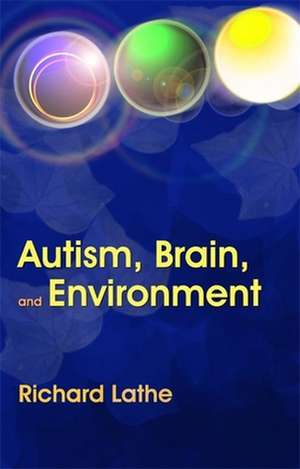
Autism, Brain, and Environment
Autor Richard Latheen Limba Engleză Hardback – 11 mai 2006
În lucrarea Autism, Brain, and Environment, descoperim o perspectivă clinică riguroasă asupra sistemului limbic, capitolul dedicat anomaliilor cerebrale fiind punctul de plecare pentru o reevaluare a tulburărilor din spectrul autist (TSA). Notăm cu interes argumentația lui Richard Lathe, care depășește explicațiile bazate strict pe schimbarea criteriilor de diagnostic, propunând un model în care expunerea la metale grele și toxicitatea mediului declanșează disfuncții neurologice la persoanele cu predispoziție genetică. Găsim în această carte o analiză detaliată a modului în care problemele fiziologice — adesea considerate secundare — precum dereglările hormonale sau imunitare, sunt de fapt factori care produc și exacerbează simptomatologia.
Structura volumului este una progresivă, debutând cu limitările modelelor genetice actuale și culminând cu soluții de terapie biomedicală. Autorul dedică secțiuni importante interdependenței dintre corp și minte, explicând cum modificările fiziologice influențează direct comportamentul. Ca alternativă la The Autism Puzzle pentru cursurile de psihologia dezvoltării sau neuroștiințe, lucrarea aduce avantajul unei fundamentări teoretice interdisciplinare, legând sănătatea mediului de patologii diverse, de la ADHD la Alzheimer. Spre deosebire de Autism Spectrum Disorders, care se concentrează pe identificarea markerilor timpurii, Richard Lathe pune accentul pe mecanismele de deteriorare a creierului limbic, oferind o bază științifică pentru noi strategii de tratament. Textul este unul dens, cu peste o sută de referințe la studii de specialitate, fiind esențial pentru înțelegerea impactului factorilor externi asupra neurodezvoltării.
Preț: 190.09 lei
Preț vechi: 254.97 lei
-25%
Carte disponibilă
Livrare economică 03-17 iunie
Specificații
ISBN-10: 1843104385
Pagini: 288
Dimensiuni: 172 x 242 x 25 mm
Greutate: 0.6 kg
Ediția:1
Editura: JESSICA KINGSLEY PUBLISHERS
Colecția Jessica Kingsley Publishers
Locul publicării:London, United Kingdom
V-ar putea interesa
-
 Psychology, Mental Health and DistressJohn Cromby-27%Preț: 417.23 lei573.85 lei
 -
 Cry of Pain: Understanding Suicide and the Suicidal MindProfessor Mark Williams-27%Preț: 88.09 lei121.05 lei
 -
 -8%Preț: 630.49 lei685.31 lei
 -
 Mental Health WorldwideS. Fernando-15%Preț: 614.75 lei723.23 lei
 -
 -28%Preț: 76.63 lei106.14 lei
 -
 From Isolation to Intimacy: Making Friends without WordsPhoebe Caldwell-21%Preț: 124.92 lei158.22 lei
 -
 -22%Preț: 137.15 lei174.77 lei
 -
 -26%Preț: 417.82 lei565.79 lei
 -
 -20%Preț: 117.95 lei147.40 lei
 -
 -20%Preț: 155.29 lei194.92 lei
 -
 An Exceptional Children's Guide to Touch: Teaching Social and Physical Boundaries to KidsMcKinley Hunter Manasco-21%Preț: 116.27 lei146.40 lei
 -
 Living with VoicesJacqui DillonPreț: 210.16 lei
De ce să citești această carte
Recomandăm această carte profesioniștilor din domeniul sănătății și cercetătorilor care caută o explicație științifică pentru creșterea cazurilor de autism. Cititorul câștigă o înțelegere profundă a legăturii dintre mediul toxic și funcționarea creierului limbic. Este o resursă valoroasă pentru cei care doresc să exploreze terapiile biomedicale și impactul factorilor fiziologici asupra comportamentului, oferind argumente solide pentru politici de mediu mai stricte.
Despre autor
Richard Lathe este director al Pieta Research, o firmă de consultanță în biotehnologie din Edinburgh, având o carieră academică și de cercetare remarcabilă. A deținut funcția de profesor la universitățile din Edinburgh și Strasbourg și a publicat peste o sută de articole în reviste de specialitate evaluate de colegi (peer-reviewed). Expertiza sa acoperă neuroștiințele și biotehnologia, cu un interes specific în studiul sistemului limbic, al autismului și al bolii Alzheimer, ceea ce îi conferă autoritatea necesară pentru a aborda interdisciplinar relația dintre patologia umană și factorii de mediu.
Descriere
Autism, Brain, and Environment proposes that autism is a disorder of the limbic brain, which is damaged by toxic heavy metals present in the environment. Lathe argues that most ASD children have additional physiological problems and that these, far from being separate from the psychiatric aspects of ASD, can produce and exacerbate the condition.
This important and groundbreaking text provides a closely-argued scientific case for the involvement of both environmental and physiological factors in autism. Lathe's argument will also have a direct impact on treatment strategies and options. It will be of great interest to the scientific community, professionals, researchers, political and environmental lobbyists, teachers, psychologists, and parents and people with ASDs.
Recenzii
I would recommend this book to psychologists working in the field of ASD who want a clear and well argued introduction to a subject which, although undoubtedly controversial, deserves serious attention.
Autism. Brain and Environment provides a new account of the biological basis for autism, with consequences for a wide range of professionals as well as for families.
This densely informative book is a comfort to read. One can browse or follow through. The index is enormous and useful. Definitions are strengthened. Gene and brain variations are covered and the nature/nurture interaction exposed.
This is a well- written user- friendly book. The key points at the end of the chapters give a helpful summary. The book presents a comprehensive overview of the aetiological factors in autistic disorders with extensive bibliography... Richard Lathe makes an excellent case for the interplay of factors and gives an unbiased presentation of the available evidence for all the possible hypotheses in the causation of autistic syndromes. The section on the impact of heavy metal toxicity is particularly interesting... This is an important book that brings together all the current issues in the aetiology of autistic disorders. The chapter on biomedical therapy, subtyping and interventions gives possible ways forward in management which may seem well worth adapting in clinical practise. This is a must- read book for trainees in psychiatry and paediatrics and for practitioners in the field.
Autism, Brain and Environment engages with wider scientific debate and is comprehensively researched.