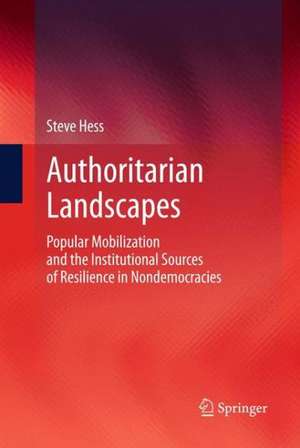
Authoritarian Landscapes
Autor Steve Hessen Limba Engleză Hardback – 2 mar 2013
Preț: 667.41 lei
Preț vechi: 785.19 lei
-15%
Puncte Express: 1001
Carte tipărită la comandă
Livrare economică 24 noiembrie-08 decembrie
Livrare prin curier în România Termenul estimat este afișat lângă disponibilitate.
Transport gratuit pentru acest produs Plată online sau ramburs, în funcție de opțiunile comenzii.
Retur gratuit în 14 zile Comandă securizată și suport în română.
Specificații
ISBN-13: 9781461465362
ISBN-10: 1461465362
Pagini: 256
Ilustrații: X, 244 p.
Dimensiuni: 160 x 241 x 19 mm
Greutate: 0.5 kg
Ediția:2013
Editura: Springer
Locul publicării:New York, NY, United States
ISBN-10: 1461465362
Pagini: 256
Ilustrații: X, 244 p.
Dimensiuni: 160 x 241 x 19 mm
Greutate: 0.5 kg
Ediția:2013
Editura: Springer
Locul publicării:New York, NY, United States
V-ar putea interesa
-
 Free Market FairnessJohn TomasiPreț: 228.75 lei
 -
 -27%Preț: 889.05 lei1210.69 lei
 -
 Undoing Border ImperialismHarsha WaliaPreț: 89.47 lei
 -
 Divided States: Strategic Divisions in Eu-Russia RelationsScott Nicholas Romaniuk-19%Preț: 468.18 lei578.00 lei
Public țintă
ResearchCuprins
Introduction.- Authoritarian Landscapes .- Single-Party Regimes.- Taiwan.- China.- Personalist Regimes.- The Philippines.- Kazakhstan.- Conclusion.- Bibliography.
Textul de pe ultima copertă
The turbulent year of 2011 has brought the appearance of mass popular unrest and the collapse of long lived autocratic regimes in Egypt, Tunisia, Libya and possibly Syria. The sudden and unanticipated fall of these regimes – often thought of as exemplars of authoritarian resilience - has brought much of the conventional wisdom on the durability and vulnerability of nondemocratic regimes into question. This book seeks to advance the existing literature by treating the autocratic state not as a unitary actor characterized by strength or weakness but rather as a structure or terrain that can alternatively inhibit or facilitate the appearance of national level forms of protests. In the mode of the Arab Spring, the color revolutions of the former Soviet Union, and the people power movement of the Philippines, such movements overcome the daunting impediments presented by autocrats, appeal to likeminded counterparts across society, and overwhelm the ability of regimes to maintain order. Conversely, in other settings, such as contemporary China, decentralized state structures provide an inhospitable environment for national-level protest, leading collective actors to opt for more local and parochial forms of contention. This outcome produces paradoxical situations, such as in the PRC, where protests are frequent but national-level mobilization and coordination is absent.
Caracteristici
Analyses popular mobilization in non-democratic settings Focuses particular attention to the characteristics of autocracies that increase or decrease their longevity and propensity to collapse Investigates how the features of authoritarian institutional structures can alternatively facilitate or constrain popular actors’ ability to organize sustained nationwide protest movements? Includes supplementary material: sn.pub/extras