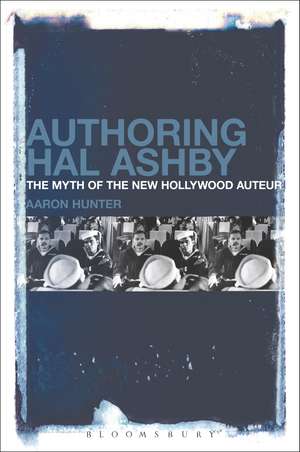
Authoring Hal Ashby: The Myth of the New Hollywood Auteur
Autor Dr. Aaron Hunteren Limba Engleză Hardback – 25 aug 2016
Placing Ashby's films and career within the historical context of his era to show how he actively resisted the auteur label, the author demonstrates how this resistance led to Ashby's marginalization by film executives of his time and within subsequent film scholarship. Through rigorous analysis of several films, Hunter moves on to demonstrate Ashby's own signature authorial contributions to his films and provides thorough and convincing demonstrations of the authorial contributions made by several of Ashby's key collaborators.
Building on emerging scholarship on multiple-authorship, Authoring Hal Ashby lays out a creative new approach to understanding one of Hollywood cinema's most exciting eras and one of its most vital filmmakers.
Preț: 835.04 lei
Preț vechi: 1242.36 lei
-33%
Puncte Express: 1253
Carte tipărită la comandă
Livrare economică 27 noiembrie-11 decembrie
Livrare prin curier în România Termenul estimat este afișat lângă disponibilitate.
Transport gratuit pentru acest produs Plată online sau ramburs, în funcție de opțiunile comenzii.
Retur gratuit în 14 zile Comandă securizată și suport în română.
Specificații
ISBN-13: 9781501308437
ISBN-10: 1501308432
Pagini: 240
Ilustrații: 12 bw illus
Dimensiuni: 152 x 229 x 14 mm
Greutate: 0.68 kg
Editura: Bloomsbury Publishing
Colecția Bloomsbury Academic
Locul publicării:New York, United States
ISBN-10: 1501308432
Pagini: 240
Ilustrații: 12 bw illus
Dimensiuni: 152 x 229 x 14 mm
Greutate: 0.68 kg
Editura: Bloomsbury Publishing
Colecția Bloomsbury Academic
Locul publicării:New York, United States
V-ar putea interesa
-
 Jacobean DramaProfessor Pascale Aebischer-16%Preț: 191.55 lei226.73 lei
 -
 Preț: 389.32 lei
 -
 Hollywood's Stephen KingT. MagistralePreț: 452.30 lei
 -
 The Persistence of HollywoodThomas ElsaesserPreț: 463.64 lei
 -
 Preț: 343.86 lei
 -
 The First Lady of HollywoodSamantha BarbasPreț: 226.85 lei
 -
 -32%Preț: 88.00 lei129.04 lei
 -
 -28%Preț: 112.33 lei155.20 lei
 -
 Poitier Revisited: Reconsidering a Black Icon in the Obama AgeIan Gregory Strachan-27%Preț: 278.68 lei379.36 lei
 -
 Cinematic Homecomings: Exile and Return in Transnational CinemaDr Rebecca Prime-24%Preț: 280.05 lei370.64 lei
 -
 Alain Delon: Style, Stardom and MasculinityProfessor Nick Rees-Roberts-25%Preț: 276.77 lei368.85 lei
 -
 Darren Aronofsky’s Films and the Fragility of HopeDr. Jadranka Skorin-Kapov-25%Preț: 276.68 lei368.81 lei
 -
 Making Sense of Cinema: Empirical Studies into Film Spectators and SpectatorshipCarrieLynn D. ReinhardPreț: 279.48 lei
 -
 The Ironic Filmmaking of Stephen FrearsProfessor Lesley Brill-14%Preț: 836.02 lei972.12 lei
 -
 -31%Preț: 97.19 lei141.55 lei
 -
 The British Cinema BookRobert Murphy-21%Preț: 270.17 lei341.33 lei
 -
 Fade to BlackPaul Donnelley-49%Preț: 131.56 lei258.02 lei
 -
 Preț: 177.78 lei
Cuprins
Introduction
Part One
History, Historiography, and Hal Ashby's Reputation
Chapter One
Hal Ashby and the New Hollywood Establishment
Chapter Two
Auteurs and the New Hollywood Canon
Part Two
Tracing Ashby's Authorship
Chapter Three
Authorship, Narrative, Themes
Chapter Four
Authorship, Form, Style
Part Three
Multiple-Authorship
Chapter Five
Being There: A Case Study
Final Thoughts
Re-thinking New Hollywood as a Cinema of Multiple-Authorship
Part One
History, Historiography, and Hal Ashby's Reputation
Chapter One
Hal Ashby and the New Hollywood Establishment
Chapter Two
Auteurs and the New Hollywood Canon
Part Two
Tracing Ashby's Authorship
Chapter Three
Authorship, Narrative, Themes
Chapter Four
Authorship, Form, Style
Part Three
Multiple-Authorship
Chapter Five
Being There: A Case Study
Final Thoughts
Re-thinking New Hollywood as a Cinema of Multiple-Authorship
Recenzii
A very useful and lucid contribution to understanding of the films of Hal Ashby and the New Hollywood context in which they are situated. Makes a strong and valuable case for the benefits of an approach that acknowledges multiple contributions to authorship, both in this case and as a way of revisiting the films of the period more generally.
In this extremely well researched and engagingly written study, Aaron Hunter performs a difficult balancing act. He challenges many of the foundational assumptions of Film Studies to do with directorial authorship, the evaluation of films, and canon formation. At the same time, he makes a strong case for the importance of one particular director, offering a wonderfully perceptive, complex analysis of his collaborative working methods and of the stylistic characteristics and thematic concerns of his films. He thus challenges us to reconsider not only Hal Ashby's work and status, but also our preconceptions about the New Hollywood and indeed our understanding of Film Studies as an academic discipline.
With Authoring Hal Ashby: The Myth of the New Hollywood Auteur, Aaron Hunter provides an outstanding contribution to the nascent field of collective authorship studies of film. Combining archival research, interviews, and insightful film analyses, Hunter untangles the complex web of collaborative contributions in films directed by Hal Ashby. In doing so he achieves in this highly readable, thorough, and engaging work much more than an account of an overlooked director and his collaborative approach to film production. He demonstrates that auteur criticism of New Hollywood has mystified our understandings of both New Hollywood directors and the period itself. By tracing the contributions of key production crew to Ashby's films, Hunter gives compelling cause for film scholars to reconsider New Hollywood through the lens of multiple authorship.
In this impeccably-researched volume, Aaron Hunter makes a compelling case for reevaluating one of New Hollywood's neglected auteurs, changing as a result the way we look at film history. It is a pleasure to read and a timely return to some of the 1970s most important and enjoyable films.
Authoring Hal Ashby offers a fresh approach to understanding films of the seventies, which Hunter sees as a period not of directorial dominance but collaboration. The book shows how Ashby's unorthodox approach to filmmaking produced an assortment of intriguing films.
Rather than giving us an antiauteurist screed or a deflation of the New Hollywood mythology, Hunter's book deepens our appreciation for the thematic complexity, stylistic adventurousness, and the wealth of talent collaborating in this vibrant moment of film history.
In this extremely well researched and engagingly written study, Aaron Hunter performs a difficult balancing act. He challenges many of the foundational assumptions of Film Studies to do with directorial authorship, the evaluation of films, and canon formation. At the same time, he makes a strong case for the importance of one particular director, offering a wonderfully perceptive, complex analysis of his collaborative working methods and of the stylistic characteristics and thematic concerns of his films. He thus challenges us to reconsider not only Hal Ashby's work and status, but also our preconceptions about the New Hollywood and indeed our understanding of Film Studies as an academic discipline.
With Authoring Hal Ashby: The Myth of the New Hollywood Auteur, Aaron Hunter provides an outstanding contribution to the nascent field of collective authorship studies of film. Combining archival research, interviews, and insightful film analyses, Hunter untangles the complex web of collaborative contributions in films directed by Hal Ashby. In doing so he achieves in this highly readable, thorough, and engaging work much more than an account of an overlooked director and his collaborative approach to film production. He demonstrates that auteur criticism of New Hollywood has mystified our understandings of both New Hollywood directors and the period itself. By tracing the contributions of key production crew to Ashby's films, Hunter gives compelling cause for film scholars to reconsider New Hollywood through the lens of multiple authorship.
In this impeccably-researched volume, Aaron Hunter makes a compelling case for reevaluating one of New Hollywood's neglected auteurs, changing as a result the way we look at film history. It is a pleasure to read and a timely return to some of the 1970s most important and enjoyable films.
Authoring Hal Ashby offers a fresh approach to understanding films of the seventies, which Hunter sees as a period not of directorial dominance but collaboration. The book shows how Ashby's unorthodox approach to filmmaking produced an assortment of intriguing films.
Rather than giving us an antiauteurist screed or a deflation of the New Hollywood mythology, Hunter's book deepens our appreciation for the thematic complexity, stylistic adventurousness, and the wealth of talent collaborating in this vibrant moment of film history.