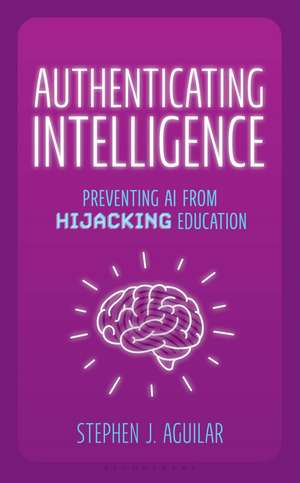
Authenticating Intelligence: Preventing AI from Hijacking Education
Autor Stephen J. Aguilaren Limba Engleză Paperback – 6 aug 2026
Rather than portraying AI as a miracle cure or a looming threat, Aguilar frames it as a sophisticated tool whose impact depends on three interacting elements: the users, the technology, and the surrounding context. Drawing on philosophy, design theory, and decades of educational technology research, he explains how AI can enhance learning, personalize instruction, and free teachers to engage in deeper human interaction-while also exposing pitfalls such as bias, academic integrity challenges, and widening equity gaps.
Practical lists, case studies, and actionable recommendations equip educators, administrators, policymakers, and even curious parents with the knowledge to "authenticate" human intelligence, make informed decisions, and harness AI responsibly. This balanced, accessible guide equips readers to navigate today's AI infused classrooms and shape a future where technology amplifies-not replaces-human learning.
Preț: 217.85 lei
Nou
Puncte Express: 327
Carte disponibilă
Livrare economică 09-23 noiembrie
Livrare express 24-30 octombrie pentru 23.57 lei
Livrare prin curier în România Termenul estimat este afișat lângă disponibilitate.
Transport gratuit de la 400.00 lei Plată online sau ramburs, în funcție de opțiunile comenzii.
Retur gratuit în 14 zile Comandă securizată și suport în română.
Specificații
ISBN-13: 9798216438564
Pagini: 192
Dimensiuni: 148 x 226 x 14 mm
Greutate: 0.27 kg
Editura: Bloomsbury Publishing
Colecția Bloomsbury Academic
Locul publicării:New York, United States
Pagini: 192
Dimensiuni: 148 x 226 x 14 mm
Greutate: 0.27 kg
Editura: Bloomsbury Publishing
Colecția Bloomsbury Academic
Locul publicării:New York, United States
Cuprins
Foreword by Pedro A. Noguera
Preface
Chapter 1: Why "Authenticating" Intelligence
Chapter 2: EdTech and History
Chapter 3: EdTech "Reimagenines" Education
Chapter 4: The Role of Design Affordances
Chapter 5: Avoiding Imaginary Enemies
Chapter 6: GenAI Fueled Equity?
Chapter 7: GenAI and K12
Chapter 8: GenAI and Higher Ed
Chapter 9: The Future of Education with GenAI
Preface
Chapter 1: Why "Authenticating" Intelligence
Chapter 2: EdTech and History
Chapter 3: EdTech "Reimagenines" Education
Chapter 4: The Role of Design Affordances
Chapter 5: Avoiding Imaginary Enemies
Chapter 6: GenAI Fueled Equity?
Chapter 7: GenAI and K12
Chapter 8: GenAI and Higher Ed
Chapter 9: The Future of Education with GenAI
Recenzii
Authenticating Intelligence offers a historically and philosophically-grounded examination of what generative AI means for education-cutting through both hype and panic to focus on what truly matters in the here-and-now for human learning. Written very accessibly but well supported by both recent and classic scholarship, this book is valuable for educators and other thinkers who have fundamental questions about the role of AI in the educational system.
Dr. Stephen J. Aguilar's Authenticating Intelligence is essential reading for anyone committed to learner-centered, equitable education in the age of AI. Aligned to Digital Promise's Powerful Learning framework, this book demonstrates how generative AI can amplify-rather than replace-the competencies that matter most: critical thinking, creative problem-solving, and authentic intellectual engagement. Aguilar masterfully bridges scholarship across philosophy, psychology, and educational technology to address our most pressing challenge: designing learning experiences where AI serves as a thinking partner that deepens understanding rather than a shortcut that bypasses it. His work on digital equity and academic integrity pushes us beyond surface solutions toward fundamentally rethinking what authentic learning means when machines can generate flawless outputs. Whether you're an educator, policymaker, or researcher, this book provides the ethical frameworks and actionable guidance needed to ensure AI enhances human agency and the pursuit of knowledge itself-the very foundations of powerful learning in our digital age.
Reading Authenticating Intelligence means having a conversation with Stephen about how to think about AI. Stephen has a way of providing examples and framing questions that strips away the hyperbole and hysteria and presents a pragmatic lens for understanding and envisioning what the ubiquity of AI could mean for education. He stresses how, as a tool (or rather many different tools), the degree to which AI disrupts our approach to learning is dependent on much more than the tools themselves. Instead, like all the educational technology "disruptors" that have come before, it is foremost about people and context and how they interact with the technology. Everyone, whether in higher education, K-12 education, or the corporate world - is scrambling to understand what AI means, and what policies and practices are necessary as its application expands. Authenticating Intelligence equips the reader with a toolkit for critically examining and discussing both future possibilities and current practices - a perspective that will continue to serve even as the technology inevitably changes.
Dr. Stephen J. Aguilar's Authenticating Intelligence is essential reading for anyone committed to learner-centered, equitable education in the age of AI. Aligned to Digital Promise's Powerful Learning framework, this book demonstrates how generative AI can amplify-rather than replace-the competencies that matter most: critical thinking, creative problem-solving, and authentic intellectual engagement. Aguilar masterfully bridges scholarship across philosophy, psychology, and educational technology to address our most pressing challenge: designing learning experiences where AI serves as a thinking partner that deepens understanding rather than a shortcut that bypasses it. His work on digital equity and academic integrity pushes us beyond surface solutions toward fundamentally rethinking what authentic learning means when machines can generate flawless outputs. Whether you're an educator, policymaker, or researcher, this book provides the ethical frameworks and actionable guidance needed to ensure AI enhances human agency and the pursuit of knowledge itself-the very foundations of powerful learning in our digital age.
Reading Authenticating Intelligence means having a conversation with Stephen about how to think about AI. Stephen has a way of providing examples and framing questions that strips away the hyperbole and hysteria and presents a pragmatic lens for understanding and envisioning what the ubiquity of AI could mean for education. He stresses how, as a tool (or rather many different tools), the degree to which AI disrupts our approach to learning is dependent on much more than the tools themselves. Instead, like all the educational technology "disruptors" that have come before, it is foremost about people and context and how they interact with the technology. Everyone, whether in higher education, K-12 education, or the corporate world - is scrambling to understand what AI means, and what policies and practices are necessary as its application expands. Authenticating Intelligence equips the reader with a toolkit for critically examining and discussing both future possibilities and current practices - a perspective that will continue to serve even as the technology inevitably changes.