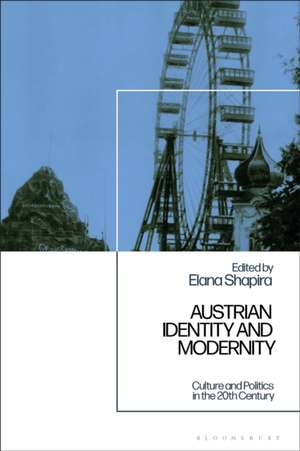
Austrian Identity and Modernity: Culture and Politics in the 20th Century
Editat de Elana Shapiraen Limba Engleză Hardback – 20 feb 2025
- The transformation of liberal ideologies, scientific leadership, technology and social inclusion
- How professional women shaped alternative collectives, art and design movements
- Socialist cultural projects and national unity
- The Catholic Church and politics
- Antisemitism and memory culture in context
- Political shifts and modern architecture and music
- Migration, remigration and pluralism in Austrian culture
Divided into four chronological parts, the book surveys the period from the late-19th century through to the post-WWII era. It serves to offer up innovative approaches to the concepts of nation and nationalism, as well as ground-breaking research on the roles played by regionalism, Europeanism, and migration in culture, design and the shaping of Austrian identities.
Preț: 553.58 lei
Preț vechi: 817.78 lei
-32%
Puncte Express: 830
Carte disponibilă
Livrare economică 02-16 noiembrie
Livrare prin curier în România Termenul estimat este afișat lângă disponibilitate.
Transport gratuit pentru acest produs Plată online sau ramburs, în funcție de opțiunile comenzii.
Retur gratuit în 14 zile Comandă securizată și suport în română.
Specificații
ISBN-13: 9781350441934
ISBN-10: 1350441937
Pagini: 312
Ilustrații: 20 colour illus and 80 bw illus
Dimensiuni: 164 x 238 x 22 mm
Greutate: 0.62 kg
Editura: Bloomsbury Publishing
Colecția Bloomsbury Academic
Locul publicării:London, United Kingdom
ISBN-10: 1350441937
Pagini: 312
Ilustrații: 20 colour illus and 80 bw illus
Dimensiuni: 164 x 238 x 22 mm
Greutate: 0.62 kg
Editura: Bloomsbury Publishing
Colecția Bloomsbury Academic
Locul publicării:London, United Kingdom
Cuprins
List of Illustrations
List of Contributors
Acknowledgements
Introduction: Austrian Identity and Modernity, Elana Shapira
Part I Modernity and the Challenge of Pluralism in the House of Austria
1. Austrian Identity and the Modern Life of Empire, Malachi Haim Hacohen
2. The Exners: A scientific elite, Its Ambivalent Modernism, and Their Cultural Identity, Michael Stöltzner and Veronika Hofer
3. Austrian Technology, Austrian Engineers? Transnational Aspects of Nationalism, Modernity, and Technology, Florian Bettel
4. Artist Carl Moll and the Idea of an Integrative Viennese Modernism as an Expression of a New Austrian Identity, Cornelia Cabuk
5. Design in the Service of the Nation: Berta Zuckerkandl and Gisela Urban and the Shaping of Austrian Public Womanhood, Elana Shapira
Part II Transformation of a Multiethnic Empire into a Democratic Nation State
6. Changing Terms of Modernity? From the Required Diversity of Habsburg Austrian Officers to the Desired Homogeneity of Republican Austrian officers, Tamara Scheer
7. Republic Celebrations, Workers' Costume Associations, 'Social Hiking,' and the Solidarity of Rafters. Red Vienna and the Austrian Alpine (Federal) States in the First Republic, Werner Michael Schwarz and Georg Spitaler
8. The Werkbund Movement in the Austrian States: National and Regional Identities in a Political Landscape, Antje Senarclens De Grancy
9. From the Alps to the Metropolis: The Faces of Interwar Austrian Expressionism, Julia Secklehner
Part III The Politics of Austrofascism and Nazism within the Discourses of Identity and Modernity
10. "Cultural Wars": Catholic Church, the Labor Movement and Fascism in Interwar Austria, Florian Wenninger
11. Faded Out: National Socialism in the Canon of Modernism. Josef Hoffmann and Oswald Haerdtl's Roles in the Context of National Socialist Policies in Vienna, Ingrid Holzschuh
12. Alfred Hrdlicka's Memorial against War and Fascism and Austrian Memory Culture, Tanja Schult and Diana I. Popescu
13. Fragmented Narratives: Jewish Women Cinema Owners, Restitution Cases, and the Fight against Antisemitism, Monika Kaczek
14. Fighting against Fascism and Patriarchy. The "World Movement against Racial Hatred and Human Misery" and the National and International Women Circles of Irene Harand in the 1930s and 1940s, Christian Klösch
Part IV The Legacy of Modernity in the Second Republic of Austria
15. The Dark Side of Modern Austrian Tourism: Vanishing Jewish Heritage in Velden since 1945, Dieter and Louise Hecht
16. Austrian Postwar Cinema between "Restoration" and "Modernism" 1945-1955, Ramón Reichert
17. On Slippery Foundations: A Reflection on Austrian Architecture after 1945, Monika Platzer
18. What is Austrian Music? The Creation and Discussion of National Music in Austria after 1918, Anita Mayer-Hirzberger
Index
List of Contributors
Acknowledgements
Introduction: Austrian Identity and Modernity, Elana Shapira
Part I Modernity and the Challenge of Pluralism in the House of Austria
1. Austrian Identity and the Modern Life of Empire, Malachi Haim Hacohen
2. The Exners: A scientific elite, Its Ambivalent Modernism, and Their Cultural Identity, Michael Stöltzner and Veronika Hofer
3. Austrian Technology, Austrian Engineers? Transnational Aspects of Nationalism, Modernity, and Technology, Florian Bettel
4. Artist Carl Moll and the Idea of an Integrative Viennese Modernism as an Expression of a New Austrian Identity, Cornelia Cabuk
5. Design in the Service of the Nation: Berta Zuckerkandl and Gisela Urban and the Shaping of Austrian Public Womanhood, Elana Shapira
Part II Transformation of a Multiethnic Empire into a Democratic Nation State
6. Changing Terms of Modernity? From the Required Diversity of Habsburg Austrian Officers to the Desired Homogeneity of Republican Austrian officers, Tamara Scheer
7. Republic Celebrations, Workers' Costume Associations, 'Social Hiking,' and the Solidarity of Rafters. Red Vienna and the Austrian Alpine (Federal) States in the First Republic, Werner Michael Schwarz and Georg Spitaler
8. The Werkbund Movement in the Austrian States: National and Regional Identities in a Political Landscape, Antje Senarclens De Grancy
9. From the Alps to the Metropolis: The Faces of Interwar Austrian Expressionism, Julia Secklehner
Part III The Politics of Austrofascism and Nazism within the Discourses of Identity and Modernity
10. "Cultural Wars": Catholic Church, the Labor Movement and Fascism in Interwar Austria, Florian Wenninger
11. Faded Out: National Socialism in the Canon of Modernism. Josef Hoffmann and Oswald Haerdtl's Roles in the Context of National Socialist Policies in Vienna, Ingrid Holzschuh
12. Alfred Hrdlicka's Memorial against War and Fascism and Austrian Memory Culture, Tanja Schult and Diana I. Popescu
13. Fragmented Narratives: Jewish Women Cinema Owners, Restitution Cases, and the Fight against Antisemitism, Monika Kaczek
14. Fighting against Fascism and Patriarchy. The "World Movement against Racial Hatred and Human Misery" and the National and International Women Circles of Irene Harand in the 1930s and 1940s, Christian Klösch
Part IV The Legacy of Modernity in the Second Republic of Austria
15. The Dark Side of Modern Austrian Tourism: Vanishing Jewish Heritage in Velden since 1945, Dieter and Louise Hecht
16. Austrian Postwar Cinema between "Restoration" and "Modernism" 1945-1955, Ramón Reichert
17. On Slippery Foundations: A Reflection on Austrian Architecture after 1945, Monika Platzer
18. What is Austrian Music? The Creation and Discussion of National Music in Austria after 1918, Anita Mayer-Hirzberger
Index
Recenzii
Diverse readers will find this volume instructive and eye-opening. If some of the essays feel frustratingly short, the numerous footnotes offer avenues for further research. It should be added to any library collection of books on modern Austria.
This ambitious and wide-ranging volume breaks new ground by bringing the study of Austrian art, music, architecture, and design - into dialogue with questions of politics, nationalism, and national identity from the Habsburg empire through the Nazi period and beyond. Its essays brilliantly reveal the intricate intertwining of Austrian modernisms with visions of Austrian nationhood across five regimes.
There is still much to discover when it comes to Austrian history, from the late Habsburgs and all the formative years in between to the Second Republic. Elana Shapira's anthology offers an impressive collection of essays and is a welcome contribution to ongoing debates about modernity and identity in Austria, including reflections on the role of Jews and coming to terms with the Nazi past. Bringing together a group of experts from diverse disciplinary backgrounds, it is sure to be read by scholars and the interested public alike.
Austrian identity is still being emotionally debated and politically instrumentalized. Austrian Identity and Modernity provides an impressive overview of the various struggles for Austrian identities from the late 19th century to the present, focusing on art, architecture, film and music in a national as well as global political context.
Drawing on the latest research, the volume sheds exciting and often surprising light on the changes in Austrian identities in the wake of historical upheavals and how cultural modernity shaped these changes and was shaped by them.
This ambitious and wide-ranging volume breaks new ground by bringing the study of Austrian art, music, architecture, and design - into dialogue with questions of politics, nationalism, and national identity from the Habsburg empire through the Nazi period and beyond. Its essays brilliantly reveal the intricate intertwining of Austrian modernisms with visions of Austrian nationhood across five regimes.
There is still much to discover when it comes to Austrian history, from the late Habsburgs and all the formative years in between to the Second Republic. Elana Shapira's anthology offers an impressive collection of essays and is a welcome contribution to ongoing debates about modernity and identity in Austria, including reflections on the role of Jews and coming to terms with the Nazi past. Bringing together a group of experts from diverse disciplinary backgrounds, it is sure to be read by scholars and the interested public alike.
Austrian identity is still being emotionally debated and politically instrumentalized. Austrian Identity and Modernity provides an impressive overview of the various struggles for Austrian identities from the late 19th century to the present, focusing on art, architecture, film and music in a national as well as global political context.
Drawing on the latest research, the volume sheds exciting and often surprising light on the changes in Austrian identities in the wake of historical upheavals and how cultural modernity shaped these changes and was shaped by them.