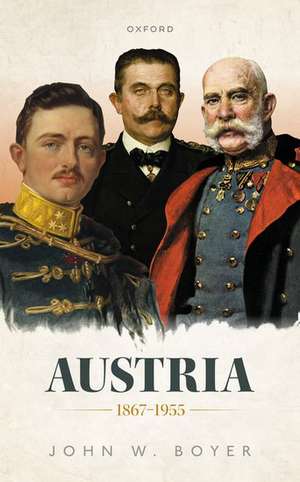
Austria 1867-1955: Oxford History of Modern Europe
Autor John W. Boyeren Limba Engleză Hardback – 13 oct 2022
Din seria Oxford History of Modern Europe
- 15%
 Preț: 290.99 lei
 - 12%
 Preț: 312.30 lei
 - 9%
 Preț: 194.64 lei
 - 28%
 Preț: 504.77 lei
 - 33%
 Preț: 769.73 lei
 - 33%
 Preț: 1745.40 lei
 - 32%
 Preț: 639.13 lei
 - 33%
 Preț: 707.33 lei
 - 20%
 Preț: 403.85 lei
 - 20%
 Preț: 366.94 lei
 - 32%
 Preț: 1051.13 lei
 - 32%
 Preț: 647.53 lei
 - 33%
 Preț: 1811.54 lei
 - 32%
 Preț: 1230.30 lei
 - 29%
 Preț: 437.42 lei
 - 19%
 Preț: 417.70 lei
Preț: 372.62 lei
Preț vechi: 399.44 lei
-7%
Puncte Express: 559
Carte disponibilă
Livrare economică 13-24 noiembrie
Livrare express 30 octombrie-05 noiembrie pentru 104.24 lei
Livrare prin curier în România Termenul estimat este afișat lângă disponibilitate.
Transport gratuit de la 400.00 lei Plată online sau ramburs, în funcție de opțiunile comenzii.
Retur gratuit în 14 zile Comandă securizată și suport în română.
Specificații
ISBN-13: 9780198221296
ISBN-10: 0198221290
Pagini: 1152
Dimensiuni: 160 x 242 x 50 mm
Greutate: 1.42 kg
Editura: OUP OXFORD
Colecția OUP Oxford
Seria Oxford History of Modern Europe
Locul publicării:Oxford, United Kingdom
ISBN-10: 0198221290
Pagini: 1152
Dimensiuni: 160 x 242 x 50 mm
Greutate: 1.42 kg
Editura: OUP OXFORD
Colecția OUP Oxford
Seria Oxford History of Modern Europe
Locul publicării:Oxford, United Kingdom
Recenzii
In his brilliant opus magnum John Boyer shows why Austria needed three attempts to build a stable democracy and how co-operation of formerly antagonistic political elites finally succeeded in the years after World War II.
This volume offers a very comprehensive analysis of Austrian history. The extensive bibliography and index add to its usefulness for scholars. Given the in-depth coverage, the text will be most useful to those who are already familiar with the basics of Austrian history.
Austria 1867—1955 constitutes a massive undertaking. The presentation is abundant in detail, which, together with a copious index, also recommends the study as a reference work. Its focus lies on political processes and negotiations. In tune with his distinguished scholarly record, John Boyer has provided a well-informed, detailed, and generally sober analysis of modern Austrian politics. His primary audience is specialists in the field. Even if some readers may have appreciated a stronger emphasison long-term patterns and developments, the detailed mastery of so comprehensive a subject deserves nothing but praise.
This Austrian history is recommended to anyone who wants a deeper, more detailed understanding of how it was that an empire was succeeded by a small republic at the center of Europe.
What is most impressive about this admirable work is the extent of scholarship that went into it. Not only does Boyer cite almost 100 pages of secondary literature; he has looked at thirty-three Nachlasse (personal papers) along with other collections in some twenty archives, not to speak of twelve pages of printed primary records and contemporary sources.
This book is a magnificent handbook of administrative and political history. It especially complements the more decentered approaches historians have pursued oflate by emphasizing the core and its central administration. Students of Austrian history from undergraduates to professional scholars should onceagain be profoundly grateful to Boyer for his extraordinary contribution to our field.
To my mind, the great benefit of uniting the Imperial and Republican histories in one study is apparent only if the historian presents a compelling new interpretation that allows us to see both periods in a new light. This is a great accomplishment of the book. Writing a synthetic history, Boyer does not offer an easily portable "new take" on modern Austria, and he pragmatically sidesteps the "national indifference" discourse that has shaped Habsburg historiography for the last decade. He tells a story, one with a surprisingly optimistic conclusion, about a resolution of clashing worldviews.
This is a truly remarkable book, which will provide guidance and inspiration for the next generations of scholars. It provides a political history at its best and covers a time period known for its turmoil and ruptures. With his impressive control of an extensive body of literature, Boyer integrates research that is rarely brought together into one overarching argument.
John Boyer's Austria 1867-1955 is a magnificent achievement. It examines the development of politics, government, foreign policy, and civil society over the period with greater depth and insight than any other synthesis on modern Austrian history in English or German known to this reader.
This volume offers a very comprehensive analysis of Austrian history. The extensive bibliography and index add to its usefulness for scholars. Given the in-depth coverage, the text will be most useful to those who are already familiar with the basics of Austrian history.
Austria 1867—1955 constitutes a massive undertaking. The presentation is abundant in detail, which, together with a copious index, also recommends the study as a reference work. Its focus lies on political processes and negotiations. In tune with his distinguished scholarly record, John Boyer has provided a well-informed, detailed, and generally sober analysis of modern Austrian politics. His primary audience is specialists in the field. Even if some readers may have appreciated a stronger emphasison long-term patterns and developments, the detailed mastery of so comprehensive a subject deserves nothing but praise.
This Austrian history is recommended to anyone who wants a deeper, more detailed understanding of how it was that an empire was succeeded by a small republic at the center of Europe.
What is most impressive about this admirable work is the extent of scholarship that went into it. Not only does Boyer cite almost 100 pages of secondary literature; he has looked at thirty-three Nachlasse (personal papers) along with other collections in some twenty archives, not to speak of twelve pages of printed primary records and contemporary sources.
This book is a magnificent handbook of administrative and political history. It especially complements the more decentered approaches historians have pursued oflate by emphasizing the core and its central administration. Students of Austrian history from undergraduates to professional scholars should onceagain be profoundly grateful to Boyer for his extraordinary contribution to our field.
To my mind, the great benefit of uniting the Imperial and Republican histories in one study is apparent only if the historian presents a compelling new interpretation that allows us to see both periods in a new light. This is a great accomplishment of the book. Writing a synthetic history, Boyer does not offer an easily portable "new take" on modern Austria, and he pragmatically sidesteps the "national indifference" discourse that has shaped Habsburg historiography for the last decade. He tells a story, one with a surprisingly optimistic conclusion, about a resolution of clashing worldviews.
This is a truly remarkable book, which will provide guidance and inspiration for the next generations of scholars. It provides a political history at its best and covers a time period known for its turmoil and ruptures. With his impressive control of an extensive body of literature, Boyer integrates research that is rarely brought together into one overarching argument.
John Boyer's Austria 1867-1955 is a magnificent achievement. It examines the development of politics, government, foreign policy, and civil society over the period with greater depth and insight than any other synthesis on modern Austrian history in English or German known to this reader.
Notă biografică
John W. Boyer is the Martin A. Ryerson Distinguished Service Professor in History at the University of Chicago and an Editor of the Journal of Modern History. A specialist in Central European history, Boyer has written three books in the field of Austrian political and social history, most recently Karl Lueger (1844-1910): Christlichsoziale Politik als Beruf, published in 2010. In 2015 he published The University of Chicago. A History. Boyer has received the Cross of Honor for Science and Art, First Class, from the Republic of Austria, in recognition of his scholarly work on the Habsburg Empire. He is also a Corresponding Member of the Austrian Academy of Sciences. Since 1992 he has served as Dean of the College at the University of Chicago.
Cuprins
- Introduction: The Terms of Austrian History
- 1: The Settlement of 1867 and the Creation of a Liberal Constitutional Order
- 2: Liberalism Ascendant: State Politics and Administration in the Austrian Lands, 1867-1879
- 3: The Era of the Iron Ring: State Consolidation and the Emergence of Civic Radicalism, 1879-1895
- 4: Two Decades of Constitutional Upheaval, 1895-1914
- 5: Late Imperial Society and Culture: The Crucible of Vienna
- 6: The Monarchy in the First World War
- 7: The Revolution of 1918-1919
- 8: The First Austrian Republic, 1920-1932
- 9: The Catholic Dictatorship and the Nazi Occupation, 1933-1945
- 10: The Reconstruction of a Republican Political System, 1945-1955
- Conclusion: The Construction of a New Political Culture, 1955-1983