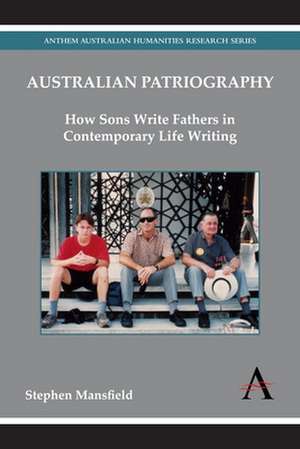
Australian Patriography: Anthem Australian Humanities Research Series
Autor Stephen Mansfielden Limba Engleză Paperback – noi 2014
Beginning with an analysis of the paradigmatic case of the sub-genre, Edmund Gosse's Victorian masterpiece 'Father and Son', the study moves quickly on to embrace its Australian literary frame, demonstrating Gosse's influence on a range of classic Australian autobiographies, including Hal Porter's 'The Watcher on the Cast-Iron Balcony'. Mansfield then offers five 'case studies' on the seminal works of the current era: Raimond Gaita's 'Romulus, My Father'; Richard Freadman's 'Shadow of Doubt'; Peter Rose's 'Rose Boys'; John Hughes's 'The Idea of Home'; and Robert Gray's 'The Land I Came Through Last'.
How do these authors 'perform' their masculinity in the act of writing the father? What are some of the ethical complexities that must be negotiated when representing the reticent-laconic in autobiography? And, ultimately, how does one decide what an ethical representation of the father is? These are some of the questions Mansfield addresses in 'Australian Patriography', the first study of its kind in Australian literature.

Preț: 267.34 lei
Puncte Express: 401
Carte disponibilă
Livrare economică 11-25 noiembrie
Livrare prin curier în România Termenul estimat este afișat lângă disponibilitate.
Transport gratuit de la 400.00 lei Plată online sau ramburs, în funcție de opțiunile comenzii.
Retur gratuit în 14 zile Comandă securizată și suport în română.
Specificații
ISBN-13: 9781783083381
ISBN-10: 1783083387
Pagini: 222
Dimensiuni: 152 x 229 x 13 mm
Greutate: 0.37 kg
Editura: Anthem Press
Colecția Anthem Australian Humanities Research Series
Seria Anthem Australian Humanities Research Series
ISBN-10: 1783083387
Pagini: 222
Dimensiuni: 152 x 229 x 13 mm
Greutate: 0.37 kg
Editura: Anthem Press
Colecția Anthem Australian Humanities Research Series
Seria Anthem Australian Humanities Research Series
V-ar putea interesa
-
 Preț: 258.59 lei
 -
 Stephen King's the Dark Tower ConcordanceRobin FurthPreț: 203.90 lei
 -
 To Show and to TellPhillip LopatePreț: 102.02 lei
 -
 Narcissistic NarrativeLinda HutcheonPreț: 288.36 lei
 -
 More Than Dates and Dead PeopleStephen MansfieldPreț: 60.58 lei
 -
 Preț: 167.04 lei
 -
 The Twilight SymbolsJulie-Anne SykleyPreț: 166.06 lei
 -
 A Short History of FantasyFarah MendlesohnPreț: 125.32 lei
 -
 Dragonwriter: A Tribute to Anne McCaffrey and PernTodd McCaffreyPreț: 80.41 lei
Cuprins
Acknowledgements; List of Illustrations; Introduction Writing Patrimony: The Son’s Book of the Father as a Sub-genre; PART I: CHALLENGING AUTHORITY: Chapter One: ‘The Paradigm Case’: Contesting the Father in Edmund Gosse’s ‘Father and Son: A Study of Two Temperaments’; Chapter Two: ‘An Indubitable Australian’: Renouncing the Father in Hal Porter’s ‘The Watcher on the Cast-Iron Balcony’; PART II: MEMORIALISING SELF-DENIAL: Chapter Three: ‘Words to Keep Fully Amongst Us’: Honouring the Father in Raimond Gaita’s ‘Romulus, My Father’; Chapter Four: ‘I Really Was the Son of Such a Man’: Replacing the Father in Richard Freadman’s ‘Shadow of Doubt: My Father and Myself’; PART III: PERFORMING MASCULINITY: Chapter Five: A Speaking Subject/A Watching Object: Addressing the Father in Peter Rose’s ‘Rose Boys’; Chapter Six: Choosing Patrimony: Performing for the Father in John Hughes’s ‘The Idea of Home’; Chapter Seven: ‘Neither to Vindicate nor to Vilify’: Becoming the Father in Robert Gray’s ‘The Land I Came Through Last’; Conclusion: The Turn to the Father in Autobiography; Bibliography; Index