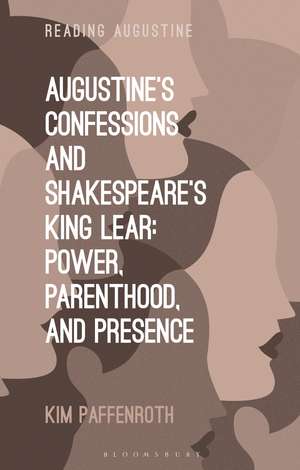
Augustine’s Confessions and Shakespeare’s King Lear: Power, Parenthood, and Presence: Reading Augustine
Autor Kim Paffenrothen Limba Engleză Paperback – 11 dec 2025
Having examined problems addressed in both works of love, language, nature, and reason, Paffenroth here picks up more purely relational matters: both protagonists wield (or have wielded) power over others, yet struggle to learn its right application; both raise children, but have deeply problematic relations with their children, their partners, and (in the case of Augustine at least) their parents; neither has an intuitive or unproblematic relationship with a fully present God or gods - Augustine struggles mightily to have such, while Lear cries out to heaven but it is unclear he ever gets a reply. As different as the books and men are, how they relate to women and God shows illuminating and complementary points of comparison.
Din seria Reading Augustine
- 22%
 Preț: 156.40 lei
 -
 Preț: 128.34 lei
 - 28%
 Preț: 177.80 lei
 - 26%
 Preț: 176.99 lei
 - 26%
 Preț: 163.80 lei
 - 27%
 Preț: 175.37 lei
 - 21%
 Preț: 176.99 lei
 - 13%
 Preț: 155.20 lei
 - 26%
 Preț: 183.18 lei
 - 28%
 Preț: 183.18 lei
 - 22%
 Preț: 156.00 lei
 - 49%
 Preț: 122.01 lei
 - 26%
 Preț: 176.82 lei
 - 22%
 Preț: 167.89 lei
 - 17%
 Preț: 155.20 lei
 - 22%
 Preț: 173.25 lei
 - 22%
 Preț: 161.34 lei
 - 22%
 Preț: 156.40 lei
 - 21%
 Preț: 182.16 lei
 - 19%
 Preț: 160.77 lei
 - 28%
 Preț: 181.55 lei
 - 16%
 Preț: 155.60 lei
 - 21%
 Preț: 182.76 lei
 - 21%
 Preț: 175.77 lei
 - 19%
 Preț: 162.07 lei
 - 22%
 Preț: 168.31 lei
 - 22%
 Preț: 162.58 lei
Preț: 167.57 lei
Puncte Express: 251
Carte disponibilă
Livrare economică 18 mai-01 iunie
Specificații
ISBN-13: 9781350500877
ISBN-10: 1350500879
Pagini: 136
Dimensiuni: 136 x 214 x 14 mm
Greutate: 0.14 kg
Editura: Bloomsbury Publishing
Colecția Bloomsbury Academic
Seria Reading Augustine
Locul publicării:London, United Kingdom
ISBN-10: 1350500879
Pagini: 136
Dimensiuni: 136 x 214 x 14 mm
Greutate: 0.14 kg
Editura: Bloomsbury Publishing
Colecția Bloomsbury Academic
Seria Reading Augustine
Locul publicării:London, United Kingdom
Cuprins
Acknowledgments
Introduction Origins and Ends
1. Augustine and Power
2. Lear and Power
3. Augustine and Women in Confessions
4. Women in King Lear
5. Conclusion: Powerfully Present
Epilogue
Bibliography
Index
Introduction Origins and Ends
1. Augustine and Power
2. Lear and Power
3. Augustine and Women in Confessions
4. Women in King Lear
5. Conclusion: Powerfully Present
Epilogue
Bibliography
Index
Recenzii
Paffenroth has done a remarkable job highlighting the continued relevance of two unlikely figures in the western canon: Augustine and Shakespeare. Should the world fear two "toxic males" in a world skeptical of power imbalances? No, Paffenroth suggests. In fact, what makes Augustine and Shakespeare's Lear stand out is their awareness of their problematic privilege and power despite their obvious shortcomings in fully addressing these problems they identify. Paffenroth reminds us that with the hermeneutic of scrutiny we can still find beauty in literary texts regarded as classics. Caring scrutiny is what we need to discover the real reason these men and their stories have endured: the discovery of empathy even amid failure. And if the powerful can discover empathy despite their own failures and shortcomings, there is hope for the future.
At the end of this book, Paffenroth references the "scrutiny and aesthetics and moral judgments" in his critique of these two classics. He hopes these interpretive tools succeed in opening new dimensions of the texts' beauty and meaning. They do-even for veteran readers. But his "moral judgments" go deeper. Paffenroth extracts a prophetic critique from the texts that spotlights the tragedy unfolding in the drama of our politics. Malignant pride, lust for power, untethered ambition, misogyny, and humiliation rather than humility emerge within his interpretations as cautionary themes for our times. The book is a clinical dissection of the libido dominandi that both Augustine and Lear confess, each in his own way, a libido that remains unconfessed, unchecked, and incapable of the eventual resolutions attained by Augustine and Lear.
Paffenroth offers a lively discussion that puts Augustine's Confessions and Shakespeare's King Lear into a contemporary discourse, using accessible, colloquial language and opening the door with his analysis to today's students and lay readers. There's a lot to think about in this exploration of toxic masculinity, the mysteries of God and humility, and the weight of responsibility that eventually must settle somewhere, no matter how those with power might like to frame it.
At the end of this book, Paffenroth references the "scrutiny and aesthetics and moral judgments" in his critique of these two classics. He hopes these interpretive tools succeed in opening new dimensions of the texts' beauty and meaning. They do-even for veteran readers. But his "moral judgments" go deeper. Paffenroth extracts a prophetic critique from the texts that spotlights the tragedy unfolding in the drama of our politics. Malignant pride, lust for power, untethered ambition, misogyny, and humiliation rather than humility emerge within his interpretations as cautionary themes for our times. The book is a clinical dissection of the libido dominandi that both Augustine and Lear confess, each in his own way, a libido that remains unconfessed, unchecked, and incapable of the eventual resolutions attained by Augustine and Lear.
Paffenroth offers a lively discussion that puts Augustine's Confessions and Shakespeare's King Lear into a contemporary discourse, using accessible, colloquial language and opening the door with his analysis to today's students and lay readers. There's a lot to think about in this exploration of toxic masculinity, the mysteries of God and humility, and the weight of responsibility that eventually must settle somewhere, no matter how those with power might like to frame it.