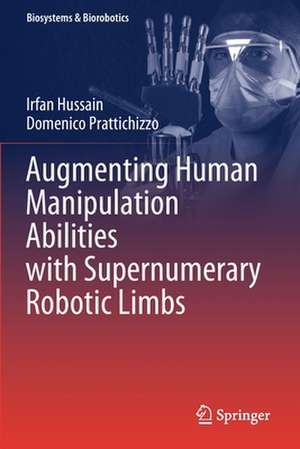
Augmenting Human Manipulation Abilities with Supernumerary Robotic Limbs: Biosystems & Biorobotics, cartea 26
Autor Irfan Hussain, Domenico Prattichizzoen Limba Engleză Paperback – 18 iul 2021
This book offers a timely report on an emerging topic in the field of wearable assistive technology: the design and development of robotic extra fingers. After a concise review of the state of the art and a description of earlier prototypes, it discusses the authors’ efforts to address issues such as portability and wearability of the devices, including strategies to reduce fatigue and to integrate the motion of the extra fingers with that of the human hand. The book also explores optimized control algorithms and the design of wearable sensorimotor interfaces, and presents a set of tests carried out on healthy subjects and chronic stroke patients. Merging concepts from robotics, biomechanics, human factors and control theory and offering an overview of supernumerary robotic fingers, including the challenges, this book will inspire researchers involved in the development of wearable robotic devices and interfaces based on the principles of wearability, safety, ergonomics and user comfort.
Din seria Biosystems & Biorobotics
- 15%
 Preț: 589.22 lei
 - 24%
 Preț: 1876.28 lei
 - 15%
 Preț: 671.15 lei
 - 15%
 Preț: 682.12 lei
 - 15%
 Preț: 662.36 lei
 - 15%
 Preț: 664.57 lei
 - 24%
 Preț: 3327.60 lei
 - 18%
 Preț: 989.66 lei
 - 5%
 Preț: 1534.58 lei
 - 18%
 Preț: 751.95 lei
 - 18%
 Preț: 1167.63 lei
 - 15%
 Preț: 659.06 lei
 -
 Preț: 120.35 lei
 - 18%
 Preț: 1276.13 lei
 - 20%
 Preț: 676.02 lei
 - 18%
 Preț: 1165.66 lei
 - 18%
 Preț: 1740.05 lei
 - 18%
 Preț: 2459.35 lei
 - 18%
 Preț: 947.14 lei
 - 15%
 Preț: 661.90 lei
 - 18%
 Preț: 1220.17 lei
 - 24%
 Preț: 1352.77 lei
 - 18%
 Preț: 1333.30 lei
 - 24%
 Preț: 985.80 lei
 - 15%
 Preț: 672.92 lei
Preț: 612.38 lei
Preț vechi: 720.45 lei
-15%
Puncte Express: 919
Carte tipărită la comandă
Livrare economică 30 noiembrie-14 decembrie
Livrare prin curier în România Termenul estimat este afișat lângă disponibilitate.
Transport gratuit pentru acest produs Plată online sau ramburs, în funcție de opțiunile comenzii.
Retur gratuit în 14 zile Comandă securizată și suport în română.
Specificații
ISBN-13: 9783030520045
ISBN-10: 3030520048
Pagini: 160
Ilustrații: XIII, 145 p. 77 illus., 72 illus. in color.
Dimensiuni: 155 x 235 x 9 mm
Greutate: 0.25 kg
Ediția:1st ed. 2020
Editura: Springer
Colecția Biosystems & Biorobotics
Seria Biosystems & Biorobotics
Locul publicării:Cham, Switzerland
ISBN-10: 3030520048
Pagini: 160
Ilustrații: XIII, 145 p. 77 illus., 72 illus. in color.
Dimensiuni: 155 x 235 x 9 mm
Greutate: 0.25 kg
Ediția:1st ed. 2020
Editura: Springer
Colecția Biosystems & Biorobotics
Seria Biosystems & Biorobotics
Locul publicării:Cham, Switzerland
Cuprins
Introduction.- Enhancing human hand manipulation abilities through supernumerary robotic fingers.- Compensating hand function in chronic stroke patients through the supernumerary robotic finger.- Design and development of soft supernumerary robotic fingers for grasp compensation in chronic stroke patients.- Wearable sensory motor interfaces for supernumerary robotic fingers.- Wearable EMG interfaces for motion control of supernumerary robotic fingers.- From grasp compensation towards hemiparetic upper limb rehabilitation.- Conclusions and future work.
Notă biografică
Dr. Hussain is an assistant professor in Mechanical Engineering department at Khalifa University (KU), Abu Dhabi, UAE. He received his PhD degree in robotics from University of Siena, Italy. His research interests include Supernumerary (Extra) Robotic limbs, Medical Robotics, Soft
Robotic hands, Complaint Manipulators, Exoskeletons and prosthesis.
Prof. Prattichizzo is a professor of robotics at the University of Siena, Siena, Italy, and since 2009 he is a Scientific Consultant at Istituto Italiano di Tecnoloogia, Genova, Italy. In 1994, he was a Visiting Scientist at the MIT AI Lab. He received the Ph.D. degree in robotics and automation from the University of Pisa, Pisa, Italy, in 1995. His research interests are in Supernumerary (Extra) Robotic limbs, haptics, grasping, visual servoing, mobile robotics and geometric control.
Textul de pe ultima copertă
This book offers a timely report on an emerging topic in the field of wearable assistive technology: the design and development of robotic extra fingers. After a concise review of the state of the art and a description of earlier prototypes, it discusses the authors’ efforts to address issues such as portability and wearability of the devices, including strategies to reduce fatigue and to integrate the motion of the extra fingers with that of the human hand. The book also explores optimized control algorithms and the design of wearable sensorimotor interfaces, and presents a set of tests carried out on healthy subjects and chronic stroke patients. Merging concepts from robotics, biomechanics, human factors and control theory and offering an overview of supernumerary robotic fingers, including the challenges, this book will inspire researchers involved in the development of wearable robotic devices and interfaces based on the principles of wearability, safety, ergonomics and user comfort.
Caracteristici
Reports on an emerging topic in the field of medical robotics Offers design guidelines for developing robotic extra fingers Describes sensory and motion control interfaces