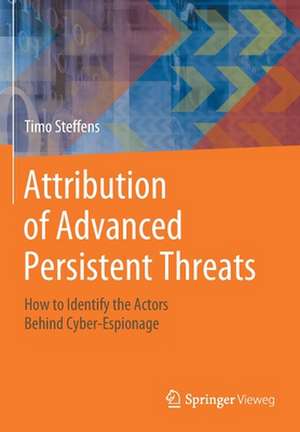
Attribution of Advanced Persistent Threats
Autor Timo Steffensen Limba Engleză Paperback – 22 iul 2021
Attribution is the process of tracking and identifying the actors behind these cyber-attacks. Often it is considered an art, not a science.
This book systematically analyses how hackers operate, which mistakes they make, and which traces they leave behind. Using examples from real cases the author explains the analytic methods used to ascertain the origin of Advanced Persistent Threats.
Preț: 476.53 lei
Preț vechi: 595.67 lei
-20%
Puncte Express: 715
Carte tipărită la comandă
Livrare economică 07-21 decembrie
Livrare prin curier în România Termenul estimat este afișat lângă disponibilitate.
Transport gratuit pentru acest produs Plată online sau ramburs, în funcție de opțiunile comenzii.
Retur gratuit în 14 zile Comandă securizată și suport în română.
Specificații
ISBN-13: 9783662613153
ISBN-10: 3662613158
Pagini: 220
Ilustrații: XIV, 205 p. 49 illus.
Dimensiuni: 168 x 240 x 13 mm
Greutate: 0.36 kg
Ediția:1st ed. 2020
Editura: Springer Berlin, Heidelberg
Locul publicării:Berlin, Heidelberg, Germany
ISBN-10: 3662613158
Pagini: 220
Ilustrații: XIV, 205 p. 49 illus.
Dimensiuni: 168 x 240 x 13 mm
Greutate: 0.36 kg
Ediția:1st ed. 2020
Editura: Springer Berlin, Heidelberg
Locul publicării:Berlin, Heidelberg, Germany
V-ar putea interesa
-
 Fancy Bear Goes PhishingScott Shapiro-30%Preț: 66.08 lei94.18 lei
 -
 SandwormAndy Greenberg-20%Preț: 100.54 lei125.69 lei
 -
 InvasionFrank GardnerPreț: 73.32 lei
 -
 The Hacker and the StateBen BuchananPreț: 159.72 lei
 -
 Preț: 381.53 lei
 -
 -36%Preț: 114.01 lei178.59 lei
 -
 Hack to the FutureEmily Crose-20%Preț: 169.61 lei212.01 lei
 -
 Cybersecurity - Politics, Governance and Conflict in CyberspaceAaron F. BrantlyPreț: 157.60 lei
 -
 The Dark Forest Theory of the InternetBogna KoniorPreț: 86.72 lei
 -
 Plot to Hack AmericaMalcolm NancePreț: 113.42 lei
 -
 DownfallAnna ArutunyanPreț: 78.80 lei
 -
 -18%Preț: 64.72 lei79.01 leiRecomandat
 -
 ComplicitPeter ObornePreț: 95.92 lei
 -
 -37%Preț: 197.47 lei312.30 lei
 -
 -25%Preț: 69.90 lei93.61 lei
 -
 The Hour of the PredatorGiuliano Da EmpoliPreț: 90.89 lei
 -
 The Invisible CampaignJane Gulliford LowesPreț: 148.53 leiNou
 -
 Counterintelligence in a Cyber WorldPaul A. Watters-20%Preț: 402.16 lei502.71 lei
 -
 Russian Influence Operations and the War in UkraineVladimir Sazonov-15%Preț: 616.31 lei725.06 lei
 -
 Advanced Malware Analysis and IntelligenceMahadev Thukaram-20%Preț: 236.39 lei295.48 lei
Cuprins
Advanced Persistent Threats.- The attribution process.-Analysis of malware.- Attack infrastructure.- Analysis of control servers.- Geopolitical analysis.- Telemetry - data from security products.- Methods of intelligence agencies.- Doxing.- False flags.- Group set-ups.- Communication.- Ethics of attribution.
Textul de pe ultima copertă
An increasing number of countries develop capabilities for cyber-espionage and sabotage. The sheer number of reported network compromises suggests that some of these countries view cyber-means as integral and well-established elements of their strategical toolbox. At the same time the relevance of such attacks for society and politics is also increasing. Digital means were used to influence the US presidential election in 2016, repeatedly led to power outages in Ukraine, and caused economic losses of hundreds of millions of dollars with a malfunctioning ransomware. In all these cases the question who was behind the attacks is not only relevant from a legal perspective, but also has a political and social dimension.
Attribution is the process of tracking and identifying the actors behind these cyber-attacks. Often it is considered an art, not a science.
This book systematically analyses how hackers operate, which mistakes they make, and which traces they leave behind. Using examples from real cases the author explains the analytic methods used to ascertain the origin of Advanced Persistent Threats.
The Content
Dr. Timo Steffens was involved in the analysis of many of the most spectacular cyber-espionage cases in Germany. He has been tracking the activities and techniques of sophisticated hacker groups for almost a decade.
Attribution is the process of tracking and identifying the actors behind these cyber-attacks. Often it is considered an art, not a science.
This book systematically analyses how hackers operate, which mistakes they make, and which traces they leave behind. Using examples from real cases the author explains the analytic methods used to ascertain the origin of Advanced Persistent Threats.
The Content
- Advanced Persistent Threats
- The attribution process
- Analysis of malware
- Attack infrastructure
- Analysis of control servers
- Geopolitical analysis
- Telemetry - data from security products
- Methods of intelligence agencies
- Doxing
- False flags
- Group set-ups
- Communication
- Ethics of attribution
- IT-security professionals
- International relations researchers
- Technical journalists
- Employees of organizations that are targeted by Advanced Persistent Threats
Dr. Timo Steffens was involved in the analysis of many of the most spectacular cyber-espionage cases in Germany. He has been tracking the activities and techniques of sophisticated hacker groups for almost a decade.
Caracteristici
Explains how hackers operate and which mistakes they make Presents the technical methods to track and identify the perpetrators Compares the approaches of security companies and government agencies Shows how to identify false flags A look behind the scenes of investigators and analysts Detailed examples from real cases