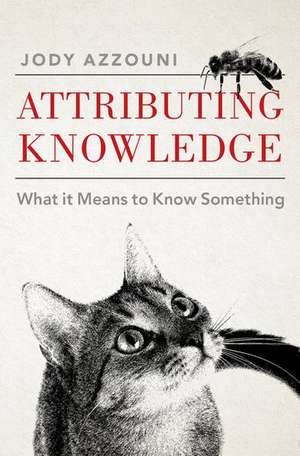
Attributing Knowledge: What It Means to Know Something
Autor Jody Azzounien Limba Engleză Hardback – 17 noi 2020
Preț: 646.23 lei
Preț vechi: 751.44 lei
-14%
Puncte Express: 969
Carte disponibilă
Livrare economică 13-24 noiembrie
Livrare prin curier în România Termenul estimat este afișat lângă disponibilitate.
Transport gratuit pentru acest produs Plată online sau ramburs, în funcție de opțiunile comenzii.
Retur gratuit în 14 zile Comandă securizată și suport în română.
Specificații
ISBN-13: 9780197508817
ISBN-10: 0197508812
Pagini: 482
Dimensiuni: 163 x 239 x 36 mm
Greutate: 0.84 kg
Editura: Oxford University Press
Colecția OUP USA
Locul publicării:New York, United States
ISBN-10: 0197508812
Pagini: 482
Dimensiuni: 163 x 239 x 36 mm
Greutate: 0.84 kg
Editura: Oxford University Press
Colecția OUP USA
Locul publicării:New York, United States
V-ar putea interesa
-
 Ontology Without BordersJody Azzouni-19%Preț: 269.71 lei331.89 lei
 -
 -18%Preț: 375.56 lei455.23 lei
 -
 A Novel Defense of Scientific RealismJarrett Leplin-30%Preț: 1059.85 lei1519.68 lei
 -
 -30%Preț: 995.44 lei1425.95 lei
 -
 -30%Preț: 622.88 lei888.52 lei
 -
 Epistemology and the Psychology of Human JudgmentMichael A Bishop-20%Preț: 354.82 lei445.54 lei
 -
 Stability and Justification in Hume's TreatiseLouis E. Loeb-20%Preț: 493.83 lei619.14 lei
 -
 The Oxford Handbook of EpistemologyPaul K. Moser-19%Preț: 365.77 lei450.48 lei
 -
 A Priori JustificationAlbert Casullo-21%Preț: 489.40 lei619.29 lei
 -
 -10%Preț: 332.99 lei369.76 lei
 -
 Tracking Reason: Proof, Consequence, and TruthJody Azzouni-13%Preț: 292.87 lei335.13 lei
 -
 Nonlinearity, Chaos, and Complexity: The Dynamics of Natural and Social SystemsCristoforo Sergio Bertuglia-23%Preț: 786.49 lei1020.97 lei
 -
 Putting Logic in its Place: Formal Constraints on Rational BeliefDavid Christensen-18%Preț: 367.40 lei447.35 lei
 -
 Tracking Truth: Knowledge, Evidence, and ScienceSherrilyn Roush-18%Preț: 333.64 lei406.07 lei
 -
 -32%Preț: 1189.53 lei1746.17 lei
 -
 -10%Preț: 387.22 lei430.29 lei
 -
 The Nature of TruthMichael P Lynch-15%Preț: 469.40 lei552.24 lei
 -
 Hume's Epistemology and Metaphysics: An IntroductionGeorges DickerPreț: 423.45 lei
 -
 Durkheim and RepresentationsW. S. F. Pickering-18%Preț: 1111.68 lei1355.70 lei
 -
 Metaphysical Myths, Mathematical PracticeJody AzzouniPreț: 344.00 lei
 -
 Preț: 460.44 lei
 -
 Analyzing Social KnowledgeAngelo J. Corlett-27%Preț: 276.27 lei378.01 lei
 -
 Rule-following and MeaningAlexander MillerPreț: 430.95 lei
Recenzii
... an excellent, engaging piece of analytic philosophy...Summing Up: Recommended. Graduate students, researchers, faculty.
Notă biografică
Jody Azzouni received his doctorate from The CUNY Graduate Center and is Professor of Philosophy at Tufts University. He writes broadly in philosophy of mathematics, science, logic and language, as well as in epistemology and metaphysics.
Cuprins
- Contents
- Introduction
- 1. Knowledge attributions to minimal epistemic agents
- 2. Knowledge and knowing that P; "knowledge" and "knowing that P"
- 3. The variability of know(s) that judgments
- 4. Assertion norms
- 5. Usage traps in the language of iterated knowledge attributions
- 6. Iterated and ground-floor knowledge, KK and K¬K, arguments and empirical studies
- 7. Inferential justification
- 8. Representational justification and challenges to "the given"
- 9. Confidence, belief and knowledge; the vagueness of "know(s)"
- 10. Usage challenges to fallibilism
- 11. The (complex) structure of the meaning of "know(s)"
- Appendix: The aesthetics of hangman knots
- Detailed Contents
- Introduction
- Part 1
- i. Epistemology: What it is
- ii. The importance of words
- iii. Some of the distinctive epistemic claims I attempt in this book
- iv. Brief synopses of the chapters in this book
- Part 2
- v. Insights from lexical semantics: Ambiguity and polysemy
- vi. Insights from lexical semantics: Retraction and the factivity of "know(s)"
- vii. Insights from lexical semantics: Literality and metaphoricality
- viii. Insights from lexical semantics: Semantic entailments
- ix. The lexical analysis of words versus the functional analysis of them
- x. An example: "true"
- xi. Xphilosophy and the threat of idiolectical scepticism
- 1. Knowledge attributions to minimal epistemic agents
- 1.1 First remarks
- 1.2 What animals know
- 1.3 Insects and non-biological things know a lot too
- 1.4 The flexibility of cognition attributions: ¿ ing that p
- 1.5 Knowledge, belief, action and consciousness
- 1.6 Knowledge and belief (and consciousness too)
- 1.7 Mindless knowing
- 1.8 Final lesson from knowledge attributions to animals: Methods of knowing aren't modular
- 1.9 What's been done and a look ahead
- 2. Knowledge and knowing that A; "knowledge" and "knowing that"
- 2.1 First remarks
- 2.2 "Knowledge"
- 2.3 "Knowing P" and "knowing that P"
- 3. The variability of know(s)-that judgments
- 3.1 First remarks
- 3.2 Some thought experiments that are problematic for classic invariantists
- 3.3 Hawthorne's DSK principle
- 3.4 Comparing knowing and knowledge attributions across contexts
- 3.5 Comparing knowing and knowledge attributions across agents
- 3.6 Knowledge-relativism denied
- 3.7 What speaker-hearers can reasonably be taken to be confused about with respect to their own usage
- 3.8 Making progress? (Where we are and where we're going)
- 4. Assertion norms
- 4.1 Introduction; preliminaries about assertion
- 4.2 Semantic perceptions
- 4.3 Experiencing asserting, assertions, and their differences
- 4.4 The assertions of spokespersons and Moorean remarks
- 4.5 Assertions: Of journalists, in advertisements, by cartoon characters and flakes
- 4.6 Assertion norms
- 4.7 Burge's acceptance principle
- 4.8 Expectations in special cases
- 4.9 Concluding remarks
- 5. Usage traps in the language of iterated knowledge attributions
- 5.1 Introductory remarks about KK and K¬K, and about metacognition
- 5.2 Exclamation and redundancy uses of "know(s)"
- 5.3 Redundancy usages for "aware" and the puzzling case of pain
- 5.4 Iterated knowledge and an agent's command of her concepts
- 5.5 Davidson, Dretske, Esken, and Malcolm on metacognition, cognition, belief and metabelief
- 5.6 Iterated knowledge and belief, and justification
- 5.7 Level-confusions in epistemology
- 5.8 Conclusion and transition to the next chapter
- 6. Iterated and ground-floor cognition, KK and K¬K arguments and empirical studies
- 6.1 Introduction
- 6.2 The Cartesian perspective: Full metacognition about the self
- 6.3 A very minimal ground-floor epistemic agent who cognizes and knows without iterated knowledge or cognitions
- 6.4 The non-transparency of knowing state
- 6.5 Iterated knowledge about deduction
- 6.6 Nonhuman-animal studies in "metacognition"
- 6.7 A possible case of nonhuman-animal iterated cognition?
- 6.8 Conclusion
- 7. Inferential justification
- 7.1 First remarks
- 7.2 Justification and truth
- 7.3 Justifications based on truth-preserving deduction
- 7.4 Infinite chains of justifications
- 7.4.1 Infinite deductive sequences of justifications
- 7.4.2 Probabilistic infinite sequences of justifications
- 7.4.3 A failing grade for infinitism, nevertheless
- 7.5 Conclusion
- 8. Representational justification and challenges to the given
- 8.1 Representational justification characterized
- 8.2 Representation and deduction exhaust justification
- 8.3 The given-dilemma for nonpropositional justification
- 8.4 Why representational justifications needn't be experiential
- 8.5 There are justificational stopping points
- 8.6 Justificational stopping points in conversation
- 8.7 Metacognitive motivations for enriching justification
- 8.8 Concluding remarks
- 9. Confidence, belief and knowledge; the vagueness of "know(s)"
- 9.1 Introduction
- 9.2 Piecemeal knowledge and piecemeal iterated knowledge
- 9.3 Confidence, knowledge and iterated knowledge
- 9.4 The invisibility of epistemic standards; the invisibility of the vagueness of epistemic standards
- 9.5 Williamson on KK
- 9.6 Concluding remarks
- 10. Usage challenges to fallibilism
- 10.1 Introduction
- 10.2 Preliminaries: Characterizing fallibilism, infallibilism and parity reasoning
- 10.3 When factivity misleads
- 10.4 The factivity of "know(s)" and Kripke's dogmatism paradox
- 10.5 The factivity and fallibility of "know(s)," and lotteries
- 10.6 Going to extremes
- 10.7 Prefaces and lotteries
- 10.8 Fallibility implies the denial of knowledge closure
- 10.9 Rational belief and concluding remarks
- 11. The (complex) structure of the meaning of "know(s)"
- 11.1 Introduction
- 11.2 Necessary conditions and sufficient conditions for "know(s)"; the relation of these conditions to criterion transcendence
- 11.3 Why "know(s)" evades a definition
- 11.4 Conceptually engineering a successor notion to "know(s)"?
- 11.5 Social-role epistemology
- 11.6 Conclusion (to the whole book)
- Appendix: The aesthetics of hangman knots