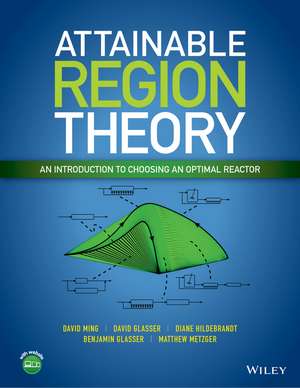
Attainable Regions Reactors
Autor Ming, Glasser, B. Glasseren Limba Engleză Hardback – 7 oct 2016
Destinat nivelului de studiu de licență (anii II-IV), master și cercetare doctorală, Attainable Region Theory reprezintă o resursă fundamentală pentru ingineria proceselor chimice. Apreciem rigoarea cu care David Ming, David Glasser și echipa lor de autori — practicieni și cofondatori ai teoriei — structurează procesul de selecție și optimizare a reactoarelor în sisteme reactive complexe. Volumul nu se rezumă la teorie pură, ci propune o metodologie aplicată pentru interpretarea rețelelor de reactoare, fiind un instrument de referință atât pentru mediul academic, cât și pentru specialiștii din industrie care urmăresc eficientizarea proceselor. Structura narativă a textului tehnic este echilibrată prin includerea a peste 200 de ilustrații și 70 de exemple practice rezolvate, elemente care facilitează studiul individual și pregătirea cursurilor de specialitate. Un punct forte al acestei ediții publicate de Wiley este integrarea instrumentelor software interactive, care permit cititorului să testeze ipoteze și să vizualizeze limitele teoretice ale randamentului reacțiilor. Cititorii familiarizați cu Principles of Chemical Reactor Analysis and Design de U Mann vor aprecia modul în care acest volum trece de la formularea bazată pe reacție la o metodă geometrică și sistemică de optimizare prin teoria AR. În timp ce lucrări precum Chemical Reactor Theory de K. G. Denbigh oferă o perspectivă istorică și fundamentală asupra ingineriei reacțiilor chimice, lucrarea de față aduce în prim-plan tehnici moderne de frontieră pentru proiectarea rețelelor industriale complexe.
Preț: 1230.40 lei
Preț vechi: 1352.09 lei
-9%
Carte tipărită la comandă
Livrare economică 29 octombrie-12 noiembrie
Specificații
ISBN-10: 1119157889
Pagini: 352
Dimensiuni: 221 x 286 x 24 mm
Greutate: 1.13 kg
Editura: Wiley
Locul publicării:Hoboken, United States
V-ar putea interesa
-
 Coupled Bioluminescent AssaysMichael J Corey-9%Preț: 999.70 lei1098.57 lei
 -
 -9%Preț: 1052.78 lei1156.90 lei
 -
 Reactive DistillationLuyben-9%Preț: 1094.58 lei1202.84 lei
 -
 -9%Preț: 969.22 lei1065.08 lei
 -
 IsotopesGunter Faure-23%Preț: 1155.47 lei1500.61 lei
 -
 Contaminant Transport 2eZheng-9%Preț: 1271.03 lei1396.74 lei
 -
 Excel for Scientists and EngineersE Joseph Billo-20%Preț: 503.46 lei629.33 lei
 -
 Step-GrowthRogers-9%Preț: 1576.59 lei1732.51 lei
 -
 School Social WorkDavid Dupper-23%Preț: 605.31 lei786.11 lei
 -
 HPLC Solvent 2eSadek-9%Preț: 1326.12 lei1457.27 lei
 -
 DNAKobilinsky-9%Preț: 1003.08 lei1102.30 lei
 -
 ToxicogenomicsHamadeh-5%Preț: 900.85 lei948.26 lei
 -
 Physical Chemistry for Beginners: Its Organization and AdministrationCharles Van DeventerPreț: 246.04 lei
 -
 Preț: 160.85 lei
Public țintă
Chemical/process engineers interested in chemical reactor design. Undergraduate students in their second, third and fourth years, and lecturers/professors in chemical engineering; Postgraduate/Graduate chemical engineering students and researchers; and Experienced practitioners in industry looking to understand and improve chemical reactor systemsDe ce să citești această carte
Recomandăm această carte studenților și inginerilor chimiști care doresc să stăpânească optimizarea sistemelor de reacție. Cititorul câștigă o înțelegere profundă a teoriei Regiunii Atinse (AR), beneficiind de experiența directă a fondatorilor domeniului. Este o investiție în competențe practice, oferind soluții concrete pentru proiectarea reactoarelor prin exemple rezolvate și suport software, esențiale în eficientizarea proceselor industriale moderne.
Despre autor
Echipa de autori este formată din personalități marcante ale ingineriei chimice, printre care se numără David Ming, David Glasser și Diane Hildebrandt. Aceștia sunt recunoscuți la nivel internațional drept cofondatori și pionieri ai teoriei Regiunii Atinse (AR), o metodă inovatoare în designul reactoarelor. David Glasser și Diane Hildebrandt au publicat extensiv în domeniul optimizării proceselor, munca lor fiind esențială pentru dezvoltarea unor metode geometrice aplicate în termodinamică și cinetică chimică. Expertiza lor combinată, acumulată în decenii de cercetare academică și consultanță industrială, transformă acest volum într-o resursă de autoritate în literatura de specialitate.
Descriere scurtă
"The authors of Attainable Region Theory: An Introduction to an Choosing Optimal Reactor make what is a complex subject and decades of research accessible to the target audience in a compelling narrative with numerous examples of real-world applications." TAA Award Judges, February 2019
Learn how to effectively interpret, select and optimize reactors for complex reactive systems, using Attainable Region theory
- Teaches how to effectively interpret, select and optimize reactors for complex reactive systems, using Attainable Region (AR) theory
- Written by co-founders and experienced practitioners of the theory
- Covers both the fundamentals of AR theory for readers new to the field, as we all as advanced AR topics for more advanced practitioners for understanding and improving realistic reactor systems
- Includes over 200 illustrations and 70 worked examples explaining how AR theory can be applied to complex reactor networks, making it ideal for instructors and self-study
- Interactive software tools and examples written for the book help to demonstrate the concepts and encourage exploration of the ideas