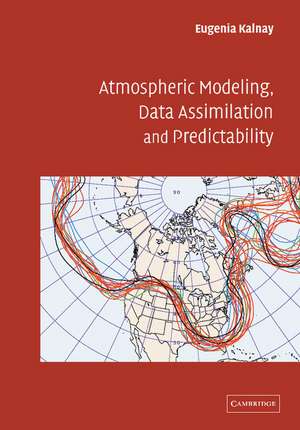
Atmospheric Modeling, Data Assimilation and Predictability
Autor Eugenia Kalnayen Limba Engleză Paperback – 6 noi 2002
În cadrul programelor de studii avansate în meteorologie și oceanografie, Atmospheric Modeling, Data Assimilation and Predictability ocupă un loc central, fiind o resursă academică de referință publicată de Cambridge University Press. Observăm că lucrarea semnată de Eugenia Kalnay nu se limitează la descrierea algoritmilor de prognoză, ci oferă o sinteză riguroasă între modelarea matematică a atmosferei și asimilarea observațiilor în timp real, o disciplină critică pentru acuratețea previziunilor moderne. Cititorii familiarizați cu Numerical Weather and Climate Prediction de Thomas Tomkins Warner vor aprecia în acest volum abordarea mai profundă a haosului în sistemele dinamice și modul în care incertitudinea este gestionată prin prognoza de ansamblu.
Structura volumului reflectă o progresie pedagogică logică: începe cu o perspectivă istorică necesară înțelegerii evoluției domeniului, trece prin fundamentul teoretic al ecuațiilor continue și tehnicile de discretizare, ajungând la complexitatea asimilării datelor. Suntem de părere că forța acestui text rezidă în claritatea capitolului dedicat predictibilității, unde conceptele de instabilitate atmosferică sunt explicate prin prisma teoriei sistemelor dinamice. Găsim în cele 368 de pagini nu doar teorie, ci și îndrumări practice, precum cele din anexe referitoare la verificarea modelelor adjointe, instrumente indispensabile cercetătorilor care dezvoltă sisteme de prognoză operativă. Cartea reușește să unifice domenii care adesea sunt tratate separat, oferind o viziune integrată asupra modului în care atmosfera este înțeleasă, măsurată și simulată pe calculator.
Preț: 538.79 lei
Preț vechi: 605.38 lei
-11%
Carte tipărită la comandă
Livrare economică 03-17 decembrie
Specificații
ISBN-10: 0521796296
Pagini: 368
Ilustrații: 86 b/w illus. 4 tables
Dimensiuni: 173 x 246 x 23 mm
Greutate: 0.82 kg
Ediția:New.
Editura: Cambridge University Press
Colecția Cambridge University Press
Locul publicării:Cambridge, United Kingdom
V-ar putea interesa
-
 Weather Prediction: What Everyone Needs to Know®Roberto Buizza-17%Preț: 78.32 lei94.79 lei
 -
 Turbulence: An Introduction for Scientists and EngineersPeter Davidson-19%Preț: 548.98 lei681.84 lei
 -
 SpeedVaclav SmilPreț: 137.51 lei
 -
 Atlas of ForecastsKaty Borner-20%Preț: 262.02 lei327.52 lei
 -
 Forecasting the OceanCommittee for the 2025-2035 Decadal Survey of Ocean Sciences for the National Science FoundationPreț: 140.95 lei
 -
 An Introduction to Synoptic-Dynamic MeteorologyGabriel Williams-33%Preț: 622.03 lei932.97 lei
 -
 -19%Preț: 435.38 lei537.50 lei
 -
 Fluid Dynamics of the Mid-Latitude AtmosphereBrian J. HoskinsPreț: 435.64 lei
 -
 Data-Driven Science and EngineeringSteven L. Brunton-22%Preț: 385.43 lei496.40 lei
 -
 Global Atmospheric and Oceanic ModellingAndrew N Staniforth-9%Preț: 666.57 lei732.49 lei
 -
 Kalman Filtering: Theory and Practice with MATLABMohinder S. Grewal-5%Preț: 662.84 lei697.72 lei
 -
 -41%Preț: 61.55 lei104.94 lei
 -
 Understand The Weather: Teach YourselfPeter Inness-27%Preț: 78.47 lei107.23 lei
 -
 -32%Preț: 90.70 lei134.00 leiRecomandat
 -
 Preț: 231.30 lei
 -
 What We Can KnowIan McEwanPreț: 115.91 leiRecomandat
 -
 Statistics for ScientistsUmberto Michelucci-20%Preț: 279.62 lei349.53 lei
 -
 Mathematical Modeling and SimulationKai Velten-8%Preț: 628.05 lei682.66 lei
De ce să citești această carte
Această carte este esențială pentru studenții la masterat și doctorat în științele atmosferei sau hidrologie. Cititorul câștigă o înțelegere profundă a întregului flux de prognoză numerică, de la ecuații fundamentale la gestionarea haosului. Este recomandată celor care doresc să treacă de la utilizarea modelelor la dezvoltarea lor, oferind suportul matematic necesar pentru asimilarea modernă a datelor și prognoza probabilistică.
Despre autor
Eugenia Kalnay este o figură proeminentă în meteorologia mondială, deținând un doctorat la MIT sub îndrumarea lui Jule Charney. Experiența sa vastă include conducerea Global Modeling and Simulation Branch la NASA Goddard Space Flight Center și funcția de director al Environmental Modeling Center (NWS/NOAA) între 1987 și 1997. În timpul mandatului său la NOAA, a coordonat proiecte majore de reanaliză a datelor meteorologice globale. În prezent, este profesor la Universitatea din Maryland, activitatea sa fiind recunoscută prin numeroase premii internaționale pentru contribuții în asimilarea datelor și predictibilitatea sistemelor complexe.
Descriere scurtă
Cuprins
Recenzii
'… quite wonderful, achieving a tremendous balance between comprehensiveness and readability. I am especially pleased with the numerical analysis part, which is crystal clear and shows the benefits of classroom testing. I also like the tiny little touches, like the stepped-on butterfly story and the mention that Poincaré knew about chaos in celestial mechanics. Your book fills an enormous hole in the literature of NWP [numerical weather prediction].' Richard C. J. Somerville, Scripps Institution of Oceanography, San Diego
'Fantastic … in content, format and practicability.' Kelvin K. Droegemeier, Regents' Professor of Meteorology, and Director, Center for Analysis and Prediction of Storms, University of Oklahoma
'[I] admire the clarity and pedagogic superiority of [this] presentation.' Anders Persson, Swedish Meteorological and Hydrological Institute (SMHI)
'… much better for learning about data assimilation than anything else currently available.' Richard Swinbank, United Kingdom Meteorological Office
'… [the] presentation is impeccable and is very accessible to non-meteorologists like me.' Eric Kostelich, University of Arizona
'… what a great wealth of historical information.' Lawrence Takacs, NASA, Data Assimilation Office
'… a delight to read … It will be of great assistance to our community and should greatly encourage young scientists who may be thinking of entering the field … the book will be of considerable value to people who are unable or unwilling to cope with mathematical technicalities. They can gain much by studying the expository sections of the text.' Peter Lynch, Assistant Director, Irish Weather Service
'… [the] method in the [data] assimilation section of starting with 'baby' examples, and then working up through the full analysis, is great for understanding. On the predictability part, the history, and the explanations of how the unstable perturbations grow is the best I've seen.' Alexander E. MacDonald, Director, NOAA Forecast Systems Lab
'… this book … is extremely useful, informative, and well-written … there are many instances where items that were only marginally familiar beforehand have now become very clear.' Brian O. Blanton, Senior Scientist/Oceanographer, University of North Carolina, Chapel Hill