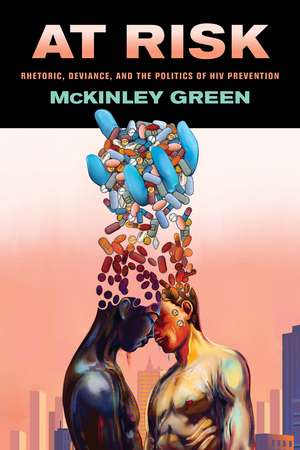
At Risk: Rhetoric, Deviance, and the Politics of HIV Prevention
Autor McKinley Greenen Limba Engleză Paperback – 11 mai 2026
At Risk explores how young people living with HIV have developed risk-reduction practices that seem to contradict public health recommendations for HIV prevention. Putting forward a rhetoric of deviance to frame these instances, McKinley Green argues that they represent intentional healthcare decisions that help young people mitigate the health risks that are most pressing in their daily lives. While current HIV risk-reduction priorities in the US are framed around a finite spectrum of sexual behaviors and medical technologies, those living with HIV often encounter a broader spectrum of risks shaped by structural inequities like racism, housing insecurity, queer and transphobia, HIV stigma, trauma in medical settings, and addiction, all of which create conditions that increase the risk of HIV transmission and present other threats to safety and autonomy.
Drawing from more than sixty hours of interviews with young people living with HIV, frontline healthcare workers, and HIV activists, Green highlights how those living with HIV have developed agency and expertise in navigating, mitigating, and communicating about risk. In doing so, he offers alternative epistemologies of sexual health risk that point toward more patient-centered HIV prevention frameworks.
Drawing from more than sixty hours of interviews with young people living with HIV, frontline healthcare workers, and HIV activists, Green highlights how those living with HIV have developed agency and expertise in navigating, mitigating, and communicating about risk. In doing so, he offers alternative epistemologies of sexual health risk that point toward more patient-centered HIV prevention frameworks.
| Toate formatele și edițiile | Preț | Express |
|---|---|---|
| Paperback (1) | 301.05 lei Precomandă | |
| Ohio State University Press – 11 mai 2026 | 301.05 lei Precomandă | |
| Hardback (1) | 754.34 lei Precomandă | |
| Ohio State University Press – 11 mai 2026 | 754.34 lei Precomandă |
Preț: 301.05 lei
Precomandă
Puncte Express: 452
Preț estimativ în valută:
53.29€ • 61.90$ • 46.17£
53.29€ • 61.90$ • 46.17£
Carte nepublicată încă
Doresc să fiu notificat când acest titlu va fi disponibil:
Se trimite...
Preluare comenzi: 021 569.72.76
Specificații
ISBN-13: 9780814259832
ISBN-10: 0814259839
Pagini: 208
Ilustrații: 4 b&w images
Dimensiuni: 152 x 229 mm
Greutate: 0.45 kg
Editura: Ohio State University Press
Colecția Ohio State University Press
ISBN-10: 0814259839
Pagini: 208
Ilustrații: 4 b&w images
Dimensiuni: 152 x 229 mm
Greutate: 0.45 kg
Editura: Ohio State University Press
Colecția Ohio State University Press
Recenzii
“At Risk impressively integrates scholarship in rhetoric of health and medicine, technical and professional communication, and queer rhetorics, extending ever-relevant conversations about rhetorical risk and resistance. Green demonstrates the need to account for sociopolitical systems and contexts in a richly contextualized and illustrative way. Our fields need more books like this.” —J. Blake Scott, author of Risky Rhetoric: AIDS and the Cultural Practices of HIV Testing
“A thoughtful, engaging, and meaningful contribution, At Risk disrupts the idea that healthy and risky behaviors are binary opposites and compellingly shows that we need a more precise and robust vocabulary of deviance in health and medicine. At the same time, it invites and challenges us to consider what ‘health’ means and who is allowed to define, access, or practice healthfulness.” —Molly Margaret Kessler, author of Stigma Stories: Rhetoric, Lived Experience, and Chronic Illness
Notă biografică
McKinley Green is Assistant Professor of English at George Mason University. His research has appeared in Rhetoric of Health and Medicine, Reflections, Technical Communication Quarterly, The Journal of Technical Writing and Communication, and Computers and Composition.
Extras
My goal in this book is to explore the tension that emerges when people living with HIV or those deemed at risk of HIV act in ways that seem inconsistent with biomedical risk priorities or push back at the presumed stability of HIV risk as defined by medical institutions. To do so, I develop what I call a rhetoric of deviance that, rather than viewing such atypical practices as unproductive (or as opportunities to educate, control, or manage those living with HIV), provides a framework to see these behaviors as opportunities to envision alternative epistemologies of risk that counter biomedical understandings of health subjectivity and sexual citizenship. I put forward the concept of deviance as a way of showing how the guise of certainty and objectivity accompanying biomedical approaches to risk reduction belies the contested social experiences of risk that surround lived confrontations with HIV: those intimate, embodied, power-laden social and sexual situations where the risks of HIV transmission surface in people’s lives. Biomedical conceptions of HIV prevention, which are often surrounded by hopeful claims to lengthen life, improve health and well-being, reduce the spread of HIV, and eradicate stigma, can prevent us from attending to the complex interpersonal and social dynamics that place people at risk, erase the racial, social, cultural dynamics that impact risk assessments, and obfuscate the lived negotiations of risk that those most impacted by the HIV epidemic enact daily. The goal of this book is to destabilize or repoliticize conceptions of HIV risk at a moment where interventions for HIV prevention seem to be unquestioned or objective, to envision possibilities for sexual subjectivity that exist beyond a sexual health prevention landscape that is overly determined by the priorities, methodologies, and epistemological foundations of biomedicine.
To illustrate this book’s core interventions, I draw from more than 60 hours of interviews with young people living with HIV, frontline health-care workers, HIV advocates, and community organizers whom I encountered across three studies, all focused in some way on how young people living with HIV navigate and subvert the frames of health risk in their daily lives. In analyzing and recounting these stories, I draw attention to moments when the people I spoke with opted to reject, deviate from, or ignore guidance from public health officials about HIV risk. People living with HIV shared stories with me about decisions or behaviors that seemed to push back on, complicate, question, or outright contradict the HIV risk-reduction strategies prioritized by public health outreach initiatives, medical guidance from doctors, or behavioral recommendations from AIDS-serving organizations. These decisions included small instances like the story of the participant’s question in the pharmaceutical presentation, when people poke at the presumed stability and objectivity of risk reduction initiatives laid out by pharmaceutical companies or question the narratives about HIV that circulate in dominant discourse around the disease. They also include situations where people living with HIV rejected opportunities to interface with public health organizations or explicitly resisted opportunities to access information about HIV risk reduction, as well as more contentious decisions, like not disclosing their serostatus to sexual partners or ignoring risk prevention guidance against hooking up with strangers during the COVID-19 pandemic. What I learned from speaking to people living with HIV is that these behaviors are often not chosen out of ignorance, willful neglect, or moral wantonness but out of a need to reduce the other, more pressing risks to their lives, or to secure a small amount of autonomy and agency that is often structurally unavailable to them. People may turn to survival sex, for instance, to reduce the risks of homelessness or to find food (even when those behaviors introduce situations where the chances of HIV transmission are higher); people with limited power in their sexual relationships may engage in higher-risk sexual behaviors out of fear of their partners. Those behaviors that so often appear as deviance, ignorance, or recklessness more often functioned as prophylaxes for people living with HIV, mitigating practices intentionally deployed to insulate their safety, autonomy, or agency from external threats and structural instability.
To illustrate this book’s core interventions, I draw from more than 60 hours of interviews with young people living with HIV, frontline health-care workers, HIV advocates, and community organizers whom I encountered across three studies, all focused in some way on how young people living with HIV navigate and subvert the frames of health risk in their daily lives. In analyzing and recounting these stories, I draw attention to moments when the people I spoke with opted to reject, deviate from, or ignore guidance from public health officials about HIV risk. People living with HIV shared stories with me about decisions or behaviors that seemed to push back on, complicate, question, or outright contradict the HIV risk-reduction strategies prioritized by public health outreach initiatives, medical guidance from doctors, or behavioral recommendations from AIDS-serving organizations. These decisions included small instances like the story of the participant’s question in the pharmaceutical presentation, when people poke at the presumed stability and objectivity of risk reduction initiatives laid out by pharmaceutical companies or question the narratives about HIV that circulate in dominant discourse around the disease. They also include situations where people living with HIV rejected opportunities to interface with public health organizations or explicitly resisted opportunities to access information about HIV risk reduction, as well as more contentious decisions, like not disclosing their serostatus to sexual partners or ignoring risk prevention guidance against hooking up with strangers during the COVID-19 pandemic. What I learned from speaking to people living with HIV is that these behaviors are often not chosen out of ignorance, willful neglect, or moral wantonness but out of a need to reduce the other, more pressing risks to their lives, or to secure a small amount of autonomy and agency that is often structurally unavailable to them. People may turn to survival sex, for instance, to reduce the risks of homelessness or to find food (even when those behaviors introduce situations where the chances of HIV transmission are higher); people with limited power in their sexual relationships may engage in higher-risk sexual behaviors out of fear of their partners. Those behaviors that so often appear as deviance, ignorance, or recklessness more often functioned as prophylaxes for people living with HIV, mitigating practices intentionally deployed to insulate their safety, autonomy, or agency from external threats and structural instability.
Cuprins
Contents
List of Illustrations
Preface
Introduction
Chapter 1 “It’s Not Because of the Behaviors . . . It’s the Broken System”: Biomedicine’s Social Foundations
Chapter 2 “Did I Potentially Just Expose Myself?”: Surveillance and Stigma in mHealth Technologies for HIV Prevention
Chapter 3 “Thanks, My Asshole Is Very Clean”: Nondisclosure as Risk Reduction on Grindr
Chapter 4 “Prefer Not to Say”: Pleasure and Infectious Disease Surveillance
Conclusion
Acknowledgments
References
Index
List of Illustrations
Preface
Introduction
Chapter 1 “It’s Not Because of the Behaviors . . . It’s the Broken System”: Biomedicine’s Social Foundations
Chapter 2 “Did I Potentially Just Expose Myself?”: Surveillance and Stigma in mHealth Technologies for HIV Prevention
Chapter 3 “Thanks, My Asshole Is Very Clean”: Nondisclosure as Risk Reduction on Grindr
Chapter 4 “Prefer Not to Say”: Pleasure and Infectious Disease Surveillance
Conclusion
Acknowledgments
References
Index
Descriere
Advances a rhetoric of deviance to show how young people with HIV defy public health recommendations in favor of their own risk-mitigation strategies informed by structural inequities.