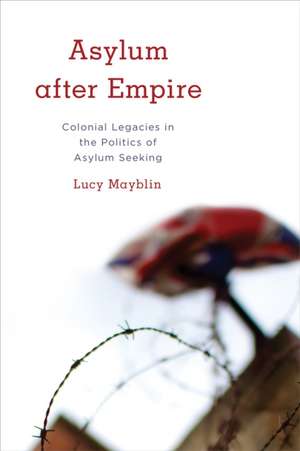
Asylum after Empire: Colonial Legacies in the Politics of Asylum Seeking: Kilombo: International Relations and Colonial Questions
Autor Lucy Mayblinen Limba Engleză Paperback – 13 iun 2018
This book presents an alternative view, drawing on theoretical insights from Third World Approaches to International Law, post- and decolonial studies, and presenting new research on the context of the British Empire. The text highlights the fact that since the early 1990s, for the first time, the majority of asylum seekers originate from countries outside of Europe, countries which until 30-60 years ago were under colonial rule. Policies which address asylum seekers must, the book argues, be understood not only as part of a global hypermobile present, but within the context of colonial histories.
| Toate formatele și edițiile | Preț | Express |
|---|---|---|
| Paperback (1) | 243.09 lei 6-8 săpt. | |
| Bloomsbury Publishing – 13 iun 2018 | 243.09 lei 6-8 săpt. | |
| Hardback (1) | 726.77 lei 6-8 săpt. | |
| Bloomsbury Publishing – 5 apr 2017 | 726.77 lei 6-8 săpt. |




Preț: 243.09 lei
Preț vechi: 330.17 lei
-26%
Puncte Express: 365
Preț estimativ în valută:
43.05€ • 50.28$ • 37.40£
43.05€ • 50.28$ • 37.40£
Carte tipărită la comandă
Livrare economică 21 februarie-07 martie
Preluare comenzi: 021 569.72.76
Specificații
ISBN-13: 9781783486168
ISBN-10: 1783486163
Pagini: 212
Ilustrații: 17 tables;
Dimensiuni: 148 x 228 x 16 mm
Greutate: 0.32 kg
Editura: Bloomsbury Publishing
Colecția Rowman & Littlefield Publishers
Seria Kilombo: International Relations and Colonial Questions
Locul publicării:New York, United States
ISBN-10: 1783486163
Pagini: 212
Ilustrații: 17 tables;
Dimensiuni: 148 x 228 x 16 mm
Greutate: 0.32 kg
Editura: Bloomsbury Publishing
Colecția Rowman & Littlefield Publishers
Seria Kilombo: International Relations and Colonial Questions
Locul publicării:New York, United States
V-ar putea interesa
-
 Golden Harvest: Events at the Periphery of the HolocaustJan Tomasz Gross-22%Preț: 68.05 lei87.48 lei
 -
 Culture, Education, and CommunityJ. LaviaPreț: 295.05 lei
 -
 Vietnam Through Rose-Colored GlassesRichard S. RosePreț: 46.95 lei
 -
 The Darker Side of Western ModernityWalter D MignoloPreț: 230.67 lei
 -
 Under the Shadow of Death: Memoirs of a Survivor of the Armenian GenocideGarabed Hagop Aaronian-17%Preț: 197.96 lei237.55 lei
 -
 -28%Preț: 53.77 lei75.05 lei
 -
 SeveredFrances LarsonPreț: 89.19 lei
 -
 Postcolonial Theory and the Specter of CapitalVivek ChibberPreț: 204.94 lei
 -
 The Hidden History of the JFK AssassinationLamar WaldronPreț: 132.50 lei
 -
 Russia in the Arctic: Hard or Soft Power?Alexander Sergunin-13%Preț: 154.92 lei178.20 lei
Cuprins
1. Introduction / 2. The Asylum 'Problem' / 3. Decolonising the 'Problem': An Alternative Standpoint for Analysing the Exclusionary Politics of Asylum / 4. The British Empire and the Right to be Human / 5. Colonialism, the League of Nations and Race Equality / 6. The United Nations and the Right to be Human / 7. Future Directions for Policy / 8. Asylum After Empire
Recenzii
Asylum After Empire is a landmark book. It is a forensic account of how asylum became central to contemporary politics in the West. Mayblin blends insightful theoretical analysis with detailed historical enquiry to show how asylum is produced by, and is productive of, colonial modernity - it is the continuation of 19th and 20th century differential rights regimes by another name. Contemporary debates about refugees, Mayblin demonstrates, are really debates about human hierarchy. Asylum After Empire is not just a fine piece of scholarship, it matters. Read it.
Lucy Mayblin takes the reader on a seminal non-Eurocentric historical sociological journey that problematizes the current European asylum crisis, revealing how it has emerged not upon a discursive foundation of universal human rights but on one of human hierarchy; a discourse which remains today as the potent legacy of connected colonial histories which she traces back over a 200-year period. Such is the originality and seminal importance of this book that it has the potential to re-track Refugee Studies/Migration Studies and associated ventures connected to the disciplines of Sociology, Politics and International Relations onto fresh, non-Eurocentric terrain.
This groundbreaking book is an illuminating application of post and de-colonial thought and the literature on race and racism to the policy of asylum. It challenges some of the fundamentals of refugee scholarship and politics and opens up new perspectives for academics and activists alike.
Lucy Mayblin's Asylum After Empire is a breath of fresh air in the examination of Britain's response to asylum seekers, reminding us forcefully that the non-European refugee is not a new, disruptive phenomenon of the post-Cold War world. . . . [it] is a game-changer in the field of refugee studies. It shifts the problem from asylum and refuge itself to a larger issue of racialized humanity as the real challenge that refugee crises throw up: they are not merely a sudden appearance of our time, but have been created in their present incarnation as a problem of a particular hierarchical superiority.
Lucy Mayblin takes the reader on a seminal non-Eurocentric historical sociological journey that problematizes the current European asylum crisis, revealing how it has emerged not upon a discursive foundation of universal human rights but on one of human hierarchy; a discourse which remains today as the potent legacy of connected colonial histories which she traces back over a 200-year period. Such is the originality and seminal importance of this book that it has the potential to re-track Refugee Studies/Migration Studies and associated ventures connected to the disciplines of Sociology, Politics and International Relations onto fresh, non-Eurocentric terrain.
This groundbreaking book is an illuminating application of post and de-colonial thought and the literature on race and racism to the policy of asylum. It challenges some of the fundamentals of refugee scholarship and politics and opens up new perspectives for academics and activists alike.
Lucy Mayblin's Asylum After Empire is a breath of fresh air in the examination of Britain's response to asylum seekers, reminding us forcefully that the non-European refugee is not a new, disruptive phenomenon of the post-Cold War world. . . . [it] is a game-changer in the field of refugee studies. It shifts the problem from asylum and refuge itself to a larger issue of racialized humanity as the real challenge that refugee crises throw up: they are not merely a sudden appearance of our time, but have been created in their present incarnation as a problem of a particular hierarchical superiority.