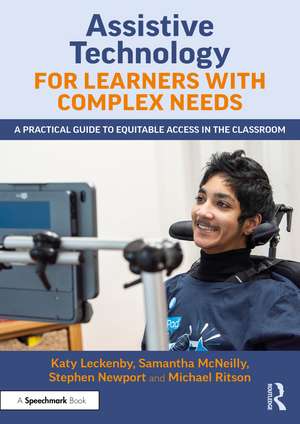
Assistive Technology for Learners with Complex Needs: A Practical Guide to Equitable Access in the Classroom
Autor Katy Leckenby, Samantha McNeilly, Stephen Newport, Michael Ritsonen Limba Engleză Paperback – oct 2026
Chapters share key evidence-based theories and practices to introduce good assistive technology principles within the classroom and support informed decision-making. They consider which tools you may already have to hand, alongside more specialised solutions, offering a range of real-world examples to show how these can facilitate equitable learning. Readily available accessibility tools in everyday software can often be cost-effective solutions and building a concrete understanding of assistive technology will help to create a legacy of good practice in every setting.
This book provides valuable insights and guidance to enhance your assistive technology journey within the classroom. It will be key reading for special educational needs coordinators, teachers and senior leaders supporting learners with complex needs.
Preț: 319.70 lei
Nou
Puncte Express: 480
Carte tipărită la comandă
Livrare economică 27 noiembrie-11 decembrie
Livrare prin curier în România Termenul estimat este afișat lângă disponibilitate.
Transport gratuit de la 400.00 lei Plată online sau ramburs, în funcție de opțiunile comenzii.
Retur gratuit în 14 zile Comandă securizată și suport în română.
Specificații
ISBN-13: 9781041071679
ISBN-10: 1041071671
Pagini: 220
Ilustrații: 146
Dimensiuni: 174 x 246 mm
Greutate: 0.41 kg
Ediția:1
Editura: Taylor & Francis
Colecția Routledge
Locul publicării:Oxford, United Kingdom
ISBN-10: 1041071671
Pagini: 220
Ilustrații: 146
Dimensiuni: 174 x 246 mm
Greutate: 0.41 kg
Ediția:1
Editura: Taylor & Francis
Colecția Routledge
Locul publicării:Oxford, United Kingdom
Public țintă
Professional Practice & DevelopmentNotă biografică
Katy Leckenby is a senior augmentative and alternative communication (AAC) consultant and specialist teacher at Ace Centre, a national charity that provides support and advice to people with complex needs around the use of assistive technology and AAC. Katy is passionate about facilitating communication and removing barriers to ensure that all students can fully access education.
Samantha McNeilly is an occupational therapist and senior AAC consultant for Ace Centre, with a passion for assistive technology. She regularly develops and delivers training, showcasing her practical experience and enthusiasm for integrating and supporting assistive technology within educational settings. Samantha is also trustee for a charity volunteering with children in Romania.
Stephen Newport completed an education doctorate in Special Educational Needs and Disability Assessment and has recently completed an MSc in Educational Assistive Technology. He spent many years working at New Bridge Multi Academy Trust, teaching and leading the interactive base for pupils considered to have Profound and Multiple Learning Disabilities. He also spent several years working as the organisation’s assistive technology coordinator. Stephen is now an AAC consultant for Ace Centre.
Michael Ritson is a qualified teacher of the visually impaired with a passion for working with people who experience a wide range of additional needs and sensory impairments to help maximise their potential – especially through the most efficient and effective use of both assistive and mainstream technology. Michael is currently a senior AAC consultant for Ace Centre.
Samantha McNeilly is an occupational therapist and senior AAC consultant for Ace Centre, with a passion for assistive technology. She regularly develops and delivers training, showcasing her practical experience and enthusiasm for integrating and supporting assistive technology within educational settings. Samantha is also trustee for a charity volunteering with children in Romania.
Stephen Newport completed an education doctorate in Special Educational Needs and Disability Assessment and has recently completed an MSc in Educational Assistive Technology. He spent many years working at New Bridge Multi Academy Trust, teaching and leading the interactive base for pupils considered to have Profound and Multiple Learning Disabilities. He also spent several years working as the organisation’s assistive technology coordinator. Stephen is now an AAC consultant for Ace Centre.
Michael Ritson is a qualified teacher of the visually impaired with a passion for working with people who experience a wide range of additional needs and sensory impairments to help maximise their potential – especially through the most efficient and effective use of both assistive and mainstream technology. Michael is currently a senior AAC consultant for Ace Centre.
Cuprins
Foreword: The Impact of Assistive Technology – Harchie’s Story
Introduction
1 The Changing Landscape of Assistive Technology
2 Assistive Technology within a Crowded Curriculum
3 How Do We Choose the Best Assistive Technology?
4 Assistive Technology to Support Communication: What is Augmentative and Alternative Communication?
5 How Can Assistive Technology Support Complex Learners with Sensory Impairments?
6 Cost-Effective Solutions to Meet Learners’ Needs
7 Access Fundamentals
8 Access Methods – How and Why?
9 Navigating Access Methods: A Skills-Building Journey
10 Getting Set Up: Mounting and Positioning of Equipment
11 Implementing Assistive Technology within an Educational Setting – Lessons Learned
12 How Can Policy Drive Organisational Change? 13 Developing the Skills to Support Assistive Technology Use
14 The Real Impact of an Assistive Technology Team
15 Usual Way of Working/Exam Access Arrangements
Conclusion
Index
Introduction
1 The Changing Landscape of Assistive Technology
2 Assistive Technology within a Crowded Curriculum
3 How Do We Choose the Best Assistive Technology?
4 Assistive Technology to Support Communication: What is Augmentative and Alternative Communication?
5 How Can Assistive Technology Support Complex Learners with Sensory Impairments?
6 Cost-Effective Solutions to Meet Learners’ Needs
7 Access Fundamentals
8 Access Methods – How and Why?
9 Navigating Access Methods: A Skills-Building Journey
10 Getting Set Up: Mounting and Positioning of Equipment
11 Implementing Assistive Technology within an Educational Setting – Lessons Learned
12 How Can Policy Drive Organisational Change? 13 Developing the Skills to Support Assistive Technology Use
14 The Real Impact of an Assistive Technology Team
15 Usual Way of Working/Exam Access Arrangements
Conclusion
Index
Descriere
This book guides you in identifying needs and key considerations for introducing assistive technology (AT) to learners and classrooms. Essential reading for SENCOs, teachers, and leaders, it offers valuable insights to enhance AT use, opening up access to the curriculum for learners with complex needs.