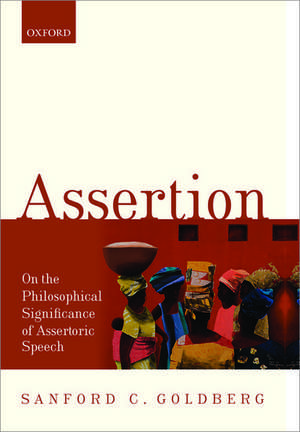
Assertion: On the Philosophical Significance of Assertoric Speech
Autor Sanford C. Goldbergen Limba Engleză Hardback – 19 feb 2015
Preț: 664.79 lei
Preț vechi: 962.44 lei
-31%
Puncte Express: 997
Carte tipărită la comandă
Livrare economică 27 noiembrie-02 decembrie
Livrare prin curier în România Termenul estimat este afișat lângă disponibilitate.
Transport gratuit pentru acest produs Plată online sau ramburs, în funcție de opțiunile comenzii.
Retur gratuit în 14 zile Comandă securizată și suport în română.
Specificații
ISBN-13: 9780198732488
ISBN-10: 0198732481
Pagini: 330
Dimensiuni: 163 x 240 x 24 mm
Greutate: 0.66 kg
Editura: OUP OXFORD
Colecția OUP Oxford
Locul publicării:Oxford, United Kingdom
ISBN-10: 0198732481
Pagini: 330
Dimensiuni: 163 x 240 x 24 mm
Greutate: 0.66 kg
Editura: OUP OXFORD
Colecția OUP Oxford
Locul publicării:Oxford, United Kingdom
V-ar putea interesa
-
 Machines and Thought: The Legacy of Alan Turing, Volume IPeter Millican-36%Preț: 305.41 lei476.81 lei
 -
 Moral ParticularismBrad Hooker-28%Preț: 439.76 lei613.33 lei
 -
 The Future for PhilosophyBrian Leiter-20%Preț: 305.52 lei382.06 lei
 -
 Epistemic LuckDuncan Pritchard-28%Preț: 354.38 lei492.70 lei
 -
 Perception and ReasonBill Brewer-19%Preț: 352.56 lei436.27 lei
 -
 -28%Preț: 406.73 lei566.82 lei
 -
 Understanding Human Knowledge: Philosophical EssaysBarry Stroud-19%Preț: 379.14 lei470.34 lei
 -
 Causing ActionsPaul M. Pietroski-19%Preț: 330.57 lei408.52 lei
 -
 -28%Preț: 410.49 lei569.01 lei
 -
 The Nature of PerceptionJohn Foster-28%Preț: 347.01 lei482.94 lei
 -
 Bayesian EpistemologyLuc Bovens-18%Preț: 359.62 lei438.12 lei
 -
 Internalism and Externalism in Semantics and EpistemologySanford C. Goldberg-31%Preț: 806.45 lei1170.50 lei
 -
 -28%Preț: 413.20 lei576.03 lei
 -
 Truth and RealismPatrick Greenough-11%Preț: 337.64 lei380.62 lei
 -
 Anti-IndividualismGoldberg Sanford C.Preț: 317.89 lei
 -
 Preț: 256.32 lei
 -
 Epistemology - An Anthology 2eErnest SosaPreț: 287.31 lei
Recenzii
This is an excellent piece of philosophy and an essential contribution to the literature on assertion. Goldberg knows the terrain far better than most do, and his discussion is acute, fair-minded, and enlightening. Even a reader who retains at the end apreference for an alternative position will put the book down less confidently than it was picked up.
Goldberg's book promises to be an important contribution to the literature: rigorously argued and with a rich source of material for future discussion, anyone with a specialist interest in assertion should read it.
This is an outstanding contribution to the growing literature on the speech act...Goldberg's work will surely be read for decades in both epistemology and the philosophy of language. With Assertion Goldberg only cements this legacy, presenting us with views that deserve to be the starting point of future investigations. Goldberg is an exceptionally clear writer, beginning each section with both a summary of the previous material and an explanation Âof its place in the book's larger scheme. It is this sort of clarity which makes it nearly impossible to get lost in the work even when it is at its most technical. This should be essential reading for those working in either the philosophy of language or epistemology. Philosophers of mind and psychology stand to learn much from it too.
Goldberg's book promises to be an important contribution to the literature: rigorously argued and with a rich source of material for future discussion, anyone with a specialist interest in assertion should read it.
This is an outstanding contribution to the growing literature on the speech act...Goldberg's work will surely be read for decades in both epistemology and the philosophy of language. With Assertion Goldberg only cements this legacy, presenting us with views that deserve to be the starting point of future investigations. Goldberg is an exceptionally clear writer, beginning each section with both a summary of the previous material and an explanation Âof its place in the book's larger scheme. It is this sort of clarity which makes it nearly impossible to get lost in the work even when it is at its most technical. This should be essential reading for those working in either the philosophy of language or epistemology. Philosophers of mind and psychology stand to learn much from it too.
Notă biografică
Sanford C. Goldberg is Professor and Chair of the Philosophy Department at Northwestern University. He works on topics at the intersection of epistemology, philosophy of mind, and philosophy of language. He is author of Anti-Individualism (CUP, 2007), Relying on Others (OUP, 2010), and numerous other articles on such topics as disagreement, testimony, reliabilism, metaepistemology, the semantics of speech reports, reference, self-knowledge, and attitude externalism.