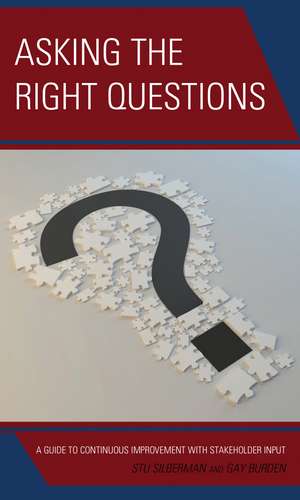
Asking the Right Questions: A Guide to Continuous Improvement with Stakeholder Input
Autor Stu Silberman, Gay Burdenen Limba Engleză Hardback – 31 dec 2019
Preț: 283.37 lei
Preț vechi: 379.00 lei
-25%
Puncte Express: 425
Carte tipărită la comandă
Livrare economică 17 noiembrie-01 decembrie
Livrare prin curier în România Termenul estimat este afișat lângă disponibilitate.
Transport gratuit de la 400.00 lei Plată online sau ramburs, în funcție de opțiunile comenzii.
Retur gratuit în 14 zile Comandă securizată și suport în română.
Specificații
ISBN-13: 9781475852578
ISBN-10: 1475852576
Pagini: 60
Dimensiuni: 148 x 224 x 12 mm
Greutate: 0.27 kg
Editura: Bloomsbury Publishing
Colecția Rowman & Littlefield
Locul publicării:New York, United States
ISBN-10: 1475852576
Pagini: 60
Dimensiuni: 148 x 224 x 12 mm
Greutate: 0.27 kg
Editura: Bloomsbury Publishing
Colecția Rowman & Littlefield
Locul publicării:New York, United States
Descriere
This book outlines a practical, four-question model that school and business leaders can use to engage stakeholder feedback, determine the organization's DNA, and establish a collective vision for improvement. Stakeholder feedback is analyzed at both the focus- and whole-group level. Results are then woven into the organizational improvement plan. Practical examples of leadership experiences in implementing the four-question model are included as well as the theory behind why these four questions are the right questions to ask. Each chapter ends with a set of reflective questions that leadership teams can utilize individually or in an organizational book study or Professional Learning Community (PLC).
Cuprins
Table of Contents
Foreward
Preface and Acknowledgments
Introduction
Chapter 1: Four-Question Model Overview
Modeling Connected Leadership
About the Authors
Determining Your Schools DNA
The Four-Question Model
Collective Efficacy
Stakeholder Focus Group Meetings
Sample Groups
Analyzing and Sharing the Results
To Sum Up
Reflective Questions/Activities
Chapter 2: What is working--things you do not want to change?
What's Working and How do we Know it's Working?
District Leadership Modeling
What's Your Leadership Style?
To Sum Up
Reflective Questions/Activities
Chapter 3: What needs to be changed to make this a better place for kids?
Christmas Trees and Kitchen Sinks
Student Voice
Weeding the Garden
College and Career Readiness
Creating Buy-in on the Front-end
To Sum Up
Reflective Questions/Activities
Chapter 4: What needs to be changed to make this a better place for adults?
Human Side of Change
Top-Down and Grassroots Effort
Symbolism
Recognizing the Super Stars
Dealing with Naysayers
The Abilene Paradox
To Sum Up
Reflective Questions/Activities
Chapter 5: What can I do, as your leader, to do a better job?
A Learning Leader is Vulnerable
Visioning and Establishing Purpose
A Clear Communication Plan
Celebrate Victories
Collective Capacity
A Practitioner's Story
Clearly Document the Process
To Sum Up
Reflective Questions/Activities
Appendix A: Debriefing Strategy: Think-a-Thon
References
About the Author
Foreward
Preface and Acknowledgments
Introduction
Chapter 1: Four-Question Model Overview
Modeling Connected Leadership
About the Authors
Determining Your Schools DNA
The Four-Question Model
Collective Efficacy
Stakeholder Focus Group Meetings
Sample Groups
Analyzing and Sharing the Results
To Sum Up
Reflective Questions/Activities
Chapter 2: What is working--things you do not want to change?
What's Working and How do we Know it's Working?
District Leadership Modeling
What's Your Leadership Style?
To Sum Up
Reflective Questions/Activities
Chapter 3: What needs to be changed to make this a better place for kids?
Christmas Trees and Kitchen Sinks
Student Voice
Weeding the Garden
College and Career Readiness
Creating Buy-in on the Front-end
To Sum Up
Reflective Questions/Activities
Chapter 4: What needs to be changed to make this a better place for adults?
Human Side of Change
Top-Down and Grassroots Effort
Symbolism
Recognizing the Super Stars
Dealing with Naysayers
The Abilene Paradox
To Sum Up
Reflective Questions/Activities
Chapter 5: What can I do, as your leader, to do a better job?
A Learning Leader is Vulnerable
Visioning and Establishing Purpose
A Clear Communication Plan
Celebrate Victories
Collective Capacity
A Practitioner's Story
Clearly Document the Process
To Sum Up
Reflective Questions/Activities
Appendix A: Debriefing Strategy: Think-a-Thon
References
About the Author
Recenzii
Margaret Wheatley once stated that "real change begins with the simple act of people talking about what they care about." Although she talked about how change happens in business, the idea is relevant to how real change happens in education. This new book, much needed and long overdue, is a perfect example. It offers a thoughtful and compelling vision for ways educational leaders can facilitate real change. Specifically, it describes a new vision of what educational leadership can be and how it can use stakeholder input to promote continuous district-wide improvement.
It is based on sound theoretical principles: educational leadership is proactive and collaborative, it values the voices of all stakeholders, and it recognizes reflection and feedback as critical to the process of continuous improvement. While theoretically sound, this book is also pragmatic and practical. It describes a four-question model of leadership grounded in the notion that the key to school improvement is the process of problem-finding and problem-solving. One way to find and solve the right problems is by asking the right questions.
When educational leaders ask the right questions, they create a collaborative, rather than a hierarchical, culture of learning with stakeholders. It is exactly this kind of culture that allows stakeholders (people talking about what they care about) to create a shared vision for real change. I believe this new book should not only be required reading for superintendents and principals currently in the field, but also for students in higher education who aspire to be inspiring educational leaders in the future.
I have had an opportunity to review the manuscript "Asking the Right Questions: How do I use Stakeholder Input to Guide Continuous District Improvement" and found it to be a tool school personnel can utilize to focus on continuous school improvement.
I have been involved with school improvement for over forty years, as a high school principal and educational consultant. In my experience, I have found it is extremely important that school district leaders be involved in the initial stage of school improvement. This book outlining the four-question model by Gay Burden and Stu Silberman, checks all the boxes for systemic change resulting from a school improvement initiative. The four question model also provides top down leadership with stakeholder feedback that establishes a collective vision.
From my experience central office personnel, principals, teacher leaders, parents, students, and community leaders will be challenged and have ownership in the process after being exposed to the model. I would recommend this book as one of the resources for districts to read, and contemplate using when planning a school improvement initiative.
I have long been a believer in the simple phrase, "nobody washes their rental car." This truth occurs because people do not own it. The same is true with school improvement. Too often the improvement ideas come from outside, garnering little ownership. The process detailed in this book provides schools and districts with tools to engage teachers, leaders and staff members in taking ownership of both the problems and solutions to problems. By focusing on asking the right questions to extend learning and understanding the root causes of both successes and problems, all staff in a district own the improvement efforts. These four guiding questions create a district framework for continuous improvement.
Stu and Gay combine unique backgrounds that provide insight into continuous district improvement-a thought-provoking read. Their backgrounds at all levels
of education has given them outstanding experience to know what makes school districts effective. Understanding what questions to ask, who to ask, and how to use that information is key to continuous district improvement.
There is nothing quite as exciting as being hired as principal or superintendent. Finally, you have the opportunity to put all you have learned - and your many ideas - into practice. But, where do you begin? As any good leader knows, you cannot simply go into a school or district and think that magically, everyone will want to follow a vision that you cast. That vision has to be formed collectively, but how? As a superintendent, I was so fortunate to have a mentor, Stu Silberman, who modeled a very clear process for me. I'd been able to see firsthand the power of listening, and sharing those insights in an effective way.
Having a protocol to use for gathering information and feedback was invaluable. It provided me the chance to learn about the district and the people inside, and gave me critically important thoughts about how to best move forward. Having a book now to capture the advice of such talented, knowledgeable and proven leaders is a true gift to leaders everywhere. The advice is practical, straightforward and if you follow it, will ensure your success. This is one you will want to keep close and refer to time and time again.
Whether you are a new or experienced principal, new or experienced superintendent or the CEO of a major non-profit organization, the challenge of analyzing the school/district/non-profit can be an overwhelming process. Where to begin? What are the best questions to ask to generate the most accurate data? How do you see through the fog of data to develop a clear vision going forward? Yet the process is critical to the success of both the leader and the organization. Building a common shared vision in a large school or organization can be a daunting task. This book provides insight into the process of asking the right questions in order to generate data that is utilized to create a shared vision among all stakeholders. This book helps you with the process of asking the best questions to generate the most useful information.
As a former elementary principal, I could not imagine not having the support and guidance of the information found in this book. It is critical to ask the right questions and include all individuals in decision making as a shared vision is developed for the school. Whether serving as a school or district administrator, allowing staff to work together to give input, developing the working foundation of the school or district provides the opportunity for much needed autonomy. Once all stakeholders are on the same page and roles are clear, the necessary change can happen and high growth for all students becomes a reality.
For someone that led two school districts as a superintendent and now works to prepare and support future education leaders, reading Stu and Gay's book provides a refreshing reminder that it is up to each of us to be open, transparent leaders in order to foster a shared vision that will endear all constituents to your school and district, ensure an efficient workplace, enjoin others to help us, enlighten our naysayers, enlarge our opportunities to grow and serve, and ultimately enhance student achievement. It should be required reading for all educators.
This book is a MUST read for school and district leaders and those aspiring to be future leaders. While simplistic in form, gaining key stakeholder input using the techniques this book prescribes, literally establishes a powerful force towards school improvement and most importantly, student achievement. Listening to staff, students, and your community is a critical variable for an effective school leader and when coupled with shared-decision making, the table is set for success. Personally, I have utilized these skills as a leader and have witnessed the power in action when you incorporate this key data into a plan of action to fulfill the needs addressed by the various school stakeholders. We have witnessed a cultural difference take place in our school district by simply listening to our people, collecting the data, and developing an action plan to address the strengths, weaknesses, opportunities, and threats shared with us by our own people.
It is based on sound theoretical principles: educational leadership is proactive and collaborative, it values the voices of all stakeholders, and it recognizes reflection and feedback as critical to the process of continuous improvement. While theoretically sound, this book is also pragmatic and practical. It describes a four-question model of leadership grounded in the notion that the key to school improvement is the process of problem-finding and problem-solving. One way to find and solve the right problems is by asking the right questions.
When educational leaders ask the right questions, they create a collaborative, rather than a hierarchical, culture of learning with stakeholders. It is exactly this kind of culture that allows stakeholders (people talking about what they care about) to create a shared vision for real change. I believe this new book should not only be required reading for superintendents and principals currently in the field, but also for students in higher education who aspire to be inspiring educational leaders in the future.
I have had an opportunity to review the manuscript "Asking the Right Questions: How do I use Stakeholder Input to Guide Continuous District Improvement" and found it to be a tool school personnel can utilize to focus on continuous school improvement.
I have been involved with school improvement for over forty years, as a high school principal and educational consultant. In my experience, I have found it is extremely important that school district leaders be involved in the initial stage of school improvement. This book outlining the four-question model by Gay Burden and Stu Silberman, checks all the boxes for systemic change resulting from a school improvement initiative. The four question model also provides top down leadership with stakeholder feedback that establishes a collective vision.
From my experience central office personnel, principals, teacher leaders, parents, students, and community leaders will be challenged and have ownership in the process after being exposed to the model. I would recommend this book as one of the resources for districts to read, and contemplate using when planning a school improvement initiative.
I have long been a believer in the simple phrase, "nobody washes their rental car." This truth occurs because people do not own it. The same is true with school improvement. Too often the improvement ideas come from outside, garnering little ownership. The process detailed in this book provides schools and districts with tools to engage teachers, leaders and staff members in taking ownership of both the problems and solutions to problems. By focusing on asking the right questions to extend learning and understanding the root causes of both successes and problems, all staff in a district own the improvement efforts. These four guiding questions create a district framework for continuous improvement.
Stu and Gay combine unique backgrounds that provide insight into continuous district improvement-a thought-provoking read. Their backgrounds at all levels
of education has given them outstanding experience to know what makes school districts effective. Understanding what questions to ask, who to ask, and how to use that information is key to continuous district improvement.
There is nothing quite as exciting as being hired as principal or superintendent. Finally, you have the opportunity to put all you have learned - and your many ideas - into practice. But, where do you begin? As any good leader knows, you cannot simply go into a school or district and think that magically, everyone will want to follow a vision that you cast. That vision has to be formed collectively, but how? As a superintendent, I was so fortunate to have a mentor, Stu Silberman, who modeled a very clear process for me. I'd been able to see firsthand the power of listening, and sharing those insights in an effective way.
Having a protocol to use for gathering information and feedback was invaluable. It provided me the chance to learn about the district and the people inside, and gave me critically important thoughts about how to best move forward. Having a book now to capture the advice of such talented, knowledgeable and proven leaders is a true gift to leaders everywhere. The advice is practical, straightforward and if you follow it, will ensure your success. This is one you will want to keep close and refer to time and time again.
Whether you are a new or experienced principal, new or experienced superintendent or the CEO of a major non-profit organization, the challenge of analyzing the school/district/non-profit can be an overwhelming process. Where to begin? What are the best questions to ask to generate the most accurate data? How do you see through the fog of data to develop a clear vision going forward? Yet the process is critical to the success of both the leader and the organization. Building a common shared vision in a large school or organization can be a daunting task. This book provides insight into the process of asking the right questions in order to generate data that is utilized to create a shared vision among all stakeholders. This book helps you with the process of asking the best questions to generate the most useful information.
As a former elementary principal, I could not imagine not having the support and guidance of the information found in this book. It is critical to ask the right questions and include all individuals in decision making as a shared vision is developed for the school. Whether serving as a school or district administrator, allowing staff to work together to give input, developing the working foundation of the school or district provides the opportunity for much needed autonomy. Once all stakeholders are on the same page and roles are clear, the necessary change can happen and high growth for all students becomes a reality.
For someone that led two school districts as a superintendent and now works to prepare and support future education leaders, reading Stu and Gay's book provides a refreshing reminder that it is up to each of us to be open, transparent leaders in order to foster a shared vision that will endear all constituents to your school and district, ensure an efficient workplace, enjoin others to help us, enlighten our naysayers, enlarge our opportunities to grow and serve, and ultimately enhance student achievement. It should be required reading for all educators.
This book is a MUST read for school and district leaders and those aspiring to be future leaders. While simplistic in form, gaining key stakeholder input using the techniques this book prescribes, literally establishes a powerful force towards school improvement and most importantly, student achievement. Listening to staff, students, and your community is a critical variable for an effective school leader and when coupled with shared-decision making, the table is set for success. Personally, I have utilized these skills as a leader and have witnessed the power in action when you incorporate this key data into a plan of action to fulfill the needs addressed by the various school stakeholders. We have witnessed a cultural difference take place in our school district by simply listening to our people, collecting the data, and developing an action plan to address the strengths, weaknesses, opportunities, and threats shared with us by our own people.