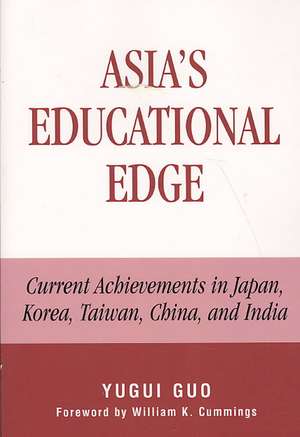
Asia's Educational Edge: Current Achievements in Japan, Korea, Taiwan, China, and India
Autor Yugui Guo Cuvânt înainte de William K. Cummingsen Limba Engleză Paperback – 8 apr 2008
Preț: 338.45 lei
Preț vechi: 436.76 lei
-23%
Puncte Express: 508
Carte tipărită la comandă
Livrare economică 23 noiembrie-07 decembrie
Livrare prin curier în România Termenul estimat este afișat lângă disponibilitate.
Transport gratuit de la 400.00 lei Plată online sau ramburs, în funcție de opțiunile comenzii.
Retur gratuit în 14 zile Comandă securizată și suport în română.
Specificații
ISBN-13: 9780739128084
ISBN-10: 0739128086
Pagini: 263
Dimensiuni: 150 x 226 x 20 mm
Greutate: 0.44 kg
Editura: Bloomsbury Publishing
Colecția Lexington Books
Locul publicării:New York, United States
ISBN-10: 0739128086
Pagini: 263
Dimensiuni: 150 x 226 x 20 mm
Greutate: 0.44 kg
Editura: Bloomsbury Publishing
Colecția Lexington Books
Locul publicării:New York, United States
Cuprins
Chapter 1 Introduction
Chapter 2 The Challenges Facing U.S. Education
Chapter 3 Profile of Japanese Education
Chapter 4 Profile of Korean Education
Chapter 5 Profile of Taiwanese Education
Chapter 6 Profile of Chinese Education
Chapter 7 Profile of Indian Education
Chapter 8 Conclusion
Chapter 2 The Challenges Facing U.S. Education
Chapter 3 Profile of Japanese Education
Chapter 4 Profile of Korean Education
Chapter 5 Profile of Taiwanese Education
Chapter 6 Profile of Chinese Education
Chapter 7 Profile of Indian Education
Chapter 8 Conclusion
Recenzii
Yugui Guo is a unique resource in international comparative education. He provides objective assessments of the educational strengths and weaknesses of the five major Asian countries that are accelerating their degrees in science and engineering, and gives an interesting Asian perspective on the U.S. educational system.
At a time when U.S. political and business leaders are becoming increasingly alarmed at the relocation of skilled jobs overseas as a result of outsourcing, this book is a welcome contribution to the current debate on education policies and economic competitiveness. . . . [It] warns against the danger of post-September-11th restrictive measures that have begun to erode the country's ability to attract foreign talent.
Asia's Educational Edge is an excellent book and a must-read for faculty and students interested in comparative and international education. U.S. education policy makers will find Guo's analysis of Asian educational achievements both informative and challenging.
Dr. Guo has produced a comprehensive analysis of Asia's growing capacity in the disciplines that will define leadership in science, engineering, and technology for decades to come. Asia's Educational Edge is a sobering reminder that human capital is a nation's most precious asset and that America's economic future depends on our ability to keep pace.
This is a well-documented argument that anyone interested in the future of American education and especially in the future of the educational underpinnings of the American high-tech economy should read.
Guo's comparative analysis sets a baseline for Americans to understand the competitive forces at work in the world today.
Asia's Educational Edge: Current Achievements in Japan, Korea, Taiwan, China, and India was undertaken both to provide a comparitive analysis of the educational systems- including K-12 education, higher education, and international education- of these five economies and to ask whether the United States will be prepared to train its own students in science and technology fields as more and more Asians seek tertiary education, terminal degrees, and ultimately, careers in Asia.... Armed with an impressive arsenal of statistics, presented intertextually as well as graphically, Guo predicts that, as opportunities increase in Asia, a smalle proportion of Asians will train for advanced degrees in the STEM( (science, technology, engineering, and mathematics) fields in the United States.... Guo's book should provide a useful resource to scholars of Asia or international education.
At a time when U.S. political and business leaders are becoming increasingly alarmed at the relocation of skilled jobs overseas as a result of outsourcing, this book is a welcome contribution to the current debate on education policies and economic competitiveness. . . . [It] warns against the danger of post-September-11th restrictive measures that have begun to erode the country's ability to attract foreign talent.
Asia's Educational Edge is an excellent book and a must-read for faculty and students interested in comparative and international education. U.S. education policy makers will find Guo's analysis of Asian educational achievements both informative and challenging.
Dr. Guo has produced a comprehensive analysis of Asia's growing capacity in the disciplines that will define leadership in science, engineering, and technology for decades to come. Asia's Educational Edge is a sobering reminder that human capital is a nation's most precious asset and that America's economic future depends on our ability to keep pace.
This is a well-documented argument that anyone interested in the future of American education and especially in the future of the educational underpinnings of the American high-tech economy should read.
Guo's comparative analysis sets a baseline for Americans to understand the competitive forces at work in the world today.
Asia's Educational Edge: Current Achievements in Japan, Korea, Taiwan, China, and India was undertaken both to provide a comparitive analysis of the educational systems- including K-12 education, higher education, and international education- of these five economies and to ask whether the United States will be prepared to train its own students in science and technology fields as more and more Asians seek tertiary education, terminal degrees, and ultimately, careers in Asia.... Armed with an impressive arsenal of statistics, presented intertextually as well as graphically, Guo predicts that, as opportunities increase in Asia, a smalle proportion of Asians will train for advanced degrees in the STEM( (science, technology, engineering, and mathematics) fields in the United States.... Guo's book should provide a useful resource to scholars of Asia or international education.