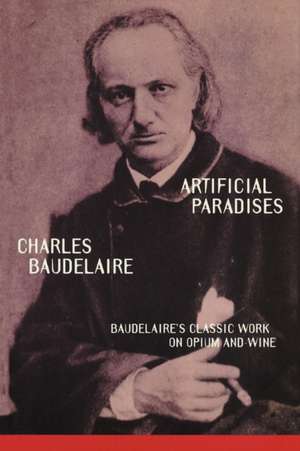
Artificial Paradises
Autor D. Baudelaireen Limba Engleză Paperback – 19 oct 1994
This new translation of a controversial book provides fascinating reading as well as a key to the mind of a great writer.
Preț: 87.29 lei
Preț vechi: 91.89 lei
-5%
Puncte Express: 131
Carte disponibilă
Livrare economică 03-17 noiembrie
Livrare prin curier în România Termenul estimat este afișat lângă disponibilitate.
Transport gratuit de la 400.00 lei Plată online sau ramburs, în funcție de opțiunile comenzii.
Retur gratuit în 14 zile Comandă securizată și suport în română.
Specificații
ISBN-13: 9780806514833
ISBN-10: 0806514833
Pagini: 204
Dimensiuni: 152 x 229 x 13 mm
Greutate: 0.34 kg
Editura: Kensington
Locul publicării:United States
ISBN-10: 0806514833
Pagini: 204
Dimensiuni: 152 x 229 x 13 mm
Greutate: 0.34 kg
Editura: Kensington
Locul publicării:United States
V-ar putea interesa
-
 Madness ExplainedRichard P BentallPreț: 123.75 lei
 -
 Thinking, Fast and SlowDaniel Kahneman-27%Preț: 90.73 lei123.57 leiRecomandat
 -
 Good Reasons for Bad FeelingsRandolph M. NessePreț: 79.96 lei
 -
 -32%Preț: 915.28 lei1347.42 lei
 -
 The Oxford Handbook of Dialectical Behaviour TherapyMichaela A. Swales-31%Preț: 881.60 lei1284.64 lei
 -
 The Parisian Prowler, 2nd Ed.Charles BaudelairePreț: 195.62 lei
 -
 Neurofeedback and Self-Regulation in ADHDWerner van den BerghPreț: 464.38 lei
 -
 Queen of HeartsFlorence St. JohnPreț: 91.59 lei
 -
 The What and How of PTSDCéline ParisPreț: 95.17 lei
 -
 Preț: 89.59 lei
 -
 Loving AndrewRomy WylliePreț: 125.99 lei
 -
 Chronic Alcoholism and Alcohol AddictionR J Gibbins-5%Preț: 97.36 lei102.49 lei
 -
 Charles Baudelaire, (French Edition) Collection de RomansCharles P. BaudelairePreț: 84.76 lei
 -
 Le Spleen de ParisCharles P. BaudelairePreț: 64.84 lei
 -
 Psychopaths in Our LivesDianne EmersonPreț: 91.99 lei
 -
 Les Paradis ArtificielsCharles P. BaudelairePreț: 69.87 lei
 -
 Bridging ResponsesLori Haskell-5%Preț: 42.04 lei44.24 lei
 -
 Oeuvres complètes de Charles Baudelaire (Éd.1868-1870)Charles BaudelairePreț: 199.78 lei
 -
 Salon de 1845 (Éd.1845)Charles BaudelairePreț: 87.91 lei
 -
 Théophile Gautier (Éd.1859)Charles BaudelairePreț: 93.97 lei
Textul de pe ultima copertă
At the time of its release in 1860, Charles Baudelaire's "Artificial Paradises (Les Paradis Artificiels)" met with immediate praise. One of the most important French symbolists, Baudelaire led a debauched, violent, and ultimately tragic life, dying an opium addict in 1867. This book, a response to Thomas De Quincey's Confessions of an Opium Eater, serves as a memoir of Baudelaire's last years. In this beautifully wrought portrait of the effects of wine, opium, and hashish on the mind, Baudelaire captures the dreamlike visions he experienced during his narcotic trances. These hallucinations, sometimes exquisite, sometimes disturbing, and the delusions of grandeur that often accompanied them, constitute the Paradis Artificiels, the gorgeous yet false worlds of ecstasy that eventually led to his ruin. Contrasting the effects of hashish and opium with those of wine, Baudelaire concludes that "wine exalts the will, hashish destroys it" and makes idlers of all those who use it.
This new translation of a controversial book provides fascinating reading as well as a key to the mind of a great writer.
This new translation of a controversial book provides fascinating reading as well as a key to the mind of a great writer.
Notă biografică
Charles Pierre Baudelaire (1821 - 1867) was a French poet who also produced notable work as an essayist, art critic and pioneering translator of Edgar Allan Poe. His most famous work, Les Fleurs du mal (The Flowers of Evil), expresses the changing nature of beauty in modern, industrializing Paris during the 19th century. Baudelaire's highly original style of prose-poetry influenced a whole generation of poets including Paul Verlaine, Arthur Rimbaud and Stéphane Mallarmé among many others. He is credited with coining the term "modernity" (modernité) to designate the fleeting, ephemeral experience of life in an urban metropolis and the responsibility art has to capture that experience.