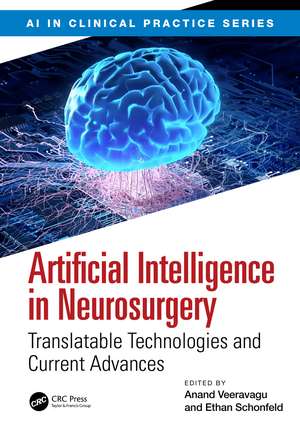
Artificial Intelligence in Neurosurgery: Translatable Technologies and Current Advances: AI in Clinical Practice
Editat de Anand Veeravagu, Ethan Schonfelden Limba Engleză Paperback – 4 oct 2026
This groundbreaking textbook equips neurosurgeons with the foundational knowledge to navigate the complexities of AI in clinical practice. It explores the remarkable progress of AI systems, from machine learning–enhanced neuronavigation to agentic systems capable of autonomous, multistep workflows. With a focus on real-world clinical data, fairness and interpretability, the book addresses the critical hurdles of evaluation lag, dataset curation and regulatory oversight.
As AI transitions from passive tools to active participants in medical problem-solving, this text provides a roadmap for neurosurgeons to lead the charge in developing, implementing and critically assessing these transformative technologies. By bridging the gap between innovation and practice, this book ensures that the next generation of neurosurgeons is prepared to harness the full potential of AI while safeguarding patient care.


Preț: 703.94 lei
Preț vechi: 740.99 lei
-5% Nou
Puncte Express: 1056
Carte tipărită la comandă
Livrare economică 23 noiembrie-07 decembrie
Livrare prin curier în România Termenul estimat este afișat lângă disponibilitate.
Transport gratuit pentru acest produs Plată online sau ramburs, în funcție de opțiunile comenzii.
Retur gratuit în 14 zile Comandă securizată și suport în română.
Specificații
ISBN-13: 9781032748375
ISBN-10: 1032748370
Pagini: 240
Ilustrații: 60
Dimensiuni: 178 x 254 mm
Greutate: 0.44 kg
Ediția:1
Editura: CRC Press
Colecția CRC Press
Seria AI in Clinical Practice
ISBN-10: 1032748370
Pagini: 240
Ilustrații: 60
Dimensiuni: 178 x 254 mm
Greutate: 0.44 kg
Ediția:1
Editura: CRC Press
Colecția CRC Press
Seria AI in Clinical Practice
Public țintă
Professional Practice & DevelopmentCuprins
Chapter 1: Neurons to Networks – Introducing the Role of Artificial Intelligence in Modern Neurosurgery
Chapter 2: Multimodal Foundation Models for Healthcare
Chapter 3: From Data to Decisions: AI-Driven Outcome Prediction in Spine Surgery
Chapter 4: Outcome Prediction in Brain Surgery
Chapter 5: Outcome Prediction in Neurosurgery: Liquid Biopsy and the Role of Machine Learning
Chapter 6: Diagnostic Applications of Artificial Intelligence in Neuro Oncology
Chapter 7: Detection and Diagnosis of Cerebrovascular Lesions Using Artificial Intelligence
Chapter 8: Artificial Intelligence Usage by Robotics in Neurosurgery
Chapter 9: The Compass of the Future: Machine Learning-Guided Navigation in Spine Surgery
Chapter 10: Artificial Intelligence for Surgical Workflow Analysis
Chapter 11: The Mind-Machine Interface
Chapter 12: Neurosurgical Sub-Task Automation
Chapter 13: Artificial Intelligence for Simulation and Neurosurgical Training
Chapter 14: Computer Vision in Neurosurgery
Chapter 15: Large Language Models in Neurosurgery
Chapter 16: Federated Learning in Neurosurgery
Chapter 17: Policy Perspective on the Regulatory Landscape, Evaluation, and Translation of Artificial Intelligence for Neurosurgery
Chapter 18: Neurosurgical Data Sources and Data Needs for Artificial Intelligence
Chapter 19: Current Challenges for Deep Learning Neurosurgery: Clinically Applicable Metrics and Domain Shift
Chapter 20: Using Operating Room Audio and Video for Predictive Analytics
Chapter 21: Advancing Basic Laboratory Research by Artificial Intelligence
Chapter 2: Multimodal Foundation Models for Healthcare
Chapter 3: From Data to Decisions: AI-Driven Outcome Prediction in Spine Surgery
Chapter 4: Outcome Prediction in Brain Surgery
Chapter 5: Outcome Prediction in Neurosurgery: Liquid Biopsy and the Role of Machine Learning
Chapter 6: Diagnostic Applications of Artificial Intelligence in Neuro Oncology
Chapter 7: Detection and Diagnosis of Cerebrovascular Lesions Using Artificial Intelligence
Chapter 8: Artificial Intelligence Usage by Robotics in Neurosurgery
Chapter 9: The Compass of the Future: Machine Learning-Guided Navigation in Spine Surgery
Chapter 10: Artificial Intelligence for Surgical Workflow Analysis
Chapter 11: The Mind-Machine Interface
Chapter 12: Neurosurgical Sub-Task Automation
Chapter 13: Artificial Intelligence for Simulation and Neurosurgical Training
Chapter 14: Computer Vision in Neurosurgery
Chapter 15: Large Language Models in Neurosurgery
Chapter 16: Federated Learning in Neurosurgery
Chapter 17: Policy Perspective on the Regulatory Landscape, Evaluation, and Translation of Artificial Intelligence for Neurosurgery
Chapter 18: Neurosurgical Data Sources and Data Needs for Artificial Intelligence
Chapter 19: Current Challenges for Deep Learning Neurosurgery: Clinically Applicable Metrics and Domain Shift
Chapter 20: Using Operating Room Audio and Video for Predictive Analytics
Chapter 21: Advancing Basic Laboratory Research by Artificial Intelligence
Notă biografică
Anand Veeravagu is Associate Professor of Neurosurgery Department of Neurosurgery, Stanford University School of Medicine. Dr. Veeravagu is an expert in the field of minimally invasive spine surgery and serves on national committees. He is the Director of Minimally Invasive Spine Surgery at Stanford University and Director of the Stanford Neurosurgical Artificial Intelligence and Machine Learning Laboratory. He currently serves as the team neurosurgeon for the San Francisco 49ers. He is a leader in the field, having edited and authored a textbook on Robotic and Navigated Spine Surgery.
Ethan Schonfeld is a medical student at Stanford University School of Medicine. He is a member of the Stanford Neurosurgical Artificial Intelligence and Machine Learning Laboratory. He has earned a master's degree at Stanford Medicine in Biomedical Informatics where his research focused on the generation of synthetic imaging in neurosurgery. He has authored numerous journal articles and multiple textbook chapters on artificial intelligence in neurosurgery.
Ethan Schonfeld is a medical student at Stanford University School of Medicine. He is a member of the Stanford Neurosurgical Artificial Intelligence and Machine Learning Laboratory. He has earned a master's degree at Stanford Medicine in Biomedical Informatics where his research focused on the generation of synthetic imaging in neurosurgery. He has authored numerous journal articles and multiple textbook chapters on artificial intelligence in neurosurgery.
Descriere
This groundbreaking text equips neurosurgeons with the foundational knowledge to navigate the complexities of AI in clinical practice. With a focus on real-world clinical data, fairness, and interpretability, the book addresses the critical hurdles of evaluation lag, dataset curation, and regulatory oversight.