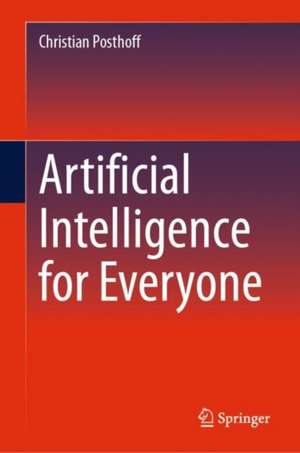
Artificial Intelligence for Everyone
Autor Christian Posthoffen Limba Engleză Hardback – 22 iun 2024
Preț: 632.97 lei
Preț vechi: 781.44 lei
-19%
Puncte Express: 949
Carte tipărită la comandă
Livrare economică 15-21 decembrie
Livrare prin curier în România Termenul estimat este afișat lângă disponibilitate.
Transport gratuit pentru acest produs Plată online sau ramburs, în funcție de opțiunile comenzii.
Retur gratuit în 14 zile Comandă securizată și suport în română.
Specificații
ISBN-13: 9783031572074
ISBN-10: 3031572076
Pagini: 236
Ilustrații: XV, 219 p. 90 illus., 56 illus. in color.
Dimensiuni: 160 x 241 x 19 mm
Greutate: 0.47 kg
Ediția:2024
Editura: Springer
Locul publicării:Cham, Switzerland
ISBN-10: 3031572076
Pagini: 236
Ilustrații: XV, 219 p. 90 illus., 56 illus. in color.
Dimensiuni: 160 x 241 x 19 mm
Greutate: 0.47 kg
Ediția:2024
Editura: Springer
Locul publicării:Cham, Switzerland
V-ar putea interesa
-
 Using Artificial Intelligence Absolute Beginner's GuideMichael Miller-20%Preț: 202.89 lei253.60 lei
-
 How To Think About AI: A Guide For The PerplexedRichard Susskind-20%Preț: 67.11 lei83.88 lei
-
 Artificial IntelligenceMelanie Mitchell-34%Preț: 56.50 lei85.04 lei
-
 Preț: 96.03 leiRecomandat
-
 If Anyone Builds It, Everyone DiesEliezer Yudkowsky-20%Preț: 130.20 lei162.75 lei
-
 Welcome to AIMatthieu Dugal-16%Preț: 92.10 lei109.90 lei
-
 Artificial IntelligenceMichael Wooldridge-35%Preț: 49.08 lei75.72 lei
-
 Preț: 122.72 lei
-
 Artificial Intelligence For DummiesJohn Paul MuellerPreț: 165.96 lei
-
 The Essential Book of AIAnne Rooney-20%Preț: 76.61 lei95.77 lei
-
 Artificial Intelligence - 10 Things You Should Know: 10 Things You Should KnowProfessor Tim Rocktäschel-26%Preț: 68.90 lei93.03 lei
-
 -41%Preț: 58.72 lei99.07 lei
-
 -42%Preț: 79.28 lei136.00 lei
-
 -27%Preț: 56.93 lei77.82 lei
-
 Artificial Intelligence in Byte-sized ChunksPeter J. Bentley-26%Preț: 53.21 lei72.02 lei
-
 How to Make AI UsefulMagnus ReinerPreț: 78.62 lei
-
 Get Ready for A.I.Barnas MonteithPreț: 78.00 lei
-
 AI for the Rest of Us: An Illustrated IntroductionSairam Sundaresan-44%Preț: 82.87 lei148.23 lei
Cuprins
Introduction.- How to define intelligence.- The Historical Development.- Mathematics on the Computer.- Polynomial and Exponential Complexity.- Game Theory Cybernetics and Information Theory.- Machine Learning and Neural Networks.- Other Applications.- Digitization.- Image processing.- Robotics.- Artificial Intelligence in Finance.- Artificial Intelligence and Education.- Artificial Intelligence in the Arts.- Artificial Intelligence in Law.- The Development in South and Central America and the Caribbean.- Future Developments.
Notă biografică
Bernd Steinbach studied Information Technology at the University of Technology in Chemnitz (Germany) and graduated with an M.Sc. in 1973. He graduated with a Ph.D. and with a Dr. sc. techn. (Doctor scientiae technicarum) for his second doctoral thesis from the Faculty of Electrical Engineering of the Chemnitz University of Technology in 1981 and 1984, respectively. In 1991 he obtained the Habilitation (Dr.-Ing. habil.) from the same Faculty. Topics of his theses involved Boolean equations, Boolean differential equations, and their application in the field of circuit design using efficient algorithms and data structures on computers.
He was working in industry as an Electrician, there he tested professional controlling systems at the Niles Company. After finishing his studies, he taught as Assistant Lecturer at the Department of Information Technology of the Chemnitz University of Technology. In a following period of industrial occupation as a research engineer he developed programs for test pattern generation for computer circuits at the company ROBOTRON. Thereafter he returned to the Department of Information Technology of the Chemnitz University of Technology as Associate Professor for design automation in logic design.
From 1992 to 2017 he was a Full Professor of Computer Science / Software Engineering and Programming at the Freiberg University of Mining and Technology, Department of Computer Science. He served as Head of the Department of Computer Science and Vice-Dean of the Faculty of Mathematics and Computer Science. His research areas include logic functions and equations and their application in many fields, such as Artificial Intelligence, UML - based testing of software, UML - based hardware / software co-design, and extremely complex problems. He is the head of a group that developed the XBOOLE software system. He is co-author and editor of 19 books. He published more than 280 chapters in books, complete issuesof journals, and papers in journals and proceedings.
He has served as Program Chairman for the IEEE International Symposium on Multiple-Valued Logic (ISMVL), and as guest editor of the Journal of Multiple-Valued Logic and Soft Computing. He is the initiator and was the general chair of the first 12 workshops of a biennial series of International Workshops on Boolean Problems (IWSBP), which started in 1994. He received the Barkhausen Award from the University of Technology Dresden in 1983.
Christian Posthoff studied Mathematics at the University of Leipzig. From 1968 to 1972, he worked as a programmer and in the field of Operations Research; simultaneously, he did his Ph.D. in 1975 with the thesis "Application of Mathematical Methods in Communicative Psychotherapy". In 1972, he began working at the Department of Information Technology at the Chemnitz University of Technology; up to 1983, his research activities concentrated on logic design. Important results have been algorithms and programs for solving Boolean equations with a high number of variables and the Boolean Differential Calculus (a generalized differential and integral calculus for Boolean rings) for the analytical treatment of different problems in the field of logic design. These results have been collected in a monograph "Binary Dynamic Systems", and allowed the habilitation (Dr.-Ing. habil.) at the Faculty of Electrical Engineering in 1979 and the promotion to Associate Professor. In 1983, he was promoted to Full Professor of Computer Science in the Department of Computer Science at the same university, and since 1984, he was Head of the Institute of Theoretical Computer Science and Artificial Intelligence and Research Director of the Department of Computer Science. His research activities included the application of fuzzy logics for the modeling of human-like "thinking" methods, learning from examples, the construction of intelligent tutoring systems, the parallelization of inference mechan
Textul de pe ultima copertă
This book demystifies the topic of Artificial Intelligence for readers of varying backgrounds. The content should enable many people to discuss and follow ongoing developments in an informed way, to draw conclusions for their own life and workplace and to acquire the necessary new knowledge. The book strives to provide basic knowledge that will objectify the discussions and relieve some of the creepiness of utopian films. It must also be understood that research results are a necessary condition for progress; they are not sufficient until they can be translated into practice embedded in programs. This difficult relationship between theory and practice has been known for a long time.
- Offers a concise introduction to Artificial Intelligence (AI), accessible to readers of varying backgrounds;
- Discusses the development of AI in an historical context;
- Describes various, current applications of AI, their development and use cases.