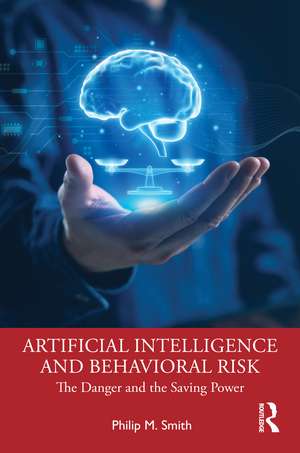
Artificial Intelligence and Behavioral Risk: The Danger and the Saving Power
Autor Philip M. Smithen Limba Engleză Paperback – 18 dec 2026
Preț: 323.31 lei
Preț vechi: 461.78 lei
-30% Precomandă
Puncte Express: 485
Carte nepublicată încă
Livrare prin curier în România Precomanda se expediază când titlul devine disponibil.
Transport gratuit de la 400.00 lei Plată online sau ramburs, în funcție de opțiunile comenzii.
Retur gratuit în 14 zile Comandă securizată și suport în română.
Doresc să fiu notificat când acest titlu va fi disponibil:
Se trimite...
Specificații
ISBN-13: 9781041330417
ISBN-10: 1041330413
Pagini: 248
Ilustrații: 8
Dimensiuni: 156 x 234 mm
Ediția:1
Editura: Taylor & Francis
Colecția Routledge
Locul publicării:Oxford, United Kingdom
ISBN-10: 1041330413
Pagini: 248
Ilustrații: 8
Dimensiuni: 156 x 234 mm
Ediția:1
Editura: Taylor & Francis
Colecția Routledge
Locul publicării:Oxford, United Kingdom
Public țintă
PostgraduateCuprins
Chapter 1. Behavioural Risk: Habitat and Dynamics. Chapter 2. Artificial Intelligence and Brand Human: The Challenges of the AI Enterprise. Chapter 3. AI and the Individual: Virtual 'I'; Virtual 'Me'. Chapter 4. AI and Interpersonal Interaction: Virtual You, Virtual Me. Chapter 5. AI and Social Groups: Virtual We. Chapter 6. AI and Formal Organisations: Virtual Us. Chapter 7. AI and Society: Virtually Everyone. Chapter 8. Synthesis, Summary and Conjecture.
Notă biografică
Philip M. Smith is an Organisation and Business Psychology consultant to large global organisations who has held faculty appointments at the London School of Economics, the University of Bristol, the University of British Columbia, Cranfield School of Management and Hong Kong University School of Professional and Continuing Education. A founding member of the Human Factors Group of the Royal Aeronautical Society, he has worked with safety critical and regulated industries on leadership development and the mitigation of behavioural risk for more than 30 years.
Descriere
This book provides a systematic framework for examining how AI challenges human thought, feeling, and behavior. It explores eight critical psychological themes, cognition, identity, emotion, skill, influence, privacy, ethics, and trust, revealing how vulnerabilities manifest across individual, interpersonal, group, and organizational levels.