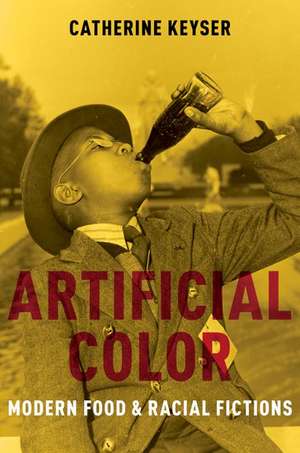
Artificial Color: Modern Food and Racial Fictions
Autor Catherine Keyseren Limba Engleză Paperback – 9 noi 2021
Preț: 172.35 lei
Preț vechi: 219.41 lei
-21%
Puncte Express: 259
Carte disponibilă
Livrare economică 12-18 noiembrie
Livrare prin curier în România Termenul estimat este afișat lângă disponibilitate.
Transport gratuit de la 400.00 lei Plată online sau ramburs, în funcție de opțiunile comenzii.
Retur gratuit în 14 zile Comandă securizată și suport în română.
Specificații
ISBN-13: 9780197620182
ISBN-10: 0197620183
Pagini: 232
Ilustrații: 6 black-and-white halftones
Dimensiuni: 244 x 157 x 15 mm
Greutate: 0.34 kg
Editura: Oxford University Press
Colecția OUP USA
Locul publicării:New York, United States
ISBN-10: 0197620183
Pagini: 232
Ilustrații: 6 black-and-white halftones
Dimensiuni: 244 x 157 x 15 mm
Greutate: 0.34 kg
Editura: Oxford University Press
Colecția OUP USA
Locul publicării:New York, United States
Recenzii
In Artificial Color, Catherine Keyser makes visible how race is constructed in American literature in the first half of the twentieth century through references to and depictions of food. Keyser's reading of well- and lesser known-as well as unpublished-texts is precise, engaging, and ultimately very satisfying.
This sophisticated, incisive book explores literature's capacity to imagine what might be, while detailing the intertwined histories of food and race that determined what was
In Artificial Color everything is interconnected. The ecosystems which produce food and the commercial systems which distribute it are political. The politics of race, class, and culture are inextricably connected to the systems in which they operate. ... Throughout Artificial Color, Keyser maintains our focus on each of these interconnected but complex strands of thought: cultural production and food production are never too far apart.
Catherine Keyser is a leading scholar of American literature and critical food studies. Traversing nutrition science, product advertising, industrial design, culinary tourism, and a broad archive of experimental and popular writing, Artificial Color tells a new story about race and modernity that is theoretically innovative and beautifully written.
Keyser demonstrates superb command of relevant scholarship from food and modernist literary studies, and she offers it with a light, deft touch so that it enhances her arguments without overwhelming them or leaving the reader buried in jargon. More importantly, her wonderful archival research and careful attention to subtle textual detail result in truly original readings of alimentary representations in the work of a diverse set of Lost Generation and Harlem Renaissance writers and texts.
This is a timely and important project. Dr. Keyser's project has a solid thesis, the readings are engaging, and the chapters are meticulously researched. I recommend this book for food studies historians, literary critics, and anyone working on twentieth-century US literature.
In Artificial Color, Catherine Keyser has produced a book that will quickly become a pivotal text in critical eating studies. It makes clear how an understanding of the alimentary intimacies in writings by Fitzgerald, Toomer, Schuyler, Stein, Hurston, West, and Hemingway oblige us to think about food's racial embodiment. With its elegant readings of modern US narrative literature on both sides of the color line, Keyser asks us to think about how food can be an imaginative vehicle for racial transformations. This isn't simply a book about eating but about how a practice of reading that centers food can go a long way in talking about mutability of the body in its gendered and racialized forms.
This sophisticated, incisive book explores literature's capacity to imagine what might be, while detailing the intertwined histories of food and race that determined what was
In Artificial Color everything is interconnected. The ecosystems which produce food and the commercial systems which distribute it are political. The politics of race, class, and culture are inextricably connected to the systems in which they operate. ... Throughout Artificial Color, Keyser maintains our focus on each of these interconnected but complex strands of thought: cultural production and food production are never too far apart.
Catherine Keyser is a leading scholar of American literature and critical food studies. Traversing nutrition science, product advertising, industrial design, culinary tourism, and a broad archive of experimental and popular writing, Artificial Color tells a new story about race and modernity that is theoretically innovative and beautifully written.
Keyser demonstrates superb command of relevant scholarship from food and modernist literary studies, and she offers it with a light, deft touch so that it enhances her arguments without overwhelming them or leaving the reader buried in jargon. More importantly, her wonderful archival research and careful attention to subtle textual detail result in truly original readings of alimentary representations in the work of a diverse set of Lost Generation and Harlem Renaissance writers and texts.
This is a timely and important project. Dr. Keyser's project has a solid thesis, the readings are engaging, and the chapters are meticulously researched. I recommend this book for food studies historians, literary critics, and anyone working on twentieth-century US literature.
In Artificial Color, Catherine Keyser has produced a book that will quickly become a pivotal text in critical eating studies. It makes clear how an understanding of the alimentary intimacies in writings by Fitzgerald, Toomer, Schuyler, Stein, Hurston, West, and Hemingway oblige us to think about food's racial embodiment. With its elegant readings of modern US narrative literature on both sides of the color line, Keyser asks us to think about how food can be an imaginative vehicle for racial transformations. This isn't simply a book about eating but about how a practice of reading that centers food can go a long way in talking about mutability of the body in its gendered and racialized forms.
Notă biografică
Catherine Keyser is Professor of English at the University of South Carolina and the author of Playing Smart: New York Women Writers and Modern Magazine Culture (Rutgers University Press 2010).
Cuprins
- Acknowledgments
- Introduction
- Chapter 1: "Purple Fluid, Carbon-Charged": Jean Toomer's Mutable Materials
- Chapter 2: Genius in the Raw: The Schuyler Family and the Modern Mulatta
- Chapter 3: Eating Like a Local: Stein, Hemingway, and the Stakes of Terroir
- Chapter 4: "A Beaker Full of the Warm South": The Fitzgeralds and Mediterranean Infusions
- Chapter 5: The Monstropolous Beast: Animacy and Industry in Zora Neale Hurston and Dorothy West
- Notes
- Index