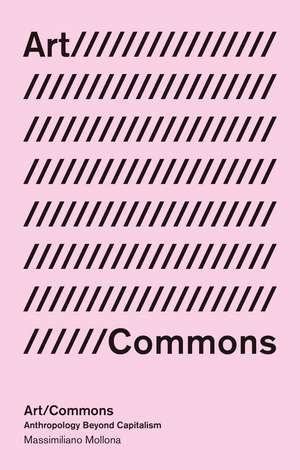
Art/Commons: Anthropology beyond Capitalism: In Common
Autor Massimiliano Mollonaen Limba Engleză Hardback – 20 mai 2021





Preț: 502.91 lei
Preț vechi: 565.07 lei
-11%
Puncte Express: 754
Carte tipărită la comandă
Livrare economică 21 noiembrie-05 decembrie
Livrare prin curier în România Termenul estimat este afișat lângă disponibilitate.
Transport gratuit pentru acest produs Plată online sau ramburs, în funcție de opțiunile comenzii.
Retur gratuit în 14 zile Comandă securizată și suport în română.
Specificații
ISBN-13: 9781786996985
ISBN-10: 1786996987
Pagini: 208
Dimensiuni: 138 x 216 x 19 mm
Greutate: 0.39 kg
Editura: Bloomsbury Publishing
Colecția Zed Books
Seria In Common
Locul publicării:London, United Kingdom
ISBN-10: 1786996987
Pagini: 208
Dimensiuni: 138 x 216 x 19 mm
Greutate: 0.39 kg
Editura: Bloomsbury Publishing
Colecția Zed Books
Seria In Common
Locul publicării:London, United Kingdom
V-ar putea interesa
-
 Curating the Commons: Socially Engaged Public ArtKatia ArfaraPreț: 342.10 lei
 -
 Feminism. Art. Capitalism.Angela DimitrakakiPreț: 189.50 lei
 -
 Preț: 136.49 lei
 -
 The One and the ManyGrant H KesterPreț: 268.59 lei
 -
 Contemporary Art in the Conflicts of GlobalizationJonathan HarrisPreț: 386.45 lei
 -
 Preț: 187.13 lei
 -
 Art, Labour, Text and Radical CareAdam WalkerPreț: 413.54 lei
 -
 Preț: 123.74 lei
 -
 Commons and Public Partnership: Legitimizing a Commons Political SphereDr Torange Khonsari-33%Preț: 552.38 lei820.12 lei
 -
 Art and the Critical Medical HumanitiesFiona Johnstone-32%Preț: 557.83 lei823.45 lei
 -
 A Studious Use: Designing From The UndercommonsGiovanni Marmont-19%Preț: 135.19 lei166.13 lei
 -
 -19%Preț: 126.02 lei155.73 lei
 -
 -19%Preț: 176.58 lei217.67 lei
 -
 Preț: 173.29 lei
 -
 Towards the Ethical Art MuseumGareth HarrisPreț: 161.52 lei
 -
 Climate Action in the Art World: Towards a Greener FutureAnnabel Keenan-23%Preț: 186.62 lei243.19 lei
 -
 The Social Organization of Arts: A Theoretical CompendiumVolker KirchbergPreț: 364.32 lei
 -
 NocturnalitiesAgata Bar-16%Preț: 152.49 lei181.87 lei
 -
 Labour and Privilege | Future CommonsMelissa Karmen LeePreț: 401.38 lei
Cuprins
Introduction
Part I: Anthropology, Art and Political Economy
1. The Allure of Abstraction
2. Labour, Art and Slavery
3. Art and Commoning: A Short History
Part II: Projects
4. Participatory Films
5. Curatorial Projects
6. Institute of Radical Imagination
Conclusion
Part I: Anthropology, Art and Political Economy
1. The Allure of Abstraction
2. Labour, Art and Slavery
3. Art and Commoning: A Short History
Part II: Projects
4. Participatory Films
5. Curatorial Projects
6. Institute of Radical Imagination
Conclusion
Recenzii
Mollona is our absolutely singular guide through the interwoven fields of critical theory, global activism and contemporary art as it has turned away from capitalist markets and towards hosting new forms of cooperation, care and community. Unlike so many recent texts in art and theory which offer us slogans and platitudes, Mollona's book invites us to think deeply, carefully and with conviction about the commons from a diverse, worldly and intersectional perspective. It demands we recognize the imagination as a common power that can destroy systems of domination and create worlds of solidarity and freedom.
With intellectual intensity and ethical commitment, Mollona tackles the question of how artistic practices oriented to the common can counter the abstractions of capitalist aesthetics, Moving seamlessly from critical theories of aesthetics and capital to contemporary experiments in art collectivity and communing, Art/commons provides an anti-colonial, antiracist manifesto for an expanded understanding of art as the multiple ways in which creating together cultivates new habits of affect, new relays of energy, and alternative modes of mutual embodiment far removed from the gallery, museum, and cinema.
Art/Commons deftly takes Anthropology out of your comfort zone when it foregrounds racial critique in a reflection on what has been named its object's, that is, the Human's, unique capacities, namely productivity (economic) and creativity (aesthetic). It is a must read for anyone interested in exploring the ethico-political possibilities that open when art guides the critique of capital.
With intellectual intensity and ethical commitment, Mollona tackles the question of how artistic practices oriented to the common can counter the abstractions of capitalist aesthetics, Moving seamlessly from critical theories of aesthetics and capital to contemporary experiments in art collectivity and communing, Art/commons provides an anti-colonial, antiracist manifesto for an expanded understanding of art as the multiple ways in which creating together cultivates new habits of affect, new relays of energy, and alternative modes of mutual embodiment far removed from the gallery, museum, and cinema.
Art/Commons deftly takes Anthropology out of your comfort zone when it foregrounds racial critique in a reflection on what has been named its object's, that is, the Human's, unique capacities, namely productivity (economic) and creativity (aesthetic). It is a must read for anyone interested in exploring the ethico-political possibilities that open when art guides the critique of capital.