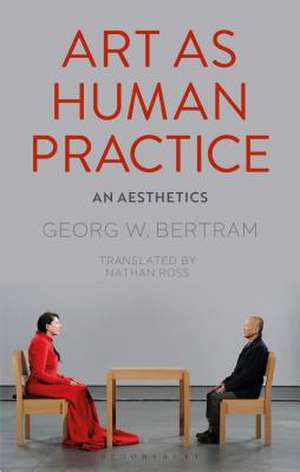
Art as Human Practice: An Aesthetics
Autor Georg W. Bertram Traducere de Nathan Rossen Limba Engleză Hardback – 10 ian 2019
Preț: 536.69 lei
Preț vechi: 768.36 lei
-30%
Puncte Express: 805
Carte tipărită la comandă
Livrare economică 16-30 noiembrie
Livrare prin curier în România Termenul estimat este afișat lângă disponibilitate.
Transport gratuit pentru acest produs Plată online sau ramburs, în funcție de opțiunile comenzii.
Retur gratuit în 14 zile Comandă securizată și suport în română.
Specificații
ISBN-13: 9781350063143
ISBN-10: 1350063142
Pagini: 256
Dimensiuni: 138 x 216 mm
Greutate: 0.45 kg
Editura: Bloomsbury Publishing
Colecția Bloomsbury Academic
Locul publicării:London, United Kingdom
ISBN-10: 1350063142
Pagini: 256
Dimensiuni: 138 x 216 mm
Greutate: 0.45 kg
Editura: Bloomsbury Publishing
Colecția Bloomsbury Academic
Locul publicării:London, United Kingdom
Cuprins
Introduction
Chapter 1: A Critique of the Autonomy Paradigm
Chapter 2: From Kant to Hegel and Beyond
Chapter 3: Autonomy as Self-Referential Constitution: Art as Practical Reflection
Chapter 4: Art as Practice of Freedom
Bibliography
Index
Chapter 1: A Critique of the Autonomy Paradigm
Chapter 2: From Kant to Hegel and Beyond
Chapter 3: Autonomy as Self-Referential Constitution: Art as Practical Reflection
Chapter 4: Art as Practice of Freedom
Bibliography
Index
Recenzii
[This] book builds an important bridge between contemporary Continental and Anglo-American philosophy of art, as Bertram rather seamlessly discusses figures who rarely meet under the same cover . [It] should provoke thoughtful discussion on whether and/or to what extent art should be viewed in a less object-centered manner, as a reflective practice.
In his groundbreaking new book, Georg Bertram argues that human beings turn to artistic meaning-making precisely when they are foundering in practice or confused about how to find coherence and value in their practical lives--a recurring phenomenon within the disruptions of modernity. Audiences of artworks in turn participate imaginatively in the work's sensuous-formal exploration of new possibilities of sense. In this way, Bertram shows how art is neither a matter of entertainment alone nor theoretical insight alone, but instead urgently and intimately part of the ongoing, reciprocal self-constitution of subjects as bearers of stances within and on practices. There is no better account than this of how and why art matters.
In his groundbreaking new book, Georg Bertram argues that human beings turn to artistic meaning-making precisely when they are foundering in practice or confused about how to find coherence and value in their practical lives--a recurring phenomenon within the disruptions of modernity. Audiences of artworks in turn participate imaginatively in the work's sensuous-formal exploration of new possibilities of sense. In this way, Bertram shows how art is neither a matter of entertainment alone nor theoretical insight alone, but instead urgently and intimately part of the ongoing, reciprocal self-constitution of subjects as bearers of stances within and on practices. There is no better account than this of how and why art matters.