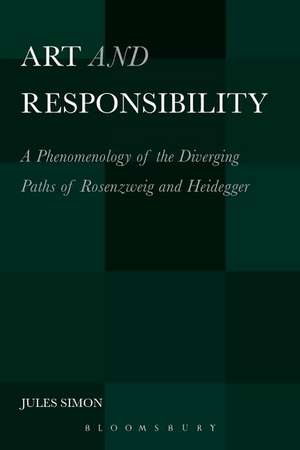
Art and Responsibility: A Phenomenology of the Diverging Paths of Rosenzweig and Heidegger
Autor Professor Jules Simonen Limba Engleză Paperback – 29 oct 2012
Preț: 279.55 lei
Puncte Express: 419
Carte tipărită la comandă
Livrare economică 02-16 decembrie
Livrare prin curier în România Termenul estimat este afișat lângă disponibilitate.
Transport gratuit de la 400.00 lei Plată online sau ramburs, în funcție de opțiunile comenzii.
Retur gratuit în 14 zile Comandă securizată și suport în română.
Specificații
ISBN-13: 9781441107848
ISBN-10: 1441107843
Pagini: 304
Dimensiuni: 156 x 234 x 16 mm
Greutate: 0.43 kg
Editura: Bloomsbury Publishing
Colecția Bloomsbury Academic
Locul publicării:New York, United States
ISBN-10: 1441107843
Pagini: 304
Dimensiuni: 156 x 234 x 16 mm
Greutate: 0.43 kg
Editura: Bloomsbury Publishing
Colecția Bloomsbury Academic
Locul publicării:New York, United States
V-ar putea interesa
-
 Existentialism: A Very Short IntroductionThomas Flynn-20%Preț: 57.20 lei71.12 lei
 -
 -15%Preț: 63.83 lei75.08 lei
 -
 The Measure of Things: Humanism, Humility, and MysteryDavid E. Cooper-11%Preț: 364.12 lei408.17 lei
 -
 -28%Preț: 397.35 lei550.45 lei
 -
 Phenomenology and Philosophy of MindDavid Woodruff Smith-28%Preț: 394.33 lei548.70 lei
 -
 Jean-Paul Sartre: Basic WritingsStephen PriestPreț: 319.09 lei
 -
 Maurice Merleau-Ponty: Basic WritingsThomas BaldwinPreț: 379.76 lei
 -
 Body Images: Embodiment as IntercorporealityGail WeissPreț: 409.25 lei
 -
 PathmarksMartin HeideggerPreț: 214.93 lei
 -
 Heidegger Being and TimePaul GornerPreț: 360.83 lei
 -
 Introduction to PhenomenologyRobert SokolowskiPreț: 195.48 lei
 -
 Not SavedPeter SloterdijkPreț: 238.71 lei
 -
 The Deleuze and Guattari DictionaryEugene B. Young-15%Preț: 200.69 lei236.96 lei
 -
 Statues: The Second Book of FoundationsProfessor Michel Serres-41%Preț: 267.41 lei456.73 lei
 -
 The Bloomsbury Companion to ExistentialismDr Felicity Joseph-24%Preț: 285.36 lei373.25 lei
 -
 Existentialism: All That MattersDavid Cerbone-7%Preț: 65.31 lei70.25 lei
 -
 Toward an Existential Philosophy of the SoulRichard SchainPreț: 80.30 lei
 -
 Between Existentialism and MarxismJean-Paul SartrePreț: 223.22 lei
Cuprins
Introduction
1. The Mask of Mephistopheles
2. Renewing Narrations or Chaos in Creation
3. Rosenzweig's Midrash as Philosophy of Language
4. The Messianic Aesthetic
5. Heidegger's Hammer: from the Workshop to the Work of Art
6. Turning through Phenomenology to Art and Ethos
7. Philosophy, Poetry, and the Absent God:
Final Words
Bibliography
1. The Mask of Mephistopheles
2. Renewing Narrations or Chaos in Creation
3. Rosenzweig's Midrash as Philosophy of Language
4. The Messianic Aesthetic
5. Heidegger's Hammer: from the Workshop to the Work of Art
6. Turning through Phenomenology to Art and Ethos
7. Philosophy, Poetry, and the Absent God:
Final Words
Bibliography
Recenzii
"Art and Responsibility is a sophisticated exploration of the ethical implications of the aesthetic and the aesthetic implications of the ethical. Simon explores this topic through a phenomenological investigation of the thought of Heidegger and Rosenzweig. Instead of producing an intellectual history of these thinkers, the author seeks to elicit the ethical repercussions of their philosophies of art through careful philological-textual analysis of their dense writings. The juxtaposition of these two seminal German thinkers has engendered a fascinating study that undoubtedly will provoke lively discussion and debate in the years to come." --Elliot R. Wolfson, Abraham Lieberman Professor of Hebrew and Judaic Studies, New York University, USA