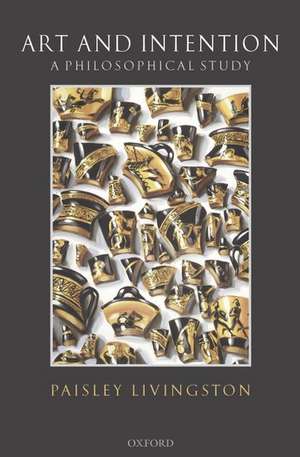
Art and Intention: A Philosophical Study
Autor Paisley Livingstonen Limba Engleză Hardback – 17 feb 2005
Preț: 741.76 lei
Preț vechi: 1101.16 lei
-33%
Puncte Express: 1113
Carte tipărită la comandă
Livrare economică 26 noiembrie-02 decembrie
Livrare prin curier în România Termenul estimat este afișat lângă disponibilitate.
Transport gratuit pentru acest produs Plată online sau ramburs, în funcție de opțiunile comenzii.
Retur gratuit în 14 zile Comandă securizată și suport în română.
Specificații
ISBN-13: 9780199278060
ISBN-10: 0199278067
Pagini: 272
Ilustrații: 2 halftones
Dimensiuni: 162 x 241 x 21 mm
Greutate: 0.56 kg
Editura: OUP OXFORD
Colecția OUP Oxford
Locul publicării:Oxford, United Kingdom
ISBN-10: 0199278067
Pagini: 272
Ilustrații: 2 halftones
Dimensiuni: 162 x 241 x 21 mm
Greutate: 0.56 kg
Editura: OUP OXFORD
Colecția OUP Oxford
Locul publicării:Oxford, United Kingdom
V-ar putea interesa
-
 Art Theory: A Very Short IntroductionCynthia Freeland-19%Preț: 57.62 lei71.42 lei
 -
 But Is It Art?: An Introduction to Art TheoryCynthia Freeland-19%Preț: 87.56 lei107.54 lei
 -
 Art Is: A Journey into the LightMakoto FujimuraPreț: 186.81 lei
 -
 Reclaiming Art in the Age of ArtificeJ. F. Martel-27%Preț: 97.88 lei133.93 lei
 -
 The Art QuestionNigel WarburtonPreț: 239.21 lei
 -
 How Painting Happens (and why it matters)Martin Gayford-19%Preț: 228.14 lei279.96 lei
 -
 Art in Theory 1900-2000 - An Anthology of Changing Ideas 2eCharles HarrisonPreț: 315.57 lei
 -
 IntentionGertrude E. M. AnscombePreț: 227.66 lei
 -
 The Dehumanization of Art and Other Essays on Art, Culture, and LiteratureJosé Ortega Y. GassetPreț: 90.47 lei
 -
 Wabi-Sabi for Artists, Designers, Poets & PhilosophersLeonard KorenPreț: 107.77 lei
 -
 -9%Preț: 1328.29 lei1459.66 lei
 -
 Preț: 384.83 leiRecomandat
 -
 -14%Preț: 147.85 lei172.73 lei
 -
 How To Live An Artful LifeKaty HesselPreț: 126.12 lei
 -
 -24%Preț: 332.79 lei439.44 lei
 -
 More Joy of Art: Keys to Appreciating ArtCarolyn Schlam-17%Preț: 233.04 lei281.26 lei
 -
 -14%Preț: 117.53 lei136.17 lei
 -
 Towards the Ethical Art MuseumGareth HarrisPreț: 161.52 lei
 -
 What Is Art For?Ben LukePreț: 255.71 lei
 -
 A New Approach to the ArtsPeter Moore-15%Preț: 674.62 lei793.67 lei
Recenzii
Richly informed, crisply written, and thoughtfully argued, Art and Intention makes a strong case for the role that intentions play and ought to be considered to play in producing and appreciating works of art. Intentions, in the author's highly plausibly understanding of them, are not always conscious or successfully realized; nor does he think that we can expect to appreciate a work's meanings in every case simply by understanding the artist's intentions. But there are also ample reasons for thinking that we will often fail to understand the individual or collective production of a work of art, its difference from texts and relation to other works in a single oeuvre, a proper interpretation of it, and, in some cases, its fictional status if we fail to pay attention to the relevant intentions. Livingston elegantly marshals these reasons in what is bound to be a major resource for philosophical thinking on the subject of intentions in art.