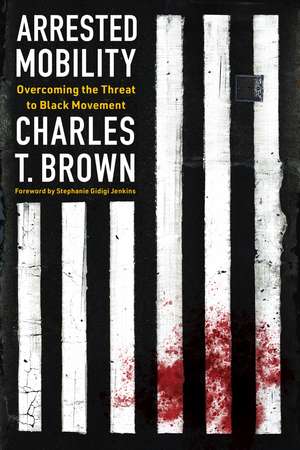
Arrested Mobility
Autor Charles T Brownen Limba Engleză Paperback – 15 mai 2025
In Arrested Mobility: Overcoming the Threat to Black Movement, Charles T. Brown, founder and CEO of Equitable Cities, examines why mobility is not afforded in the same way to everyone. He argues that the legacy of structural racism and White supremacy has led to disinvestment and over-policing in Black communities and communities of color, thwarting opportunity, as physical mobility and social mobility are intrinsically linked. This experience for Black people around the world is what Brown refers to as arrested mobility.
Mobility embodies freedom and allows people, places, and cities to thrive. In the US, freedom—synonymous with national identity—is so often represented by acts of movement such as walking, cycling, driving a car or traveling to a different city. However, for Black Americans, exercising freedom of mobility continues to mean confronting the harsh reality of White fear, fragility, and violence.
Understanding the causes of arrested mobility, will help us to develop solutions to increase mobility for Black people and other marginalized groups, Brown explains. The conditions society has created have their roots in what Brown calls “The Four Ps”: Polity, Policy, Planning, and Policing. He examines the four P’s, drawing from research, his own experience and the experience of other Black Americans. Brown then suggests solutions, some of which are already being implemented in the US.
In Arrested Mobility, Brown shows how un-arresting mobility creates an opportunity not just for a better society for Black people, but for all people. Arrested mobility is detrimental to our society as a whole, not just the people it directly harms. By not providing equitable access to jobs, community resources, and public spaces, we are limiting the potential of a large percentage of our population to participate and contribute to society. Change is possible. We can un-arrest mobility together. Charles T. Brown shows us how.
Preț: 177.93 lei
Puncte Express: 267
Preț estimativ în valută:
31.45€ • 36.82$ • 27.47£
31.45€ • 36.82$ • 27.47£
Carte disponibilă
Livrare economică 13-27 februarie
Livrare express 29 ianuarie-04 februarie pentru 76.48 lei
Specificații
ISBN-13: 9781642833515
ISBN-10: 1642833517
Pagini: 200
Ilustrații: Black-and-white images.
Dimensiuni: 150 x 226 x 15 mm
Greutate: 0.27 kg
Editura: Island Press
ISBN-10: 1642833517
Pagini: 200
Ilustrații: Black-and-white images.
Dimensiuni: 150 x 226 x 15 mm
Greutate: 0.27 kg
Editura: Island Press
V-ar putea interesa
-
 AMERICA ON FIRE PBElizabeth HintonPreț: 77.22 lei
 -
 They Can't Kill Us All: The Story of Black Lives MatterWesley Lowery-21%Preț: 54.11 lei68.28 lei
 -
 Black in White SpaceElijah AndersonPreț: 101.24 lei
 -
 The Colour of InjusticeLee Lawrence-27%Preț: 111.08 lei152.27 lei
 -
 Policing the Black ManAngela J DavisPreț: 92.90 lei
 -
 Race to the Bottom: Reclaiming AntiracismAzfar ShafiPreț: 73.35 lei
 -
 I Can't BreatheMatt Taibbi-20%Preț: 55.11 lei68.88 lei
 -
 White Space, Black HoodSheryll CashinPreț: 106.19 lei
 -
 Planning White Supremacy: Civil Rights and City Planning in Montgomery, Alabama, 1920–1970Rebecca Coleen RetzlaffPreț: 258.81 lei
 -
 Canfield Drive: A History of Race and the American City on a Street in St. LouisMatthew Knox AverettPreț: 340.95 lei
 -
 The Black AgendaAnna Gifty Opoku-AgyemanPreț: 147.34 lei
 -
 The Anti-Black CityJaime Amparo AlvesPreț: 177.24 lei
 -
 Reclaiming the RoadDavid L PrytherchPreț: 176.62 lei
 -
 Who Do You Serve, Who Do You Protect?Maya SchenwarPreț: 94.83 lei
 -
 Policing White SupremacyMike GermanPreț: 162.45 lei
 -
 From #Blacklivesmatter to Black Liberation (Expanded Second Edition)Keeanga-Yamahtta TaylorPreț: 108.74 lei
 -
 Cars and JailsAndrew RossPreț: 92.30 lei
 -
 Preț: 74.55 lei
 -
 Moving Blackness: Black Circulation, Racism, and Relations of HomespaceLisa B. Y. CalventePreț: 167.29 lei
Notă biografică
Charles T. Brown is the founder and CEO of Equitable Cities, a minority- and veteran-owned urban planning, public policy, and research firm focused on the intersection of transportation, health, and equity. He is a military veteran, creator and host of the Arrested Mobility podcast and an adjunct professor at the Edward J. Bloustein School of Planning and Public Policy at Rutgers University.
Cuprins
Foreword by Stephanie Gidigbi Jenkins
Preface
Acknowledgments
Introduction
Chapter 1: How Arrested Mobility Is Created Through Polity and Policy
Chapter 2: The Urban Planning Strategies That Have Shaped Our Communities
Chapter 3: Policing: The Means by Which Unequal Systems Are Reinforced
Chapter 4: Un-Arresting Mobility: What It Will Take to Solve Inequity in Mobility
Chapter 5: Arrested Mobility Solutions in Action
Conclusion: Breaking the Silence
Notes
Bibliography
About the Author
Preface
Acknowledgments
Introduction
Chapter 1: How Arrested Mobility Is Created Through Polity and Policy
Chapter 2: The Urban Planning Strategies That Have Shaped Our Communities
Chapter 3: Policing: The Means by Which Unequal Systems Are Reinforced
Chapter 4: Un-Arresting Mobility: What It Will Take to Solve Inequity in Mobility
Chapter 5: Arrested Mobility Solutions in Action
Conclusion: Breaking the Silence
Notes
Bibliography
About the Author
Recenzii
“Arrested Mobility reminds one of a bar from Goodie Mob’s ‘Cell Therapy’, ‘But every now and then, I wonder if the gate was put up to keep crime out — or keep our ass in.’ Brown’s book deftly gives language to a condition, a cancer he calls it, that Black folks in the United States have lived with since the 1600s — the control of Black mobility. Brown destroys all arguments that the violence, brutality and fear Black people experience while walking, running, biking, driving or riding public transit are isolated incidents, and reveals them as extensions of a gripping legacy and purposeful policy. Arrested Mobility is a must read for anyone looking to more deeply understand racial housing patterns, wealth curtailment, or the pervasiveness of segregation. In a world where the powerful are literally whitewashing history by banning any text that directly addresses the experience of others, Brown should prepare for his book to be banned, because the knowledge it contains, if heeded, could do serious damage to the cancer of arrested mobility and help change the country.”
“Charles T. Brown delivers a powerful and unflinching exploration of the impact of mobility on communities of color in the United States. This thought-provoking examination challenges the conventional belief that increased law enforcement automatically leads to enhanced safety, urging readers to confront the unexamined assumptions that underlie our perceptions of security.
Brown emphasizes that transportation is more than movement—it's life. He bravely addresses inequities woven into our legal and societal fabric while presenting concrete solutions that aim to dismantle these obstacles, fostering a future where everyone can experience the true gift of mobility.”
Brown emphasizes that transportation is more than movement—it's life. He bravely addresses inequities woven into our legal and societal fabric while presenting concrete solutions that aim to dismantle these obstacles, fostering a future where everyone can experience the true gift of mobility.”
“Charles Brown has shaped the national discourse over equity in transportation, the use of open space, and physical activity for cohorts of public health practitioners across the nation. Here, he brings together his insights on these issues to highlight the numerous ways that structural racism is woven into the fabric of the American landscape. Arrested mobility has profound impacts on the experiences of people of color and in particular, Black Americans. Brown helps us understand that only by dismantling the internal structures of thought that stigmatize and dehumanize Black lives, the structures of political power that perpetuate social and physical immobility, and the decades of decision making that have manifested a physical landscape that arrests Black mobility can true social, economic, and health justice be achieved.”
“How do we first recognize, then un-arrest the mobility of Black and other marginalized people as they move through communities, spaces and places? This timely, creative, and thoroughly engaging book offers workable policy and planning frameworks of mobility justice and racial justice to professionals, advocates, and others responsible for shaping our collective futures.”
“More than ever, this book is needed. A must read by people in power, as well as advocates, and anyone who cares about people and cities. Charles has experience and knowledge, explains clearly the problems, and provides solutions. Clearly, we can create equitable cities, but action like those he suggests must be implemented. Now.”
Descriere
In Arrested Mobility: Overcoming the Threat to Black Movement, Charles T. Brown, founder and CEO of Equitable Cities, examines why mobility is not afforded in the same way to everyone. He argues that the legacy of structural racism and White supremacy has led to disinvestment and over-policing in Black communities and communities of color, thwarting opportunity, as physical mobility and social mobility are intrinsically linked. This experience for Black people around the world is what Brown refers to as arrested mobility.
Brown examines this condition that society has created through what he calls “The Four Ps”: Polity, Policy, Planning, and Policing and suggests solutions, some of which are already being implemented in the US. Drawing from research, his own experience, and the experience of other Black Americans, Brown shows that change is possible and inspires and guides readers to un-arrest mobility together.
Brown examines this condition that society has created through what he calls “The Four Ps”: Polity, Policy, Planning, and Policing and suggests solutions, some of which are already being implemented in the US. Drawing from research, his own experience, and the experience of other Black Americans, Brown shows that change is possible and inspires and guides readers to un-arrest mobility together.