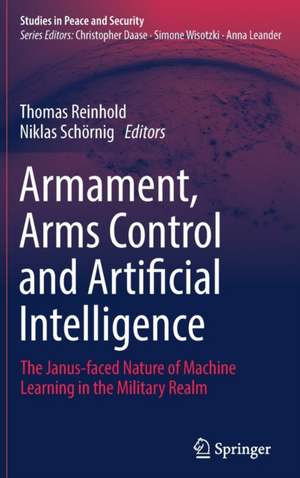
Armament, Arms Control and Artificial Intelligence: Studies in Peace and Security
Editat de Thomas Reinhold, Niklas Schörnigen Limba Engleză Hardback – 9 oct 2022
The significant increase in computing power, the increasing reliance on software, and the advent of (narrow) AI and deep-learning algorithms all have the potential to lead to disruptive changes for military operations and warfare, rendering many classical arms control instruments less effective, or even useless. On the other hand, AI might lead to completely new arms control approaches, raising the effectiveness and reliability of new verification measures. To provide a common understanding, the book starts by presenting a general introduction to the state of the art in artificial intelligence and arms control, and how the two topics are interrelated. The second part of the book looks at examples from various fields of weapon technology, including weapons of mass destruction (WMD), conventional armament, and emerging technologies. The final section offers a cross-cutting perspective based on the examples presented in the second part.
This volume will appeal to students and scholars of international relations, as well as policy-makers and practitioners interested in a better understanding of peace and security studies in general, and armament and arms control in particular with a strong focus on AI.
Preț: 711.39 lei
Preț vechi: 836.93 lei
-15%
Puncte Express: 1067
Carte tipărită la comandă
Livrare economică 20 noiembrie-04 decembrie
Livrare prin curier în România Termenul estimat este afișat lângă disponibilitate.
Transport gratuit pentru acest produs Plată online sau ramburs, în funcție de opțiunile comenzii.
Retur gratuit în 14 zile Comandă securizată și suport în română.
Specificații
ISBN-13: 9783031110429
ISBN-10: 3031110420
Pagini: 244
Ilustrații: XVII, 226 p. 1 illus.
Dimensiuni: 160 x 241 x 19 mm
Greutate: 0.52 kg
Ediția:1st ed. 2022
Editura: Springer
Colecția Studies in Peace and Security
Seria Studies in Peace and Security
Locul publicării:Cham, Switzerland
ISBN-10: 3031110420
Pagini: 244
Ilustrații: XVII, 226 p. 1 illus.
Dimensiuni: 160 x 241 x 19 mm
Greutate: 0.52 kg
Ediția:1st ed. 2022
Editura: Springer
Colecția Studies in Peace and Security
Seria Studies in Peace and Security
Locul publicării:Cham, Switzerland
V-ar putea interesa
-
 American GunChris KylePreț: 115.54 lei
 -
 Design for Six SigmaGreg BruePreț: 124.99 lei
 -
 SIPRI Yearbook 2001: Armaments, Disarmament and International SecurityStockholm International Peace Research Institute-32%Preț: 722.90 lei1061.54 lei
 -
 Webley Air PistolsGordon BrucePreț: 378.95 lei
 -
 The Illustrated World Encyclopedia of GunsWilliam FowlerPreț: 169.49 lei
 -
 Designing Small WeaponsJose Herrera-Ramirez-18%Preț: 925.10 lei1128.16 lei
 -
 Adventures in ArduinoBecky StewartPreț: 111.83 lei
 -
 Practical Gas Airsoft Pistols Upgrade & MaintenanceAirsoftpressPreț: 141.04 lei
 -
 Winchester Lever-Action RiflesMartin Pegler-27%Preț: 83.47 lei114.45 lei
 -
 Walther Pistols: PP, PPK and P 38John Walter-27%Preț: 78.80 lei107.51 lei
 -
 -18%Preț: 982.73 lei1198.44 lei
 -
 Pistols and Revolvers and Their UseJulian HatcherPreț: 131.81 lei
 -
 Survival - Army FM 21-76 (1957 Historic Edition)US Department of the ArmyPreț: 132.37 lei
 -
 First Aid - FM 4-25.11 US Army Field Manual (2002 Civilian Reference Edition)Navy And Air Force Us ArmyPreț: 110.42 lei
 -
 Preț: 118.23 lei
 -
 Preț: 112.25 lei
 -
 Preț: 138.68 lei
 -
 Christian, C: Ultimate Shooting Skills ManualChris Christian-9%Preț: 87.49 lei96.51 lei
 -
 Pistols: An Illustrated History of Their ImpactJeff Kinard-44%Preț: 406.89 lei726.28 lei
 -
 Design of Structures to Resist the Effects of Explosions & Atomic Weapons - Vol.1 Strength of Materials & Structural ElementsArmy Engineers U. S. Army EngineersPreț: 218.07 lei
 -
 Preț: 407.28 lei
 -
 Preț: 434.53 lei
 -
 -15%Preț: 620.90 lei730.47 lei
Cuprins
Chapter 1. Introduction.- Chapter 2. Introduction Into Artificial Intelligence and Machine Learning.- Chapter 3. The Military Rationale for AI.- Chapter 4. Military AI Applications: A Cross-country Comparison of Emerging Capabilities.- Chapter 5. Artificial Intelligence as an Arms Control Tool: Opportunities and Challenges.- Chapter 6. Verifying the Prohibition of Chemical Weapons in a Digitalized World.- Chapter 7. AI and Biological Weapons.- Chapter 8. Doomsday Machines? Nukes, Nuclear Verification and Artificial Intelligence.- Chapter 9. AI, WMD and Arms Control III: The Case of Nuclear Testing.- Chapter 10. Artificial Intelligence in Conventional Arms Control and Military Confidence-building.- Chapter 11. Cyber Weapons and Artificial Intelligence – Impact, Influence and the Challenges for Arms Control.- Chapter 12. Armament, Arms Control and Artificial Intelligence: the Impact of Software, Machine Learning and Artificial Intelligence on Armament and Arms Control.- Chapter 13. No, Not That Verification: Challenges Posed by Testing, Evaluation, Validation and Verification of Artificial Intelligence in Weapon Systems.- Chapter 14. Applying Export Controls to AI: Current Coverage and Potential Future Controls.- Chapter 15. Arms Control for Artificial Intelligence.
Notă biografică
Thomas Reinhold is a research assistant at the Chair of Science and Technology for Peace and Security (PEASEC) at TU Darmstadt. His research focuses on the increasing militarization of cyberspace and the influence of artificial intelligence on military developments, especially regarding questions of disarmament and arms control.
Niklas Schörnig is a senior researcher at the Peace Research Institute Frankfurt (PRIF) and head of the PRIF research group on Emerging Technology, Order and Stability (rETOS). His research focuses, inter alia, on current trends in warfare, military robotics, and arms control for emerging technologies. Schörnig holds a Ph.D. from Goethe University, Frankfurt am Main, Germany. In 2011/2012 he was a visiting professor for International Relations and Theories of Global World Order at Goethe University.
Textul de pe ultima copertă
Looking at a variety of armament sectors, the book examines how Artificial Intelligence (AI) impacts the fields of armament and arms control, how existing arms control measures will be affected by AI, and what new approaches based on AI have been or are currently developed.
The significant increase in computing power, the increasing reliance on software, and the advent of (narrow) AI and deep-learning algorithms all have the potential to lead to disruptive changes for military operations and warfare, rendering many classical arms control instruments less effective, or even useless. On the other hand, AI might lead to completely new arms control approaches, raising the effectiveness and reliability of new verification measures. To provide a common understanding, the book starts by presenting a general introduction to the state of the art in artificial intelligence and arms control, and how the two topics are interrelated. The second part of the book looks at examples from various fields of weapon technology, including weapons of mass destruction (WMD), conventional armament, and emerging technologies. The final section offers a cross-cutting perspective based on the examples presented in the second part.
This volume will appeal to students and scholars of international relations, as well as policy-makers and practitioners interested in a better understanding of peace and security studies in general, and armament and arms control in particular with a strong focus on AI.
Caracteristici
Presents a systematic overview of the most relevant fields of armament and arms control Provides a comprehensive presentation for non-IT experts Discussed chances and risks of artificial intelligence in a balanced approach