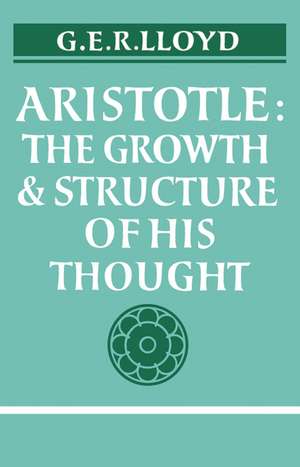
Aristotle
Autor Geoffrey E. R. Lloyd, Aristotle Editat de G. E. R. Lloyden Limba Engleză Paperback – 14 oct 2010
Preț: 245.04 lei
Puncte Express: 368
Carte tipărită la comandă
Livrare economică 04-18 decembrie
Livrare prin curier în România Termenul estimat este afișat lângă disponibilitate.
Transport gratuit de la 400.00 lei Plată online sau ramburs, în funcție de opțiunile comenzii.
Retur gratuit în 14 zile Comandă securizată și suport în română.
Specificații
ISBN-13: 9780521094566
ISBN-10: 0521094569
Pagini: 340
Dimensiuni: 127 x 203 x 20 mm
Greutate: 0.41 kg
Editura: Cambridge University Press
Locul publicării:Cambridge, United Kingdom
ISBN-10: 0521094569
Pagini: 340
Dimensiuni: 127 x 203 x 20 mm
Greutate: 0.41 kg
Editura: Cambridge University Press
Locul publicării:Cambridge, United Kingdom
V-ar putea interesa
-
 Aristotle: A Very Short IntroductionJonathan Barnes-19%Preț: 57.55 lei71.35 lei
 -
 Aristotle PoliticaDavid Ross-22%Preț: 272.80 lei350.86 lei
 -
 Aristotle's "Politics": Second EditionAristotlePreț: 142.26 lei
 -
 AristotleJohn Sellars-27%Preț: 56.71 lei77.49 lei
 -
 PoeticsAristotle-19%Preț: 20.09 lei24.92 lei
 -
 Preț: 229.34 lei
 -
 History of Animals, Volume IAristotlePreț: 228.42 lei
 -
 -14%Preț: 419.56 lei487.86 lei
 -
 -14%Preț: 418.63 lei486.77 lei
 -
 Aristotle's PoliticsAristotlePreț: 201.94 lei
 -
 Politics of AristotlePeter L Phillips SimpsonPreț: 319.46 lei
 -
 Locke: Political WritingsJohn Locke-16%Preț: 146.09 lei173.70 lei
 -
 Commentary on Aristotle's PoliticsThomas Aquinas-17%Preț: 161.92 lei196.10 lei
 -
 PoliticsAristotlePreț: 51.49 lei
 -
 MetaphysicsAristotlePreț: 64.88 lei
 -
 Nicomachean EthicsAristotlePreț: 44.60 lei
 -
 Aquinas: Basic WorksThomas Aquinas-20%Preț: 278.28 lei349.39 lei
 -
 De AnimaAristotlePreț: 70.31 lei
 -
 The PrinceNiccolò MachiavelliPreț: 33.48 lei
 -
 UtopiaThomas MorePreț: 33.19 lei
Cuprins
Preface; Abbreviations; Part I. Intellectual Development: 1. Life and writings; 2. The pupil of Plato; 3. The critic of Plato; 4. The philosopher of nature; 5. The founder of systematic research; Part II. Fundamentals of Aristotle's Thought: 6. Logic and metaphysics; 7. The physics of the heavenly region; 8. The physics of the sublunary region; 9. Psychology; 10. Ethics; 11. Politics; 12. Literary criticism; 13. Conclusion; Suggestions for further reading; Glossary of Greek terms; Index of passages referred to; General index.
Descriere
This is a concise and lucid account of the work of Aristotle.