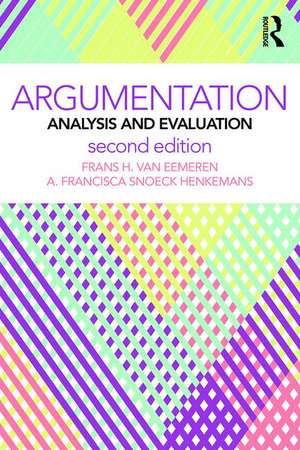
Argumentation: Analysis and Evaluation
Autor Frans H. Van Eemeren, A. Francisca Sn Henkemansen Limba Engleză Paperback – 15 noi 2016
Subliniem autoritatea academică a autorilor Frans H. Van Eemeren și A. Francisca Sn Henkemans, cercetători care au definit studiul modern al comunicării prin prisma pragma-dialecticii. În acest volum, aceștia fundamentează teoria argumentării nu ca pe un exercițiu logic abstract, ci ca pe o activitate socială și comunicativă menită să rezolve diferențe de opinie în discursul cotidian sau instituțional. Reținem că această a doua ediție a lucrării Argumentation rafinează instrumentele metodice necesare pentru identificarea, analiza și evaluarea argumentelor, oferind un cadru riguros pentru studenții și profesioniștii din domeniul comunicării. Considerăm esențială introducerea conceptului de „manevrare strategică”, o premieră în manualele de profil, care explică modul în care interlocutorii încearcă să rămână convingători fără a sacrifica standardele de rezonabilitate critică. Cititorii familiarizați cu Argumentation Theory: A Pragma-Dialectical Perspective vor aprecia modul în care acest volum transformă conceptele teoretice complexe în aplicații practice, facilitând trecerea de la teorie la analiza aplicată. Structura cărții este pedagogică și progresivă: începe cu definirea punctelor de vedere și a dezacordului, avansează spre modelul discuției critice și culminează cu tehnici de prezentare a argumentării. Fiecare capitol este flancat de rezumate ale conceptelor cheie și de exerciții bazate pe texte reale, asigurând o înțelegere profundă a mecanismelor prin care limbajul este utilizat pentru a influența opinii. Față de lucrarea From Argument Schemes to Argumentative Relations in the Wild, care explorează frontierele cercetării actuale, volumul de față servește drept fundament pedagogic indispensabil.
Preț: 415.40 lei
Preț vechi: 488.70 lei
-15%
Carte tipărită la comandă
Livrare economică 10-24 iunie
Livrare express 05-09 mai pentru 38.26 lei
Specificații
ISBN-10: 1138225088
Pagini: 184
Dimensiuni: 152 x 229 x 10 mm
Greutate: 0.27 kg
Ediția:2 ed
Editura: Taylor & Francis
Colecția Routledge
Locul publicării:Oxford, United Kingdom
V-ar putea interesa
-
 The French Lieutenant's WomanJohn Fowles-25%Preț: 57.79 lei77.00 lei
 -
 The Oxford Handbook of Translation StudiesKirsten Malmkjær-37%Preț: 839.12 lei1326.39 lei
 -
 The Oxford Handbook of EcocriticismGreg Garrard-29%Preț: 1009.33 lei1423.61 lei
 -
 Place BrandingR. GoversPreț: 481.51 lei
 -
 The Interpreting Studies ReaderFranz Pochhacker-15%Preț: 474.54 lei558.27 lei
 -
 Preț: 207.36 lei
 -
 Preț: 380.71 lei
 -
 Preț: 178.25 lei
 -
 -19%Preț: 114.41 lei140.76 lei
 -
 Handbook of Intercultural Discourse and CommunicationChristina Bratt PaulstonPreț: 339.83 lei
 -
 Preț: 383.12 lei
 -
 -15%Preț: 401.18 lei471.97 lei
 -
 The Late Work of Sam ShepardShannon Blake Skelton-20%Preț: 237.81 lei295.68 lei
 -
 OverbookedElizabeth BeckerPreț: 114.97 lei
 -
 Learning Python 5edMark Lutz-20%Preț: 405.96 lei507.45 lei
 -
 Research Methods in Applied Linguistics: A Practical ResourceBrian Paltridge-22%Preț: 257.93 lei332.32 lei
 -
 Social Network AnalysisJohn ScottPreț: 434.70 lei
 -
 Strategic PlanningDavid R. MccleanPreț: 190.64 lei
 -
 Handbook of BrewingGraham G. Stewart-18%Preț: 2266.49 lei2764.01 lei
 -
 Second-Hand CulturesLouise Crewe-17%Preț: 239.06 lei287.62 lei
 -
 Moving Target: Theatre Translation and Cultural RelocationCarol-Anne Upton-46%Preț: 189.35 lei351.37 lei
 -
 -30%Preț: 809.42 lei1157.86 lei
Public țintă
ProfessionalDe ce să citești această carte
Această lucrare este recomandată studenților și specialiștilor care doresc să stăpânească arta argumentării structurate. Cititorul câștigă capacitatea de a identifica rapid erorile de logică și de a construi discursuri convingătoare, dar etice. Este un ghid practic care transformă pragmatica limbajului într-un instrument de navigare eficientă prin conflictele de opinie, oferind exerciții aplicate pentru consolidarea competențelor de comunicare orală și scrisă.
Despre autor
Frans H. Van Eemeren este profesor emerit la Universitatea din Amsterdam și fondatorul abordării pragma-dialectice în teoria argumentării. Lucrările sale, printre care se numără și A Systematic Theory of Argumentation, au revoluționat modul în care înțelegem discursul critic. A. Francisca Sn Henkemans este un cercetător recunoscut în același domeniu, specializată în analiza structurilor argumentative complexe. Împreună, cei doi autori au transformat studiul argumentării dintr-o ramură a logicii formale într-o disciplină interdisciplinară vitală pentru științele comunicării și analiză retorică.
Descriere scurtă
The authors begin their treatment of argumentation theory at the same juncture where argumentation also starts in practice: The difference of opinion that occasions the evolvement of the argumentation. Each chapter begins with a short summary of the essentials and ends with a number of exercises that students can use to master the material. Argumentation is the first introductory textbook of this kind. It is intended as a general introduction for students who are interested in a proper conduct of argumentative discourse. Suggestions for further reading are made for each topic and several extra assignments are added to the exercises.
Special features:
• A concise and complete treatment of both the theoretical backgrounds and the practice of argumentation analysis and evaluation.
• Crucial concepts from pragmatics (speech act theory, Grice’s cooperative principle) presented in a non-technical way; introducing the theory of verbal communication.
• The first textbook treatment of strategic maneuvering as a way of balancing being reasonable with being effective
• Exercises and assignments based on real-life texts from a variety of contexts.
Cuprins
1 Standpoints and differences of opinion
Essentials
1.1 Discussion and disagreement
1.2 Explicit and implicit differences of opinion
1.3 Positive and negative standpoints
1.4 Standpoints and expressions of doubt
1.5 Types of differences of opinion
1.6 Main differences of opinion and subordinate differences of opinion
1.7 The presentation of standpoints and doubt
Further reading
Exercises
Special assignment 1
2 Argumentation and discussion
Essentials
2.1 Resolving a difference of opinion
2.2 Argumentative discourse and having a critical discussion
2.3 The ideal model of a critical discussion
2.4 Argumentation in a critical discussion
Further reading
Exercises
3 The presentation of argumentation
Essentials
3.1 Identifying the standpoint
3.2 Indicators of argumentation
3.3 Clues in the context
3.4 Additional means of identifying argumentation
3.5 Explanation, elaboration and clarification
3.6 A maximally argumentative interpretation
Further reading
Exercises
4 Unexpressed standpoints and unexpressed premises
Essentials
4.1 Unexpressed elements in argumentative discourse
4.2 Indirectness and the rules for communication
4.3 Correctness conditions for speech acts
4.4 Violations of the communication rules
4.5 Variants of indirectness
4.6 Making unexpressed standpoints explicit
4.7 Making unexpressed premises explicit
4.8 Unexpressed premises in a well-defined context
Further reading
Exercises
5 The argumentation structure
Essentials
5.1 Single arguments
5.2 Combinations of single arguments
5.3 Multiple, coordinative, and subordinative argumentation
5.4 Representing the argumentation structure schematically
5.5 The presentation of complex argumentation
5.6 A maximally argumentative analysis
5.7 Unexpressed premises and complex argumentation
5.8 Composing an analytic overview
Further reading
Exercises
Special assignments 2, 3, 4, 5
6 The soundness of argumentation
Essentials
6.1 Evaluating argumentative discourse
6.2 The acceptability of argumentative statements
6.3 The validity of the reasoning
6.4 The soundness of argument schemes
6.5 Argumentation based on a symptomatic relation
6.6 Argumentation based on a relation of analogy
6.7 Argumentation based on a causal relation
6.8 The presentation of different types of argumentation
Further reading
Exercises
7 Fallacies as violations of discussion rules 1-5
Essentials
7.1 Fallacies and discussion rules
7.2 Violations of the freedom rule
7.3 Violations of the burden-of-proof rule
7.4 Violations of the standpoint rule
7.5 Violations of the relevance rule
7.6 Violations of the unexpressed premise rule
Further reading
Exercises
8 Fallacies as violations of discussion rules 6-10
Essentials
8.1 The conclusive defense of standpoints
8.2 Violations of the starting point rule
8.3 Violations of the validity rule
8.4 Violations of the argument scheme rule
8.5 Violations of the closure rule
8.6 Violations of the usage rule
Further reading
Exercises
Special assignment 6
9 Strategic manoeuvring
Essentials
9.1 Reconciling reasonableness and effectiveness
9.2 Three aspects of strategic manoeuvring
9.3 Rhetorical analogues of dialectical aims
9.4 Various kinds of argumentative strategies
9.5 Fallacies as derailments of strategic manoeuvring
9.6 The treacherous character of fallacious strategic manoeuvring
Further reading
Exercises
Special assignment 7
10 The conventionalization of communicative activity types
Essentials
10.1 Communicative activity types
10.2 Argumentative characterization of communicative activity types
10.3 Institutional preconditions for strategic manoeuvring
10.4 Different implementations of critical questions
Further reading
Exercises
Special assignment 8
Overview of rules for critical discussion and fallacies
General references