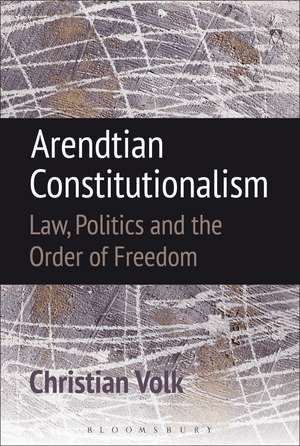
Arendtian Constitutionalism: Law, Politics and the Order of Freedom
Autor Christian Volken Limba Engleză Paperback – 26 oct 2017
Endorsements
'Christian Volk is one of the most original and penetrating Arendt interpreters of his generation. This book addresses some of the most misunderstood aspects of Arendtian thought - namely, her views of law and constitutionalism. Volk does away with a lot of misconceptions and guides us to a novel view of Arendt on these questions and beyond'.
Seyla Benhabib, Yale University
'One could not imagine something new on Arendt these days. Too much has been written in the last decades. But this volume discloses new land and gives a fresh look at Arendt's theory of the political. A great book, and a must for every reading list'.
Hauke Brunkhorst, University of Flensburg
'Hannah Arendt is famous for her unusual conception of politics, but as Christian Volk's rich and seminal study shows, Arendt's political theory goes hand in hand with a distinctive understanding of law. Volk persuasively charts the emergence of Arendt's complementary approaches to law and politics out of her analysis of the crisis of the European nation-state, and tests the power of her thought by bringing it into a fresh dialogue with an unusually wide spectrum of contemporary theorists. An impressive work that deserves the new audience it will find in this welcome translation'.
Patchen Markell, University of Chicago
'Christian Volk splendidly discovers Hannah Arendt as a legal theorist. Lawyers interested in her seminal work should just read this book'.
Christoph Möllers, Humboldt University Berlin
'As Christian Volk persuasively demonstrates, reading Arendt as a constitutional theorist is more than just adding another dimension to the interpretation of her work. Based on comprehensive textual evidence, he can instead show that this has important conceptual implications which shed a completely new light on the basic aspects of her overall theoretical outlook. Emphasising the procedural grounding of her understanding of democracy, it thus presents a major challenge to many widely held beliefs about Arendt´s work and an irresistible invitation to reinvestigate the foundations, promises and prospects of radical politics.'
Rainer Schmalz-Bruns, Leibniz University of Hanover
| Toate formatele și edițiile | Preț | Express |
|---|---|---|
| Paperback (1) | 259.62 lei 43-57 zile | |
| Bloomsbury Publishing – 26 oct 2017 | 259.62 lei 43-57 zile | |
| Hardback (1) | 557.32 lei 43-57 zile | |
| Bloomsbury Publishing – 30 iul 2015 | 557.32 lei 43-57 zile |
Preț: 259.62 lei
Preț vechi: 312.21 lei
-17%
Puncte Express: 389
Preț estimativ în valută:
45.90€ • 54.17$ • 40.20£
45.90€ • 54.17$ • 40.20£
Carte tipărită la comandă
Livrare economică 13-27 aprilie
Specificații
ISBN-13: 9781509917716
ISBN-10: 1509917713
Pagini: 312
Dimensiuni: 156 x 234 x 21 mm
Greutate: 0.43 kg
Ediția:NIPPOD
Editura: Bloomsbury Publishing
Colecția Hart Publishing
Locul publicării:London, United Kingdom
ISBN-10: 1509917713
Pagini: 312
Dimensiuni: 156 x 234 x 21 mm
Greutate: 0.43 kg
Ediția:NIPPOD
Editura: Bloomsbury Publishing
Colecția Hart Publishing
Locul publicării:London, United Kingdom
V-ar putea interesa
-
 Injustice On Appeal: The United States Courts of Appeals in CrisisWilliam M. Richman-9%Preț: 765.30 lei843.64 lei
 -
 -27%Preț: 660.44 lei909.59 lei
 -
 The Law of the ConstitutionA. V. Dicey-33%Preț: 776.01 lei1164.07 lei
 -
 America's Supreme Court: Making Democracy WorkStephen Breyer-12%Preț: 310.12 lei353.98 lei
 -
 After Public LawCormac Mac Amhlaigh-34%Preț: 752.92 lei1136.20 lei
 -
 Accountability in the Contemporary ConstitutionNicholas Bamforth-34%Preț: 770.76 lei1160.82 lei
 -
 The Cosmopolitan StateH. Patrick Glenn-27%Preț: 694.92 lei956.14 lei
 -
 The Oxford Edition of DiceyA V Dicey-23%Preț: 1530.90 lei1988.19 lei
 -
 The North Carolina State ConstitutionJohn V. Orth-27%Preț: 1321.27 lei1799.33 lei
 -
 -11%Preț: 483.16 lei542.88 lei
 -
 The Tough Luck Constitution and the Assault on Healthcare ReformAndrew Koppelman-26%Preț: 128.01 lei173.40 lei
 -
 Competing SovereigntiesRichard Joyce-18%Preț: 1198.08 lei1461.07 lei
 -
 Preț: 281.63 lei
 -
 -31%Preț: 1457.44 lei2107.17 lei
 -
 The Constitution of France: A Contextual AnalysisSophie Boyron-21%Preț: 191.92 lei242.38 lei
 -
 -18%Preț: 191.44 lei232.70 lei
 -
 Preț: 24.74 lei
Cuprins
Introduction
1. The Paradoxes of the Nation-State
I. Introduction
II. The Paradox of the Right to Self-determination
III. The Paradox of De-assimilation and De-naturalisation
IV. The Paradox of Rightlessness
V. The Paradox of Human Rights
2. The Concept of the Nation in Hannah Arendt's Thought
I. Introduction
II. Arendt and the Social Question -
A Political-theoretical Readjustment
A. Revolution and Discourse
B. Sovereignty and Misery
C. Misery and Consensus
III. The Concept of the Nation and the Volonté Générale
A. Arendt, Rousseau and the French Revolution
B. General Will and Alienation
C. The Internalisation of the Political
3. Law and the Modern State - Hannah Arendt on the Trail of Max Weber
I. Introduction
A. In Which Line of Tradition to Think About the State? Neither Hegel nor Elias
B. An Initial Plea for Max Weber
II. On the Origin of the Modern State
A. State and Modern State in Weber
B. Arendt and the Genealogy of the Modern State
III. On the Rationality of Law
A. What is Rational Law? A Look at Weber's Sociology of Law
B. Arendt and Rational Law
4. Hannah Arendt's Critique of Popular Sovereignty
I. Introduction
II. Popular Sovereignty and the Law
A. The Political-theoretical Architecture of Arendt's book on Totalitarianism
B. Arendt and the Sources of Juridification
C. Nation and Law
III. Popular Sovereignty and Politics
A. Politics in Mass Society
B. Mistrust and Authority
C. Mass Movement and Power
5. The Order of Freedom: On the Dehierarchisation of the Relationship Between Law and Politics
I. Introduction
II. Arendt's Understanding of the Political
A. Arendt and the Normativity of the Political
B. From the Power of Judgement to the Procedural Rules of the Political System
III. Arendt's Theory of Law
A. The Concept of Law: Relationship versus Substance
B. What is Legitimate Law?
C. Arendt's Demanding Concept of Political Enabling
1. The Paradoxes of the Nation-State
I. Introduction
II. The Paradox of the Right to Self-determination
III. The Paradox of De-assimilation and De-naturalisation
IV. The Paradox of Rightlessness
V. The Paradox of Human Rights
2. The Concept of the Nation in Hannah Arendt's Thought
I. Introduction
II. Arendt and the Social Question -
A Political-theoretical Readjustment
A. Revolution and Discourse
B. Sovereignty and Misery
C. Misery and Consensus
III. The Concept of the Nation and the Volonté Générale
A. Arendt, Rousseau and the French Revolution
B. General Will and Alienation
C. The Internalisation of the Political
3. Law and the Modern State - Hannah Arendt on the Trail of Max Weber
I. Introduction
A. In Which Line of Tradition to Think About the State? Neither Hegel nor Elias
B. An Initial Plea for Max Weber
II. On the Origin of the Modern State
A. State and Modern State in Weber
B. Arendt and the Genealogy of the Modern State
III. On the Rationality of Law
A. What is Rational Law? A Look at Weber's Sociology of Law
B. Arendt and Rational Law
4. Hannah Arendt's Critique of Popular Sovereignty
I. Introduction
II. Popular Sovereignty and the Law
A. The Political-theoretical Architecture of Arendt's book on Totalitarianism
B. Arendt and the Sources of Juridification
C. Nation and Law
III. Popular Sovereignty and Politics
A. Politics in Mass Society
B. Mistrust and Authority
C. Mass Movement and Power
5. The Order of Freedom: On the Dehierarchisation of the Relationship Between Law and Politics
I. Introduction
II. Arendt's Understanding of the Political
A. Arendt and the Normativity of the Political
B. From the Power of Judgement to the Procedural Rules of the Political System
III. Arendt's Theory of Law
A. The Concept of Law: Relationship versus Substance
B. What is Legitimate Law?
C. Arendt's Demanding Concept of Political Enabling
Recenzii
...the book is a great success. Through an incredibly rich and knowledgeable interpretation of Arendt's work, Volk offers new perspectives on her concepts of law and politics, and develops a distinctive approach for thinking about legitimacy and democracy today.
Overall, this is an excellent, thoughtful and detailed engagement with Arendt's work that will become a clear point of reference for those who wish to understand her work on the state and legality and who then wish to deploy it to analyse contemporary global politics.
In perhaps the most ambitious book on Hannah Arendt to appear in recent years, Christian Volk presents an Arendt of our times.
This well-written volume has a clear structure and gives the reader a rich and innovative interpretation of Arendt's political and constitutional theory.
Overall, this is an excellent, thoughtful and detailed engagement with Arendt's work that will become a clear point of reference for those who wish to understand her work on the state and legality and who then wish to deploy it to analyse contemporary global politics.
In perhaps the most ambitious book on Hannah Arendt to appear in recent years, Christian Volk presents an Arendt of our times.
This well-written volume has a clear structure and gives the reader a rich and innovative interpretation of Arendt's political and constitutional theory.