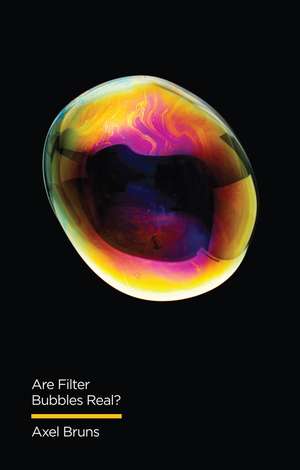
Are Filter Bubbles Real?
Autor Axel Brunsen Limba Engleză Paperback – 16 sep 2019
Preț: 129.76 lei
Puncte Express: 195
Carte tipărită la comandă
Livrare economică 30 noiembrie-14 decembrie
Livrare prin curier în România Termenul estimat este afișat lângă disponibilitate.
Transport gratuit de la 400.00 lei Plată online sau ramburs, în funcție de opțiunile comenzii.
Retur gratuit în 14 zile Comandă securizată și suport în română.
Specificații
ISBN-13: 9781509536450
ISBN-10: 1509536450
Pagini: 160
Dimensiuni: 125 x 188 x 15 mm
Greutate: 0.17 kg
Editura: Polity Press
Locul publicării:Chichester, United Kingdom
ISBN-10: 1509536450
Pagini: 160
Dimensiuni: 125 x 188 x 15 mm
Greutate: 0.17 kg
Editura: Polity Press
Locul publicării:Chichester, United Kingdom
V-ar putea interesa
-
 The PersuadersAnand Giridharadas-19%Preț: 63.70 lei78.26 lei
 -
 Attensity!The Friends of AttentionPreț: 146.13 lei
 -
 That Book Is Dangerous!Adam SzetelaPreț: 198.52 lei
 -
 -25%Preț: 70.56 lei94.41 lei
 -
 The Hype MachineSinan AralPreț: 90.28 lei
 -
 #Republic – Divided Democracy in the Age of Social MediaCass R. SunsteinPreț: 256.14 lei
 -
 The Echo MachineDavid PakmanPreț: 156.74 lei
 -
 Trolling Democracy: How Trolls Distort Digital DiscourseJ. Benjamin Taylor-15%Preț: 449.01 lei528.24 lei
 -
 Don't Talk About Politics: How to Change 21st-Century MindsSarah Stein LubranoPreț: 155.60 lei
 -
 Summer of Our Discontent: The Age of Certainty and the Demise of DiscourseThomas Chatterton Williams-32%Preț: 130.88 lei191.08 lei
 -
 Platforms, Power, and PoliticsUlrike KlingerPreț: 170.17 lei
 -
 The Dark Forest Theory of the InternetBogna KoniorPreț: 86.72 lei
 -
 -25%Preț: 81.87 lei109.22 lei
 -
 In the ArenaDavid S BrownPreț: 196.68 lei
 -
 Clearing the AirHannah RitchiePreț: 121.89 lei
 -
 The Internet ConCory DoctorowPreț: 84.06 lei
 -
 The New CensorshipAyala PanievskyPreț: 141.53 lei
 -
 EnshittificationCory DoctorowPreț: 170.65 lei
 -
 The Sirens' CallChris HayesPreț: 145.95 lei
Notă biografică
Axel Bruns is an Australian Research Council Future Fellow and Professor in the Digital Media Research Centre at Queensland University of Technology.
Descriere
"Axel Bruns argues that the influence of echo chambers and filter bubbles on contemporary public debate has been severely overstated. He evaluates the evidence for and against echo chambers and filter bubbles, and offers a persuasive argument for why we should shift our focus to more important problems"--