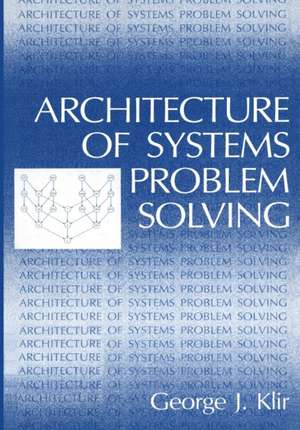
Architecture of Systems Problem Solving
Autor George J. Kliren Limba Engleză Paperback – 15 oct 2012
Preț: 356.24 lei
Preț vechi: 445.31 lei
-20%
Puncte Express: 534
Carte tipărită la comandă
Livrare economică 28 noiembrie-12 decembrie
Livrare prin curier în România Termenul estimat este afișat lângă disponibilitate.
Transport gratuit de la 400.00 lei Plată online sau ramburs, în funcție de opțiunile comenzii.
Retur gratuit în 14 zile Comandă securizată și suport în română.
Specificații
ISBN-13: 9781475711707
ISBN-10: 1475711700
Pagini: 560
Ilustrații: XVI, 540 p. 260 illus.
Dimensiuni: 178 x 254 x 30 mm
Greutate: 1.04 kg
Ediția:Softcover reprint of the original 1st ed. 1985
Editura: Springer
Locul publicării:New York, NY, United States
ISBN-10: 1475711700
Pagini: 560
Ilustrații: XVI, 540 p. 260 illus.
Dimensiuni: 178 x 254 x 30 mm
Greutate: 1.04 kg
Ediția:Softcover reprint of the original 1st ed. 1985
Editura: Springer
Locul publicării:New York, NY, United States
V-ar putea interesa
-
 Generative AnalysisJim Arlow-20%Preț: 385.24 lei481.54 lei
 -
 Concrete MathematicsRonald Graham-20%Preț: 560.73 lei700.91 lei
 -
 Computer Architecture: A Quantitative ApproachJohn L. Hennessy-39%Preț: 534.37 lei882.55 lei
 -
 Godel, Escher, Bach: An Eternal Golden BraidDouglas HofstadterPreț: 165.37 lei
 -
 Systems EngineeringDerek K Hitchins-23%Preț: 778.18 lei1010.62 lei
 -
 Notes on the Synthesis of FormChristopher AlexanderPreț: 235.55 lei
 -
 Design-Tech: Building Science for ArchitectsJason Alread-8%Preț: 496.29 lei539.45 leiRecomandat
 -
 -19%Preț: 526.02 lei649.41 lei
 -
 Computer Systems: A Programmer's Perspective, Global EditionRandal E. Bryant-20%Preț: 652.59 lei815.74 lei
 -
 -9%Preț: 563.36 lei619.07 lei
 -
 Artificial Intelligence: A Guide to Intelligent SystemsMichael Negnevitsky-20%Preț: 646.12 lei807.65 lei
 -
 -20%Preț: 134.29 lei167.85 lei
 -
 Data Science Essentials for DummiesLillian Pierson-20%Preț: 76.56 lei95.69 lei
 -
 Machine Learning For DummiesLuca Massaron-20%Preț: 149.88 lei187.36 lei
 -
 The Essential Book of AIAnne Rooney-20%Preț: 76.61 lei95.77 lei
 -
 Foundations of Analog and Digital Electronic CircuitsAnant Agarwal-28%Preț: 546.19 lei754.30 lei
 -
 System Programming in Linux: A Hands-On IntroductionStewart Weiss-35%Preț: 481.65 lei739.15 lei
 -
 Thinking Small and LargePeter ForbesPreț: 109.04 lei
 -
 Statistics for ScientistsUmberto Michelucci-20%Preț: 275.88 lei344.84 lei
 -
 General Physics IMehdi Rahmani-AndebiliPreț: 377.42 lei
Public țintă
ResearchCuprins
1: Introduction.- 1.1. Systems Science.- 1.2. Systems Problem Solving.- 1.3. Hierarchy of Epistemological Levels of Systems.- 1.4. The Role of Mathematics.- 1.5. The Role of Computer Technology.- 1.6. Architecture of Systems Problem Solving.- Notes.- 2: Source and Data Systems.- 2.1. Objects and Object Systems.- 2.2. Variables and Supports.- 2.3. Methodological Distinctions.- 2.4. Discrete Versus Continuous.- 2.5. Image Systems and Source Systems.- 2.6. Data Systems.- Notes.- Exercises.- 3: Generative Systems.- 3.1. Empirical Investigation.- 3.2. Behavior Systems.- 3.3. Methodological Distinctions.- 3.4. From Data Systems to Behavior Systems.- 3.5. Measures of Uncertainty.- 3.6. Search for Admissible Behavior Systems.- 3.7. State-Transition Systems.- 3.8. Generative Systems.- 3.9. Simplification of Generative Systems.- 3.10. Systems Inquiry and Systems Design.- Notes.- Exercises.- 4: Structure Systems.- 4.1. Wholes and Parts.- 4.2. Systems, Subsystems, Supersystems.- 4.3. Structure Source Systems and Structure Data Systems.- 4.4. Structure Behavior Systems.- 4.5. Problems of Systems Design.- 4.6. Identification Problem.- 4.7. Reconstruction Problem.- 4.8. Reconstructability Analysis.- 4.9. Simulation Experiments.- 4.10. Inductive Reasoning.- 4.11. Inconsistent Structure Systems.- Notes.- Exercises.- 5: Metasystems.- 5.1. Change versus Invariance.- 5.2. Primary and Secondary Systems Traits.- 5.3. Metasystems.- 5.4. Metasystems versus Structure Systems.- 5.5. Multilevel Metasystems.- 5.6. Identification of Change.- Notes.- Exercises.- 6: Complexity.- 6.1. Complexity in Systems Problem Solving.- 6.2. Three Ranges of Complexity.- 6.3. Measures of Systems Complexity.- 6.4. Bremermann’s Limit.- 6.5. Computational Complexity.- 6.6. Complexity Within GSPS.- Notes.-Exercises.- 7: Goal-Oriented Systems.- 7.1. Primitive, Basic, and Supplementary Concepts.- 7.2. Goal and Performance.- 7.3. Goal-Oriented Systems.- 7.4. Structure Systems as Paradigms of Goal-Oriented Behavior Systems.- 7.5. Design of Goal-Oriented Systems.- 7.6. Adaptive Systems.- 7.7. Autopoietic Systems.- Notes.- Exercises.- 8: Systems Similarity.- 8.1. Similarity.- 8.2. Similarity and Models of Systems.- 8.3. Models of Source Systems.- 8.4. Models of Data Systems.- 8.5. Models of Generative Systems.- 8.6. Models of Structure Systems.- 8.7. Models of Metasystems.- Notes.- Exercises.- 9: GSPS: Architecture, USE, Evolution.- 9.1. Epistemological Hierarchy of Systems: Formal Definition.- 9.2. Methodological Distinctions: A Summary.- 9.3. Problem Requirements.- 9.4. Systems Problems.- 9.5. GSPS Conceptual Framework: Formal Definition.- 9.6. Overview of GSPS Architecture.- 9.7. GSPS Use: Some Case Studies.- 9.8. GSPS Evolution.- Notes.- Exercises.- Appendices.- A: List of Symbols.- B: Glossary of Relevant Mathematical Terms.- C: Some Relevant Theorems.- D: Refinement Lattices.- E: Classes of Structures Relevant to Reconstructability Analysis.- References.- Author Index.