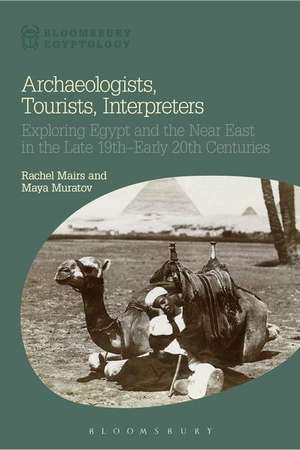
Archaeologists, Tourists, Interpreters: Exploring Egypt and the Near East in the Late 19th–Early 20th Centuries: Bloomsbury Egyptology
Autor Dr Rachel Mairs, Maya Muratov Nicholas Reevesen Limba Engleză Paperback – 24 sep 2015
This study, based on published and unpublished travel memoirs, guidebooks, personal papers and archaeological reports of the British and American archaeologists, deals with the socio-political status and multi-faceted role of interpreters at the time. Those bi- or multi-lingual individuals frequently took on (or were forced to take on) much more than just interpreting. They often played the role of go-betweens, servants, bodyguards, pimps, diplomats, spies, messengers, managers and overseers, and had to mediate, scheme and often improvise, whether in an official or unofficial capacity.
For the most part denied due credit and recognition, these interpreters are finally here given a new voice. An engrossing story emerges of how through their many and varied actions and roles, they had a crucial part to play in the introduction to Britain and America of these mysterious past cultures and civilizations.




Preț: 196.01 lei
Preț vechi: 243.40 lei
-19%
Puncte Express: 294
Carte tipărită la comandă
Livrare economică 27 noiembrie-11 decembrie
Livrare prin curier în România Termenul estimat este afișat lângă disponibilitate.
Transport gratuit de la 400.00 lei Plată online sau ramburs, în funcție de opțiunile comenzii.
Retur gratuit în 14 zile Comandă securizată și suport în română.
Specificații
ISBN-13: 9781472588807
ISBN-10: 1472588800
Pagini: 160
Ilustrații: 20 bw illus
Dimensiuni: 152 x 232 x 12 mm
Greutate: 0.26 kg
Editura: Bloomsbury Publishing
Colecția Bloomsbury Academic
Seria Bloomsbury Egyptology
Locul publicării:London, United Kingdom
ISBN-10: 1472588800
Pagini: 160
Ilustrații: 20 bw illus
Dimensiuni: 152 x 232 x 12 mm
Greutate: 0.26 kg
Editura: Bloomsbury Publishing
Colecția Bloomsbury Academic
Seria Bloomsbury Egyptology
Locul publicării:London, United Kingdom
V-ar putea interesa
-
 From the Holy MountainWilliam DalrymplePreț: 95.04 lei
 -
 The Rise of the Roman EmpirePolybe-18%Preț: 87.82 lei107.65 lei
 -
 Law and Family in Late Antiquity: The Emperor Constantine's Marriage LegislationJudith Evans Grubbs-34%Preț: 653.32 lei983.97 lei
 -
 -29%Preț: 489.39 lei686.42 lei
 -
 Pyrrho, his Antecedents, and his LegacyRichard Bett-29%Preț: 496.57 lei695.48 lei
 -
 -32%Preț: 635.94 lei941.10 lei
 -
 The Palaeolithic Origins of Human BurialPaul PettittPreț: 382.93 lei
 -
 Origins of the Peloponnesian WarG. de Ste Croix-12%Preț: 383.88 lei436.82 lei
 -
 Preț: 189.08 lei
 -
 Attila The HunChristopher KellyPreț: 113.94 lei
 -
 Roman Death: The Dying and the Dead in Ancient RomeDr Valerie M. Hope-38%Preț: 348.62 lei560.32 lei
 -
 Night's Black Agents: Witches, Wizards and the Dead in the Ancient WorldProfessor Daniel Ogden-8%Preț: 378.12 lei409.68 lei
Cuprins
List of illustrations
Acknowledgements
1. Introduction: Interpreting the Orient
2. Mediating Language and Culture
Dragomans and Tourists
The Profession of Dragoman
Innocents Abroad
Managing Clients
Learning Arabic
3. Archaeologists in the Field
Flinders Petrie in Egypt and Palestine
T. E. Lawrence in Egypt and Syria
Sir Leonard Woolley
Max Mallowan and Agatha Christie
4. Americans in the 'Land of the Bible'
The Wolfe Expedition
The Babylonian Expedition of the University of Pennsylvania 1888-1890: First and Second Campaigns
5. Daniel Z. Noorian: the 'Afterlife' of an Interpreter
6. Solomon Negima: A Dragoman and his Clients
The Testimonial Book of Dragoman Solomon N. Negima
Interpreter on the Nile
Dragoman in Palestine
Oxford to Palestine and Alone Through Syria
Floyd House
7. Conclusion
Bibliography
Index
Acknowledgements
1. Introduction: Interpreting the Orient
2. Mediating Language and Culture
Dragomans and Tourists
The Profession of Dragoman
Innocents Abroad
Managing Clients
Learning Arabic
3. Archaeologists in the Field
Flinders Petrie in Egypt and Palestine
T. E. Lawrence in Egypt and Syria
Sir Leonard Woolley
Max Mallowan and Agatha Christie
4. Americans in the 'Land of the Bible'
The Wolfe Expedition
The Babylonian Expedition of the University of Pennsylvania 1888-1890: First and Second Campaigns
5. Daniel Z. Noorian: the 'Afterlife' of an Interpreter
6. Solomon Negima: A Dragoman and his Clients
The Testimonial Book of Dragoman Solomon N. Negima
Interpreter on the Nile
Dragoman in Palestine
Oxford to Palestine and Alone Through Syria
Floyd House
7. Conclusion
Bibliography
Index
Recenzii
This book is a fascinating read from beginning to end. It comes at a time when a post-colonial approach has finally begun to be applied to early archaeological work and not only to non-professional travellers. This new interest, however, has never taken the linguistic issue into account, and thus this book comes to complement the work of scholars engaging with early archaeological colonialism.
This interesting and accessible book presents both new and little-known information on the social history of dragomans and interpreters in Egypt and Mesopotamia in the late 19th to early 20th centuries and casts light on and the Anglo-American aversion to learning Arabic and Turkish that made them necessary. Mairs and Muratov excavate new archival sources: a diary and curated testimonial book to discover the voice and agency of two individuals who shaped westerners' experience of the Holy Lands, thereby rescuing them from the anonymity of a client-based perspective.
In this well-written and good-humoured book, Mairs and Muratov examine the relationship between dragoman and client, and investigate the ways in which dragomen both reinforced and confronted Western perceptions of the East in the late 19th and early 20th centuries. . While the book presents a fresh and inclusive social history of formative archaeological work and, especially, early tourism in Egypt and the Near East, its greatest strength ultimately lies in the detailed biographies of its two key protagonists.
This interesting and accessible book presents both new and little-known information on the social history of dragomans and interpreters in Egypt and Mesopotamia in the late 19th to early 20th centuries and casts light on and the Anglo-American aversion to learning Arabic and Turkish that made them necessary. Mairs and Muratov excavate new archival sources: a diary and curated testimonial book to discover the voice and agency of two individuals who shaped westerners' experience of the Holy Lands, thereby rescuing them from the anonymity of a client-based perspective.
In this well-written and good-humoured book, Mairs and Muratov examine the relationship between dragoman and client, and investigate the ways in which dragomen both reinforced and confronted Western perceptions of the East in the late 19th and early 20th centuries. . While the book presents a fresh and inclusive social history of formative archaeological work and, especially, early tourism in Egypt and the Near East, its greatest strength ultimately lies in the detailed biographies of its two key protagonists.
Notă biografică
Rachel Mairs is Lecturer in Classics at the University of Reading, UK. Her publications include Archaeologists, Tourists and Interpreters (Bloomsbury, 2015).