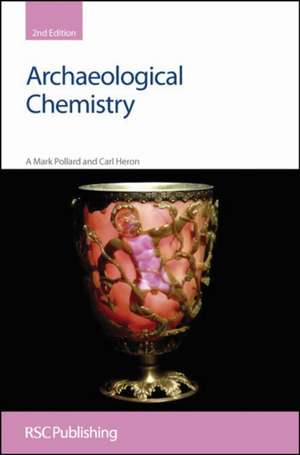
Archaeological Chemistry
Autor A Mark Pollard, Carl Heronen Limba Engleză Hardback – 22 apr 2008
Considerăm că Archaeological Chemistry reprezintă un reper fundamental pentru înțelegerea interdisciplinarității dintre științele exacte și cele umaniste. Lucrarea demonstrează cum metodologiile chimice pot răspunde unor întrebări esențiale despre compoziția artefactelor, proveniența materiilor prime și procesele de degradare suferite în timpul înhumării. Această a doua ediție, publicată de RSC Publishing, extinde cadrul teoretic prin integrarea unor tehnici analitice moderne, oferind o perspectivă riguroasă asupra modului în care chimia și biochimia avansează studiul trecutului uman. Structura volumului reflectă o progresie logică, pornind de la istoricul și obiectivele științei arheologice către aplicații extrem de specifice. Găsim în această carte capitole dedicate caracterizării obsidianului în estul Mediteranei, geochimiei argilelor pentru determinarea provenienței ceramicii și studiului coroziunii sticlei. Merită menționat că autorii nu se limitează la teorie, ci includ investigații concrete, precum utilizarea izotopilor de plumb în trasarea rutelor comerciale cu metale sau analiza substanțelor rășinoase. Comparabil cu An Introduction to Archaeological Chemistry de T. Douglas Price în ceea ce privește rigurozitatea, volumul de față se distinge prin actualizarea tehnicilor de laborator și o aplecare mai pronunțată către geochimie și stereochimie. În contextul operei autorului A Mark Pollard, această lucrare consolidează temele abordate în Handbook of Archaeological Sciences, 2 Volume Set, însă cu un accent mult mai focalizat pe fundamentele chimice ale materialelor. Dacă în An Archaeological Perspective on the History of Technology autorul explora dimensiunea socială a tehnologiei, aici se concentrează pe semnătura chimică a proceselor de producție. Tonul este precis, academic, fiind un instrument esențial pentru cei care doresc să depășească bariera dintre arheologia de teren și analiza de laborator.
Preț: 403.61 lei
Carte disponibilă
Livrare economică 09-23 noiembrie
Livrare express 23-29 octombrie pentru 58.39 lei
Specificații
ISBN-10: 0854042628
Pagini: 456
Ilustrații: 1
Dimensiuni: 159 x 241 x 32 mm
Greutate: 0.86 kg
Ediția:Nouă
Editura: Royal Society Of Chemistry
V-ar putea interesa
-
 Digital Archaeology: Bridging Method and TheoryPatrick DalyPreț: 413.84 lei
 -
 Material Evidence: Learning from Archaeological PracticeRobert Chapman-18%Preț: 1256.11 lei1531.84 lei
 -
 Ground-Penetrating Radar for ArchaeologyLawrence B. ConyersPreț: 408.41 lei
 -
 Bioarchaeology and Identity in the AmericasKelly J. KnudsonPreț: 245.80 lei
 -
 The Cultural Dynamics of Shell-Matrix SitesMirjana Roksandic-23%Preț: 547.43 lei710.94 lei
 -
 Clovis Caches: Recent Discoveries and New ResearchBruce B. Huckell-23%Preț: 463.51 lei601.96 lei
 -
 -27%Preț: 2213.24 lei3031.84 lei
 -
 -27%Preț: 2217.50 lei3037.68 lei
 -
 Chemicals in the EnvironmentR. M. Harrison-11%Preț: 491.51 lei552.26 lei
 -
 Developments and Applications in SolubilityTrevor M Letcher-14%Preț: 1131.33 lei1315.51 lei
 -
 Chemical MisconceptionsKeith TaberPreț: 211.32 lei
 -
 Additives in Water-Borne CoatingsGerry Davison-11%Preț: 686.05 lei770.84 lei
 -
 Environmental Radiochemical Analysis IIPeter Warwick-14%Preț: 863.81 lei1004.44 lei
 -
 Nanotechnology in ConstructionPeter J M Bartos-14%Preț: 791.42 lei920.26 lei
 -
 A Slice Through Time: Dendrochronology and Precision DatingM.G.L. Baillie-18%Preț: 1113.77 lei1358.26 lei
 -
 Quantitative Analysis in ArchaVanpoolPreț: 399.58 lei
 -
 Computational Approaches to Archaeological SpacesAndrew Bevan-18%Preț: 1315.35 lei1604.08 lei
 -
 Metals in AntiquitySuzanne M. M. Young-9%Preț: 861.52 lei946.72 lei
 -
 Experimental ArchaeologyJohn Morton ColesPreț: 254.40 lei
De ce să citești această carte
Recomandăm această carte studenților și profesioniștilor din domeniul conservării și arheologiei care doresc să înțeleagă mecanismele științifice din spatele analizei artefactelor. Cititorul câștigă o înțelegere profundă a modului în care tehnicile analitice, de la spectroscopie la studiul izotopilor, pot confirma sau infirma ipoteze istorice. Este un manual tehnic indispensabil pentru interpretarea corectă a datelor chimice în context istoric.
Despre autor
A Mark Pollard este un cercetător de renume în domeniul științelor arheologice, recunoscut pentru contribuțiile sale la interfața dintre chimie și arheologie. Alături de Carl Heron, a dezvoltat metodologii inovatoare pentru analiza reziduurilor organice și a materialelor anorganice. Opera sa vastă, care include coordonarea unor tratate de referință precum Handbook of Archaeological Sciences, 2 Volume Set, reflectă un angajament constant pentru rigoarea științifică aplicată istoriei tehnologiei și comerțului antic, fiind o autoritate în utilizarea tehnicilor geochimice pentru reconstituirea trecutului.