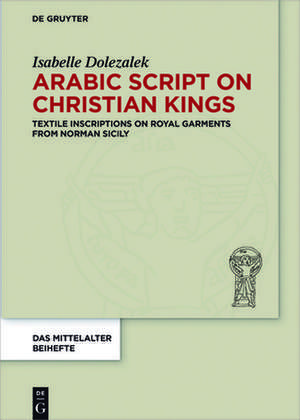
Arabic Script on Christian Kings: Das Mittelalter. Perspektiven mediävistischer Forschung. Beihefte, cartea 5
Autor Isabelle Dolezaleken Limba Engleză Hardback – 12 iun 2017






Preț: 661.58 lei
Preț vechi: 806.80 lei
-18%
Puncte Express: 992
Carte disponibilă
Livrare economică 07-21 noiembrie
Livrare prin curier în România Termenul estimat este afișat lângă disponibilitate.
Transport gratuit pentru acest produs Plată online sau ramburs, în funcție de opțiunile comenzii.
Retur gratuit în 14 zile Comandă securizată și suport în română.
Specificații
ISBN-13: 9783110532029
ISBN-10: 3110532026
Pagini: 276
Dimensiuni: 175 x 246 x 21 mm
Greutate: 0.59 kg
Ediția:1. Auflage
Editura: De Gruyter
Colecția Das Mittelalter. Perspektiven mediävistischer Forschung. Beihefte
Seria Das Mittelalter. Perspektiven mediävistischer Forschung. Beihefte
ISBN-10: 3110532026
Pagini: 276
Dimensiuni: 175 x 246 x 21 mm
Greutate: 0.59 kg
Ediția:1. Auflage
Editura: De Gruyter
Colecția Das Mittelalter. Perspektiven mediävistischer Forschung. Beihefte
Seria Das Mittelalter. Perspektiven mediävistischer Forschung. Beihefte
V-ar putea interesa
-
 Medieval Britain: A Very Short IntroductionJohn Gillingham-19%Preț: 57.85 lei71.53 lei
 -
 -20%Preț: 56.47 lei70.70 lei
 -
 The Oxford Illustrated History of Medieval EuropeGeorge Holmes-17%Preț: 209.62 lei251.46 lei
 -
 Charters of St AlbansJulia Crick-35%Preț: 451.80 lei689.92 lei
 -
 Medieval Marriage: Symbolism and SocietyDavid d'Avray-28%Preț: 405.62 lei566.12 lei
 -
 Europe after Rome: A New Cultural History 500-1000Julia M. H. Smith-22%Preț: 187.49 lei240.04 lei
 -
 The Central Middle Ages: 950-1320Daniel Power-13%Preț: 287.97 lei330.07 lei
 -
 -28%Preț: 482.87 lei671.17 lei
 -
 The Autumn of the Middle AgesJohan HuizingaPreț: 283.73 lei
 -
 Early Medieval Europe, 300-1000Roger Collins-26%Preț: 243.73 lei327.79 lei
 -
 A Distant MirrorBarbara W. TuchmanPreț: 161.69 lei
 -
 Preț: 462.60 lei
 -
 Terry Jones'' Medieval LivesAlan Ereira-26%Preț: 83.13 lei111.73 lei
 -
 Object in Focus: The Sutton Hoo HelmetSonja Marzinzik-18%Preț: 35.20 lei43.05 lei
 -
 -25%Preț: 82.75 lei109.73 lei
 -
 Fallen BodiesDyan ElliottPreț: 283.72 lei
 -
 Knights Templar EncyclopediaKaren Ralls-22%Preț: 121.33 lei156.38 lei
Notă biografică
Isabelle Dolezalek, Freie Universität Berlin and Technische Universität Berlin, Germany.
Descriere
Descriere de la o altă ediție sau format:
Roger II’s famous mantle and other royal garments from twelfth- and thirteenth-century Sicily prominently display Arabic inscriptions. While the phenomenon is highly unusual in the context of Latin Christian kingship, the use of inscriptions as a textile ornament was common and imbued with political functions in the Islamic courts of the medieval Mediterranean. This case study of the inscribed garments from Norman Sicily draws attention to the diverse functions of Arabic textile inscriptions using various contextual frames. Such a contextual approach not only highlights the specificities of the Norman textile inscriptions and emphasises the practical and political choices underlying their use at the Sicilian court, it also pinpoints the flaws of universalising approaches to transcultural ornamental in circulation in the medieval Mediterranean. This new perspective on the royal garments from Norman Sicily draws from a variety of disciplines, including Islamic and European art history, the history of textiles, epigraphy, legal history and historiography, and aims to challenge established notions of cultural and disciplinary boundaries.
Roger II’s famous mantle and other royal garments from twelfth- and thirteenth-century Sicily prominently display Arabic inscriptions. While the phenomenon is highly unusual in the context of Latin Christian kingship, the use of inscriptions as a textile ornament was common and imbued with political functions in the Islamic courts of the medieval Mediterranean. This case study of the inscribed garments from Norman Sicily draws attention to the diverse functions of Arabic textile inscriptions using various contextual frames. Such a contextual approach not only highlights the specificities of the Norman textile inscriptions and emphasises the practical and political choices underlying their use at the Sicilian court, it also pinpoints the flaws of universalising approaches to transcultural ornamental in circulation in the medieval Mediterranean. This new perspective on the royal garments from Norman Sicily draws from a variety of disciplines, including Islamic and European art history, the history of textiles, epigraphy, legal history and historiography, and aims to challenge established notions of cultural and disciplinary boundaries.