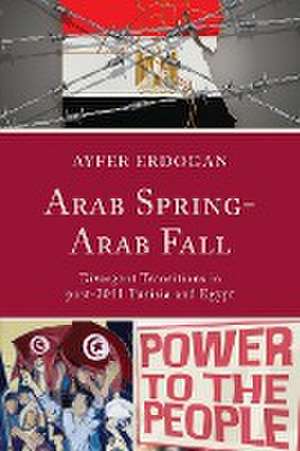
Arab Spring-Arab Fall: Divergent Transitions in post-2011 Tunisia and Egypt
Autor Ayfer Erdoganen Limba Engleză Paperback – 10 feb 2023
Preț: 222.24 lei
Preț vechi: 307.73 lei
-28%
Puncte Express: 333
Carte tipărită la comandă
Livrare economică 30 noiembrie-14 decembrie
Livrare prin curier în România Termenul estimat este afișat lângă disponibilitate.
Transport gratuit de la 400.00 lei Plată online sau ramburs, în funcție de opțiunile comenzii.
Retur gratuit în 14 zile Comandă securizată și suport în română.
Specificații
ISBN-13: 9781793610690
ISBN-10: 179361069X
Pagini: 272
Ilustrații: 2 b/w illustrations;2 tables;
Dimensiuni: 151 x 229 x 20 mm
Greutate: 0.4 kg
Editura: Bloomsbury Publishing
Colecția Lexington Books
Locul publicării:New York, United States
ISBN-10: 179361069X
Pagini: 272
Ilustrații: 2 b/w illustrations;2 tables;
Dimensiuni: 151 x 229 x 20 mm
Greutate: 0.4 kg
Editura: Bloomsbury Publishing
Colecția Lexington Books
Locul publicării:New York, United States
Cuprins
Chapter I: On Democracy and Democratic Transitions
Chapter II: Democratization in the Arab Middle East Context
Chapter III: Tunisian Revolution
Chapter IV: Egypt's Failed Revolution
Chapter V: Democratic Divergence between Egypt and Tunisia in the Post-Arab Spring Context
Chapter II: Democratization in the Arab Middle East Context
Chapter III: Tunisian Revolution
Chapter IV: Egypt's Failed Revolution
Chapter V: Democratic Divergence between Egypt and Tunisia in the Post-Arab Spring Context
Recenzii
Based on the author's doctoral dissertation, this volume contextualizes a comparative political analysis of what has been popularly referred to as the Arab Spring. The central theme is the initiation of regime change from authoritarianism to some form of democracy, focusing on Tunisia in 2011, where this process has been somewhat successful, as compared to Egypt, the most powerful nation in the Arab world, where the process has largely failed. Erdogan provides a comprehensive literature review on democratic political theory in general, followed by a literature review on the occurrence of the phenomenon in the Arab Middle East. He notes that the differing role of civil society in both countries led to different outcomes in their respective transitions. Erdogan points out that the transition process requires political elites to reach consensus on the goals for the transition to democracy, setting aside partisan interests. In the case studies selected, the rise of Islamic groups was hindered by effective political leadership in Tunisia, which Egypt lacked. Ultimately, there is no clear path for a transition from an authoritarian regime to some sort of democratic structure. Recommended. Advanced undergraduates through faculty; professionals.
Notă biografică
Ayfer Erdogan is Lecturer at the Department of Modern Languages, Yildiz Technical University, Istanbul. Her research focuses on Third Wave of Democratization, Authoritarianism, Mass Movements, Civil Society and the Middle East Politics. She has published widely on Democratic Transitions, Arab Spring, Turkish Foreign Policy, Islamist Movements/ Parties and contemporary issues surrounding the Middle East Politics. She is the author of Arab Spring-Arab Fall: Divergent Transitions of Tunisia and Egypt post Arab-Spring.