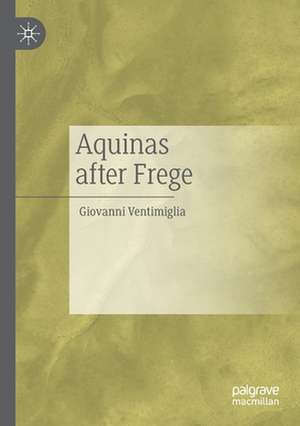
Aquinas after Frege
Autor Giovanni Ventimigliaen Limba Engleză Paperback – 23 sep 2021
This book provides a fresh reading of Aquinas’ metaphysics in the light of insights from the works of Frege. In particular, Ventimiglia argues that Aquinas’ doctrine of being can be better understood through Frege’s distinction between the ‘there is’ sense and the ‘present actuality’ sense of being, as interpreted by Peter Geach and Anthony Kenny. Aquinas’ notion of essence becomes clearer in the light of Frege’s distinction between objects and concepts and his account of concepts as functions. Aquinas’ doctrine of trancendentals is clarified with the help of Frege’s accounts of assertion and negation.
Aquinas after Frege provides us with a new Aquinas, which pays attention to his texts and their historical context. Ventimiglia’s development of ‘British Thomism’ furnishes us with a lucid and exciting re-reading of Aquinas’ metaphysics.
Aquinas after Frege provides us with a new Aquinas, which pays attention to his texts and their historical context. Ventimiglia’s development of ‘British Thomism’ furnishes us with a lucid and exciting re-reading of Aquinas’ metaphysics.
Preț: 562.35 lei
Preț vechi: 661.58 lei
-15%
Puncte Express: 844
Carte tipărită la comandă
Livrare economică 23 noiembrie-07 decembrie
Livrare prin curier în România Termenul estimat este afișat lângă disponibilitate.
Transport gratuit pentru acest produs Plată online sau ramburs, în funcție de opțiunile comenzii.
Retur gratuit în 14 zile Comandă securizată și suport în română.
Specificații
ISBN-13: 9783030483302
ISBN-10: 3030483304
Pagini: 292
Ilustrații: XVII, 274 p.
Dimensiuni: 148 x 210 x 16 mm
Greutate: 0.38 kg
Ediția:1st ed. 2020
Editura: Springer
Locul publicării:Cham, Switzerland
ISBN-10: 3030483304
Pagini: 292
Ilustrații: XVII, 274 p.
Dimensiuni: 148 x 210 x 16 mm
Greutate: 0.38 kg
Ediția:1st ed. 2020
Editura: Springer
Locul publicării:Cham, Switzerland
Cuprins
1. State of the Art.- 2.Being.- 3. Essence.- 4. Transcendentals.- 5. The Sense of Being in Context.- 6. Conclusions.
Notă biografică
Giovanni Ventimiglia is Full Professor of Philosophy and Vice Dean of the Faculty of Theology at the University of Lucerne, Switzerland. Founder of the Lugano Institute for Philosophical Studies in 2003, he teaches medieval philosophy and ontology, and has published widely in these fields, including: Is the Thomistic Doctrine of God as "Ipsum Esse Subsistens" Consistent? (2018), Tommaso d’Aquino (2014), To be o esse? (2012) and Differenza e contraddizione(1997).
Textul de pe ultima copertă
This book provides a fresh reading of Aquinas’ metaphysics in the light of insights from the works of Frege. In particular, Ventimiglia argues that Aquinas’ doctrine of being can be better understood through Frege’s distinction between the ‘there is’ sense and the ‘present actuality’ sense of being, as interpreted by Peter Geach and Anthony Kenny. Aquinas’ notion of essence becomes clearer in the light of Frege’s distinction between objects and concepts and his account of concepts as functions. Aquinas’ doctrine of trancendentals is clarified with the help of Frege’s accounts of assertion and negation.
Aquinas after Frege provides us with a new Aquinas, which pays attention to his texts and their historical context. Ventimiglia’s development of ‘British Thomism’ furnishes us with a lucid and exciting re-reading of Aquinas’ metaphysics.
Aquinas after Frege provides us with a new Aquinas, which pays attention to his texts and their historical context. Ventimiglia’s development of ‘British Thomism’ furnishes us with a lucid and exciting re-reading of Aquinas’ metaphysics.