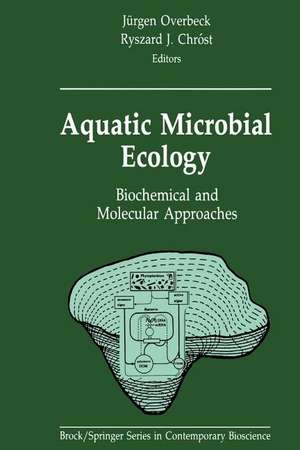
Aquatic Microbial Ecology: Brock Springer Series in Contemporary Bioscience
Editat de Jürgen Overbeck, Ryszard J. Chrosten Limba Engleză Paperback – 3 oct 2011

Preț: 639.32 lei
Preț vechi: 752.14 lei
-15%
Puncte Express: 959
Carte tipărită la comandă
Livrare economică 01-15 decembrie
Livrare prin curier în România Termenul estimat este afișat lângă disponibilitate.
Transport gratuit pentru acest produs Plată online sau ramburs, în funcție de opțiunile comenzii.
Retur gratuit în 14 zile Comandă securizată și suport în română.
Specificații
ISBN-13: 9781461279914
ISBN-10: 1461279917
Pagini: 204
Ilustrații: X, 190 p.
Dimensiuni: 155 x 235 x 12 mm
Greutate: 0.32 kg
Ediția:Softcover reprint of the original 1st ed. 1990
Editura: Springer
Colecția Brock Springer Series in Contemporary Bioscience
Seria Brock Springer Series in Contemporary Bioscience
Locul publicării:New York, NY, United States
ISBN-10: 1461279917
Pagini: 204
Ilustrații: X, 190 p.
Dimensiuni: 155 x 235 x 12 mm
Greutate: 0.32 kg
Ediția:Softcover reprint of the original 1st ed. 1990
Editura: Springer
Colecția Brock Springer Series in Contemporary Bioscience
Seria Brock Springer Series in Contemporary Bioscience
Locul publicării:New York, NY, United States
V-ar putea interesa
-
 Ecology and Evolution of the Grass-Endophyte SymbiosisGregory P. Cheplick-31%Preț: 676.72 lei983.23 lei
 -
 Fundamental Processes in Ecology: An Earth Systems ApproachDavid M. Wilkinson-21%Preț: 293.37 lei370.30 lei
 -
 The Biology of Polar RegionsD.N. Thomas-22%Preț: 475.76 lei611.91 lei
 -
 Allee Effects in Ecology and ConservationFranck Courchamp-26%Preț: 426.03 lei575.06 lei
 -
 -18%Preț: 940.29 lei1146.70 lei
 -
 -28%Preț: 433.06 lei605.28 lei
 -
 Environmental BiologyMike Calver-23%Preț: 812.68 lei1055.42 lei
 -
 Too Smart for our Own GoodCraig Dilworth-8%Preț: 434.91 lei472.73 lei
 -
 Aquatic EcosystemsNicholas V. C. Polunin-14%Preț: 1084.83 lei1261.43 lei
 -
 Ecological Developmental BiologyScott F. GilbertPreț: 384.26 lei
 -
 Reintroduction BiologyJohn G Ewen-8%Preț: 481.81 lei523.70 lei
 -
 -23%Preț: 616.84 lei801.09 lei
 -
 Preț: 427.21 lei
 -
 Marine Conservation EcologyJohn Roff-15%Preț: 584.04 lei687.10 lei
 -
 The Ecology of Browsing and GrazingIain J. Gordon-18%Preț: 922.01 lei1124.41 lei
 -
 How Likely is Extraterrestrial Life?J. Woods HalleyPreț: 382.81 lei
Public țintă
ResearchCuprins
1 Introduction: Aims, Problems, and Solutions in Aquatic Microbial Ecology.- 1.1 The aims of microbial ecology.- 1.2 Novel solutions to “old” problems.- References.- 2 Origin, Composition and Microbial Utilization of Dissolved Organic Matter.- 2.1 Introduction.- 2.2 Origin and fate of dissolved organic matter.- 2.3 Concentration and characteristics of dissolved organic matter.- 2.4 Dissolved organic matter released by phytoplankton.- 2.5 Glycolic acid: a model compound of algal release.- 2.6 Dissolved free amino acids.- 2.7 Dissolved free carbohydrates.- 2.8 Polyphenols.- 2.9 Conclusions.- References.- 3 Microbial Ectoenzymes in Aquatic Environments.- 3.1 Introduction.- 3.2 Definition of an ectoenzyme.- 3.3 Association of ectoenzymes with microbial cells.- 3.4 Ectoenzyme secretion.- 3.5 Molecular control of ectoenzyme synthesis.- 3.6 Environmental control of ectoenzyme synthesis and activity in aquatic ecosystems.- 3.7 Methods for assaying ectoenzymes.- 3.8 Significance of ectoenzymesin aquatic environments.- References.- 4 Aspects of Aquatic Microbial Carbon Metabolism: Regulation of Phosphoenolpyruvate Carboxylase.- 4.1 Introduction.- 4.2 Basic strategies of biochemical adaptation to the environment.- 4.3 Anaplerotic reactions.- 4.4 Complexity of CO2 dark uptake.- 4.5 Phosphoenolpyruvate carboxylase.- 4.6 Assays, preparation and kinetic properties of phoshoenolpyruvate carboxylase.- 4.7 Regulation of phosphoenolpyruvate carboxylase by effectors.- 4.8 Phosphoenolpyruvate carboxylase and phosphoenolpyruvate carboxykinase.- 4.9 Concluding remarks: biochemical approaches at the ecosystem level.- References.- 5 Approaches to Bacterial Population Dynamics.- 5.1 Introduction.- 5.2 Numerical taxonomic approaches.- 5.3 Immunological approaches.- 5.4 Molecular approaches.- 5.5 Isoenzymes and genetic diversity.- 5.6 Future prospects.- References.- 6 RNA Chemotaxonomy of Bacterial Isolates and Natural Microbial Communities.- 6.1 Ecological relevance of bacterial taxonomy.- 6.2 Systematics of bacteria based on nucleic acids analysis.- 6.3 The concept of RNA chemotaxonomy.- 6.4 Methodology for the analysis of pure cultures by RNA profiles.- 6.5 General results of RNA profiles from pure cultures.- 6.6 Identification of bacterial isolates by RNA chemotaxonomy.- 6.7 Analysis of mixed bacterial cultures.- 6.8 Analysis of natural bacterial communities.- 6.9 Conclusions and future developments.- References.- 7 Plasmids and Their Role in Natural Aquatic Bacterial Communities.- 7.1 Introduction.- 7.2 Ecogenetics: a new concept of microbial ecology.- 7.3 Plasmids in natural bacterial communities of some aquatic habitats.- 7.4 Open questions.- 7.5 Molecular techniques.- 7.6 Future ecogenetics.- References.