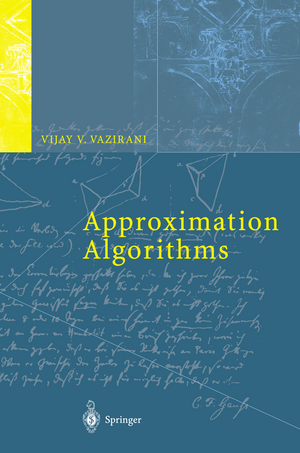
Approximation Algorithms
Autor Vijay V. Vaziranien Limba Engleză Hardback – 2 iul 2001
Resursele teoretice și algoritmii prezentați în acest volum oferă fundamentul matematic necesar pentru a aborda problemele de optimizare NP-grele, unde soluțiile exacte sunt computațional prohibitive. Approximation Algorithms nu se limitează la o simplă enumerare de tehnici, ci cartografiază riguros peisajul aproximabilității prin demonstrații structurate și analiză de factori de performanță. Apreciem în mod deosebit modul în care Vijay V. Vazirani evită categorisirea rigidă în prima parte a cărții, preferând să evidențieze caracterul individual al fiecărei probleme, de la Steiner Tree la rucsac (Knapsack) sau planificarea pe mașini paralele.
Structura volumului este una progresivă: începe cu metode combinatoriale intuitive, avansează către tehnici sofisticate bazate pe dualitate LP (Linear Programming) și culminează cu discuții despre limitele inferioare ale aproximării. Ca și David P. Williamson în The Design of Approximation Algorithms, autorul distilează experiența reală în principii acționabile, oferind instrumente matematice care transformă problemele teoretic insolubile în soluții practice cu garanții provabile. Față de lucrarea sa ulterioară, Online and Matching-Based Market Design, care se concentrează pe impactul economic și sociologic al algoritmilor de potrivire, acest titlu rămâne pilonul central de referință pentru teoria pură a algoritmilor de aproximare.
Fiecare din cele 30 de capitole este conceput să ghideze cititorul prin nuanțele proiectării algoritmice, incluzând tehnici precum programarea semidefinită și metode de numărare. Găsim în această carte nu doar soluții, ci și o perspectivă critică asupra a ceea ce face o problemă „greu de aproximat”, pregătind terenul pentru cercetare avansată în informatică teoretică.
Preț: 595.17 lei
Preț vechi: 743.97 lei
-20%
Carte tipărită la comandă
Livrare economică 01-15 decembrie
Specificații
ISBN-10: 3540653678
Pagini: 404
Ilustrații: XIX, 380 p.
Dimensiuni: 155 x 235 x 27 mm
Greutate: 0.7 kg
Ediția:2001
Editura: Springer Berlin, Heidelberg
Colecția Springer
Locul publicării:Berlin, Heidelberg, Germany
V-ar putea interesa
-
 -20%Preț: 209.98 lei262.47 lei
 -
 -20%Preț: 2116.13 lei2645.16 lei
 -
 The Nature of ComputationCristopher Moore-22%Preț: 643.73 lei820.35 lei
 -
 Algorithms UnlockedThomas H. Cormen-26%Preț: 189.43 lei256.67 lei
 -
 AlgorithmsRobert Sedgewick-20%Preț: 567.71 lei709.63 lei
 -
 Programming ChallengesSteven S Skiena-20%Preț: 484.25 lei605.31 lei
 -
 Combinatorial OptimizationChristos H. Papadimitriou-23%Preț: 147.25 lei192.34 lei
 -
 Combinatorial OptimizationEugene LawlerPreț: 138.69 lei
 -
 Introductory Discrete MathematicsV. K. Balakrishnan-18%Preț: 100.50 lei122.92 lei
 -
 Tardos, E: Algorithm DesignEva Tardos-11%Preț: 722.97 lei812.32 lei
 -
 Handbook of Combinatorial OptimizationPanos M. Pardalos-18%Preț: 3596.81 lei4386.35 lei
 -
 Assignment ProblemsRainer Burkard-9%Preț: 721.94 lei793.34 lei
 -
 The Algorithm Design ManualSteven S. Skiena-20%Preț: 421.03 lei526.30 lei
 -
 Algorithms and ComplexityIrene Finocchi-20%Preț: 502.85 lei628.57 lei
 -
 Handbook of HeuristicsRafael Martí-24%Preț: 5679.41 lei7472.92 lei
 -
 Approximation and Online AlgorithmsKlaus Jansen-20%Preț: 321.36 lei401.70 lei
 -
 -20%Preț: 828.44 lei1035.55 lei
 -
 -20%Preț: 662.02 lei827.52 lei
 -
 -20%Preț: 672.95 lei841.18 lei
 -
 -20%Preț: 318.30 lei397.88 lei
Public țintă
ResearchDe ce să citești această carte
Această lucrare este esențială pentru cercetătorii și inginerii software care se confruntă cu probleme de optimizare complexă. Cititorul câștigă o înțelegere profundă a modului în care pot fi obținute soluții eficiente, provabile, pentru probleme NP-grele. Este un ghid tehnic riguros care transformă teoria complexității într-un instrument de lucru aplicabil în designul algoritmilor moderni.
Despre autor
Vijay V. Vazirani este un cercetător de renume mondial în domeniul informaticii teoretice, deținând un doctorat de la UC Berkeley și fiind Fellow al ACM. Cariera sa s-a concentrat pe proiectarea algoritmilor eficienți, cu contribuții majore în teoria complexității, criptografie și teoria jocurilor. Publicată inițial în 2001, Approximation Algorithms este considerată lucrarea definitivă în domeniu, fiind tradusă în multiple limbi și utilizată ca referință academică globală. Expertiza sa interdisciplinară se reflectă în rigoarea și claritatea cu care abordează structurile matematice complexe.
Descriere scurtă
Cuprins
Recenzii
"Approximation algorithms is an area where much progress has been made in the last 10 years. The book under review is a very good help for understanding these results. In each of the 27 chapters an important combinatorial optimization problem is presented and one or more approximation algorithms for it are clearly and concisely described and analyzed. In this way most of the most important results from the approximation algorithm literature are covered, often more easily comprehensible than the original articles." (Viggo Kann, Zentralblatt MATH, Vol. 1005, 2003)
"The book under review concentrates on the … design and analysis of efficient approximation algorithms with good performance guarantees. It is possibly the first textbook to provide an extensive and systematic coverage of this topic. … The book starts briskly, using simple examples to illustrate some of the key concepts and draw the reader rapidly in. … Copious exercises are included to test and deepen the reader’s understanding. … It deserves a place in every computer science and mathematical library." (Mark R. Jerrum, Mathematical Reviews, 2002 h)
"The book of Vijay Vazirani is not the first one dedicated to approximation algorithms … . However it is, I believe, among the very best from a didactical point of view: this is the text I would chose, would I have to give a course on approximation algorithms … . I suspect that for many researchers it would be the first one to consult … . It is a must acquisition for libraries of computer science/engineering departments … ." (Francesco Maffioli, Mathematical Methods of Operations Research, Vol. 56 (2), 2002)
"The book gives an overview on the theory of approximation algorithms. It presents the most important problems, the basic methods and ideas which are used in this area. … The book can be used for a graduate course on approximation algorithms. … The chapters also contain asection of exercises, which can help the students to understand the material in a deeper way. … On the other hand the book can be used by the researchers of the field … ." (Csanád Imreh, Acta Scientiarum Mathematicarum, Vol. 68, 2002)
Textul de pe ultima copertă
Richard Karp,University Professor, University of California at Berkeley
Following the development of basic combinatorial optimization techniques in the 1960s and 1970s, a main open question was to develop a theory of approximation algorithms. In the 1990s, parallel developments in techniques for designing approximation algorithms as well as methods for proving hardness of approximation results have led to a beautiful theory. The need to solve truly large instances of computationally hard problems, such as those arising from the Internet or the human genome project, has also increased interest in this theory. The field is currently very active, with the toolbox of approximation algorithm design techniques getting always richer.
It is a pleasure to recommend Vijay Vazirani's well-written and comprehensive book on this important and timely topic. I am sure the reader will find it most useful both as an introduction to approximability as well as a reference to the many aspects of approximation algorithms.
László Lovász, Senior Researcher, Microsoft Research