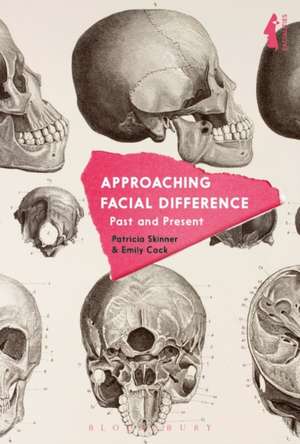
Approaching Facial Difference: Past and Present: Facialities: Interdisciplinary Approaches to the Human Face
Editat de Patricia Skinner, Emily Cocken Limba Engleză Hardback – 3 mai 2018
Faces are central to all human social interactions, yet their study has been much overlooked by disability scholars and historians of medicine alike. By examining the main linguistic, visual and material approaches to the face from antiquity to contemporary times, contributors place facial diversity at the heart of our historical and cultural narratives.
This cutting-edge collection of essays will be an invaluable resource for humanities scholars working across history, literature and visual culture, as well as modern practitioners in education and psychology.
Preț: 796.47 lei
Preț vechi: 1265.10 lei
-37%
Puncte Express: 1195
Carte tipărită la comandă
Livrare economică 03-17 decembrie
Livrare prin curier în România Termenul estimat este afișat lângă disponibilitate.
Transport gratuit pentru acest produs Plată online sau ramburs, în funcție de opțiunile comenzii.
Retur gratuit în 14 zile Comandă securizată și suport în română.
Specificații
ISBN-13: 9781350028296
ISBN-10: 1350028290
Pagini: 264
Ilustrații: 15 bw illus
Dimensiuni: 158 x 236 x 26 mm
Greutate: 0.54 kg
Editura: Bloomsbury Publishing
Colecția Bloomsbury Academic
Seria Facialities: Interdisciplinary Approaches to the Human Face
Locul publicării:London, United Kingdom
ISBN-10: 1350028290
Pagini: 264
Ilustrații: 15 bw illus
Dimensiuni: 158 x 236 x 26 mm
Greutate: 0.54 kg
Editura: Bloomsbury Publishing
Colecția Bloomsbury Academic
Seria Facialities: Interdisciplinary Approaches to the Human Face
Locul publicării:London, United Kingdom
Cuprins
List of Figures
List of Tables
Notes on Contributors
Acknowledgments
1. Introduction: Situating the Different Face, Patricia Skinner (Swansea University, UK) and Emily Cock (Swansea University, UK)
PART 1: LANGUAGE
2. Dis/enabling Courtesy and Chivalry in the Middle English and Early Modern Gawain Romances and Ballads, Bonnie Millar (University of Nottingham, UK)
3. 'A Great Blemish to her Beauty': Female Facial Disfigurement in Early Modern England, Michelle Webb (University of Exeter, UK)
4. Does Talking about Disfigurement Risk Perpetuating Stigma? Jane Frances (Changing Faces, UK)
PART 2: VISIBILITY
5. Hair Loss as Facial Disfigurement in Ancient Rome? Jane Draycott (University of Glasgow, UK)
6. Portrait? Likeness? Composite? Facial Difference in Forensic Art, Kathryn Smith (Liverpool John Moores University, UK)
7. From 'Staring' to 'Not Caring': Development of Psychological Growth and Wellbeing among Adults with Cleft Lip and Palate, Patricia Neville (University of Bristol, UK), Andrea Waylen (University of Bristol, UK), Sara Ryan (University of Oxford, UK) and Aidan Searle (University of Bristol, UK)
8. Making Up the Female Face: Pain and Imagination in the Music Videos of CocoRosie, Morna Laing (University of the Arts, London, UK)
PART 3: MATERIALITY
9. Archaeological Facial Depiction for People from the Past with Facial Differences, Caroline Wilkinson (Liverpool John Moores University, UK)
10. "Trotule (Trotula) Puts Many Things on to Decorate and Embellish the Face but I Intend Solely to Remove Infection": L'Abbe Poutrel and his Chirurgerie c.1300, Theresa Tyers (Swansea University, UK)
11. Disrupting Our Sense of the Past: Medical Photographs that Push Interpreters to the Limits of Historical Analysis, Jason Bate (University of Exeter, UK)
Bibliography
Index
List of Tables
Notes on Contributors
Acknowledgments
1. Introduction: Situating the Different Face, Patricia Skinner (Swansea University, UK) and Emily Cock (Swansea University, UK)
PART 1: LANGUAGE
2. Dis/enabling Courtesy and Chivalry in the Middle English and Early Modern Gawain Romances and Ballads, Bonnie Millar (University of Nottingham, UK)
3. 'A Great Blemish to her Beauty': Female Facial Disfigurement in Early Modern England, Michelle Webb (University of Exeter, UK)
4. Does Talking about Disfigurement Risk Perpetuating Stigma? Jane Frances (Changing Faces, UK)
PART 2: VISIBILITY
5. Hair Loss as Facial Disfigurement in Ancient Rome? Jane Draycott (University of Glasgow, UK)
6. Portrait? Likeness? Composite? Facial Difference in Forensic Art, Kathryn Smith (Liverpool John Moores University, UK)
7. From 'Staring' to 'Not Caring': Development of Psychological Growth and Wellbeing among Adults with Cleft Lip and Palate, Patricia Neville (University of Bristol, UK), Andrea Waylen (University of Bristol, UK), Sara Ryan (University of Oxford, UK) and Aidan Searle (University of Bristol, UK)
8. Making Up the Female Face: Pain and Imagination in the Music Videos of CocoRosie, Morna Laing (University of the Arts, London, UK)
PART 3: MATERIALITY
9. Archaeological Facial Depiction for People from the Past with Facial Differences, Caroline Wilkinson (Liverpool John Moores University, UK)
10. "Trotule (Trotula) Puts Many Things on to Decorate and Embellish the Face but I Intend Solely to Remove Infection": L'Abbe Poutrel and his Chirurgerie c.1300, Theresa Tyers (Swansea University, UK)
11. Disrupting Our Sense of the Past: Medical Photographs that Push Interpreters to the Limits of Historical Analysis, Jason Bate (University of Exeter, UK)
Bibliography
Index
Recenzii
This extraordinary collection of essays reveals the ways in which the intersections of gender, cultural notions of beauty and wholeness, and physical difference articulate how people in the West respond to human faces. By explicating the relationship between facial difference and notions of moral soundness, disease, and anxiety-and its apparent continuity throughout the whole of European history-the editors and contributors challenge readers and researchers to re-evaluate modern-day assumptions about beauty and difference based upon their presentation of the past.
This engaging multi-disciplinary study encourages us to 'look' at the face and its multiple facets from a variety of points of view. It is a much-needed first step in gaining a better, more holistic understanding of the face and its perceptions throughout time.
This engaging multi-disciplinary study encourages us to 'look' at the face and its multiple facets from a variety of points of view. It is a much-needed first step in gaining a better, more holistic understanding of the face and its perceptions throughout time.