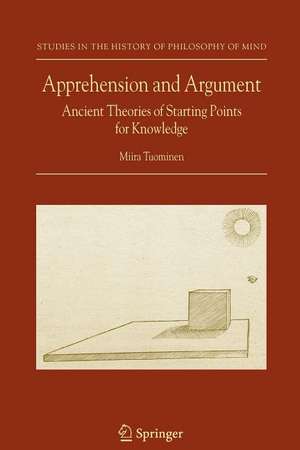
Apprehension and Argument
Autor Miira Tuominenen Limba Engleză Paperback – 30 noi 2010
This book offers the first synoptic study of how the primary elements in knowledge structures were analysed in antiquity from Plato to late ancient commentaries, the main emphasis being on the Platonic-Aristotelian tradition. It argues that, in the Platonic-Aristotelian tradition, the question of starting points was treated from two distinct points of view: from the first perspective, as a question of how we acquire basic knowledge; and from the second perspective, as a question of the premises we may immediately accept in the line of argumentation. It was assumed that we acquire some general truths rather naturally and that these function as starting points for inquiry. In the Hellenistic period, an alternative approach was endorsed: the very possibility of knowledge became a central issue when sceptics began demanding that true claims should always be distinguishable from false ones.
Preț: 951.01 lei
Preț vechi: 1159.77 lei
-18%
Puncte Express: 1427
Carte tipărită la comandă
Livrare economică 23 noiembrie-07 decembrie
Livrare prin curier în România Termenul estimat este afișat lângă disponibilitate.
Transport gratuit pentru acest produs Plată online sau ramburs, în funcție de opțiunile comenzii.
Retur gratuit în 14 zile Comandă securizată și suport în română.
Specificații
ISBN-13: 9789048172634
ISBN-10: 9048172632
Pagini: 344
Ilustrații: XIV, 328 p.
Dimensiuni: 155 x 235 x 19 mm
Greutate: 0.52 kg
Ediția:Softcover reprint of hardcover 1st edition 2007
Editura: Springer
Locul publicării:Dordrecht, Netherlands
ISBN-10: 9048172632
Pagini: 344
Ilustrații: XIV, 328 p.
Dimensiuni: 155 x 235 x 19 mm
Greutate: 0.52 kg
Ediția:Softcover reprint of hardcover 1st edition 2007
Editura: Springer
Locul publicării:Dordrecht, Netherlands
V-ar putea interesa
-
 Of Human FreedomEpictetus-21%Preț: 44.70 lei56.30 lei
 -
 The Philosophy of EpictetusTheodore Scaltsas-12%Preț: 319.46 lei362.25 lei
 -
 Oxford Studies in Ancient Philosophy, Volume 38Brad Inwood-22%Preț: 374.34 lei482.66 lei
 -
 Sayings and Anecdotes: with Other Popular MoralistsDiogenes the Cynic-19%Preț: 64.31 lei79.10 lei
 -
 Epicureanism at the Origins of ModernityCatherine Wilson-21%Preț: 347.60 lei440.35 lei
 -
 -21%Preț: 362.96 lei458.52 lei
 -
 Neoplatonism and the Philosophy of NatureJames Wilberding-31%Preț: 757.56 lei1100.18 lei
 -
 The Oxford Handbook of Presocratic PhilosophyPatricia Curd-29%Preț: 402.94 lei565.93 lei
 -
 Preț: 319.52 lei
 -
 The Cambridge Companion to EpicureanismJames WarrenPreț: 269.40 lei
 -
 The Cambridge Companion to Ancient ScepticismRichard BettPreț: 246.32 lei
 -
 Wisdom in the Ancient WorldTrevor Curnow-26%Preț: 193.48 lei259.90 lei
 -
 Introducing AristotleRupert WoodfinPreț: 63.50 lei
 -
 Introducing PlatoDave RobinsonPreț: 63.54 lei
Public țintă
ResearchCuprins
From the contents
Acknowledgements.- Abbreviations and a Note on the Texts.- Introduction.- Part I: Platonic-Aristotelian Tradition.- 1. Premises of Argumentation. 2. Intellectual Apprehension.- Part II: Alternative Approaches. 3. Hellenistic Philosophy.- Conclusion. Bibliography. Index of Contents. Index of Names.- Index of Cited Texts.
Acknowledgements.- Abbreviations and a Note on the Texts.- Introduction.- Part I: Platonic-Aristotelian Tradition.- 1. Premises of Argumentation. 2. Intellectual Apprehension.- Part II: Alternative Approaches. 3. Hellenistic Philosophy.- Conclusion. Bibliography. Index of Contents. Index of Names.- Index of Cited Texts.
Recenzii
"[...] provides some extraordinary insights into classical philosophy, insights that may prove to be useful to scholars who are willing to put the effort into pursuing them. [...] a valuable book for scholars of argument and rhetoric who are motivated enough to cross disciplinary lines." (David Hoffman, CUNY Baruch College, in Argumentation and Advocacy 47:1, 2010)
Textul de pe ultima copertă
If we know something, do we always know it through something else? Does this mean that the chain of knowledge should continue infinitely? Or, rather, should we abandon this approach and ask how we acquire knowledge? Irrespective of the fact that very basic questions concerning human knowledge have been formulated in various ways in different historical and philosophical contexts, philosophers have been surprisingly unanimous concerning the point that structures of knowledge should not be infinite. In order for there to be knowledge, there must be at least some primary elements which may be called ‘starting points’.
This book offers the first synoptic study of how the primary elements in knowledge structures were analysed in antiquity from Plato to late ancient commentaries, the main emphasis being on the Platonic-Aristotelian tradition. It argues that, in the Platonic-Aristotelian tradition, the question of starting points was treated from two distinct points of view: from the first perspective, as a question of how we acquire basic knowledge; and from the second perspective, as a question of the premises we may immediately accept in the line of argumentation. It was assumed that we acquire some general truths rather naturally and that these function as starting points for inquiry. In the Hellenistic period, an alternative approach was endorsed: the very possibility of knowledge became a central issue when sceptics began demanding that true claims should always be distinguishable from false ones.
This book offers the first synoptic study of how the primary elements in knowledge structures were analysed in antiquity from Plato to late ancient commentaries, the main emphasis being on the Platonic-Aristotelian tradition. It argues that, in the Platonic-Aristotelian tradition, the question of starting points was treated from two distinct points of view: from the first perspective, as a question of how we acquire basic knowledge; and from the second perspective, as a question of the premises we may immediately accept in the line of argumentation. It was assumed that we acquire some general truths rather naturally and that these function as starting points for inquiry. In the Hellenistic period, an alternative approach was endorsed: the very possibility of knowledge became a central issue when sceptics began demanding that true claims should always be distinguishable from false ones.
Caracteristici
The first synoptic research in monograph form concerning the theme of starting points for knowledge through the whole period from Plato to the late ancient commentators on Plato and Aristotle Unique in analyzing the most important common features and differences in various ancient theories about what kind of starting points are involved in knowledge Includes in a concise form discussions about some of the most central passages about this theme in the ancient texts Particularly important, because it provides a comprehensive picture of how passages and theories, which are often discussed in separate studies, are connected