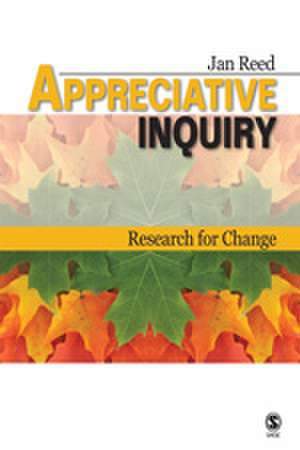
Appreciative Inquiry: Research for Change
Autor Jan Reeden Limba Engleză Hardback – 17 ian 2007
-A comprehensive introduction to AI and the range of debates that it generates for research.
-International; examples from recently published and unpublished research projects in which AI was used, with an emphasis on those that shaped policy, planning, and future practice.
-Discusses how connections can be made between AI and various research paradigms and approaches to research.
-Offers individual and group exercises that explore and illustrate ways in which AI research can be done.
| Toate formatele și edițiile | Preț | Express |
|---|---|---|
| Paperback (1) | 638.12 lei 6-8 săpt. | |
| SAGE Publications – 17 ian 2007 | 638.12 lei 6-8 săpt. | |
| Hardback (1) | 966.53 lei 6-8 săpt. | |
| SAGE Publications – 17 ian 2007 | 966.53 lei 6-8 săpt. |
Preț: 966.53 lei
Preț vechi: 1178.70 lei
-18%
Puncte Express: 1450
Preț estimativ în valută:
170.90€ • 197.51$ • 147.65£
170.90€ • 197.51$ • 147.65£
Carte tipărită la comandă
Livrare economică 04-18 mai
Specificații
ISBN-13: 9781412927468
ISBN-10: 1412927463
Pagini: 232
Dimensiuni: 152 x 229 x 17 mm
Greutate: 0.43 kg
Ediția:1
Editura: SAGE Publications
Colecția Sage Publications, Inc
Locul publicării:Thousand Oaks, United States
ISBN-10: 1412927463
Pagini: 232
Dimensiuni: 152 x 229 x 17 mm
Greutate: 0.43 kg
Ediția:1
Editura: SAGE Publications
Colecția Sage Publications, Inc
Locul publicării:Thousand Oaks, United States
V-ar putea interesa
-
 The Craft of Research, Fifth EditionWayne C. BoothPreț: 104.34 lei
 -
 -35%Preț: 182.52 lei278.92 lei
 -
 Positive Psychology and ChangeSarah LewisPreț: 250.83 lei
 -
 Practical Appreciative InquirySarah LewisPreț: 222.65 lei
 -
 Qualitative ResearchElizabeth J. TisdellPreț: 369.76 lei
 -
 Qualitative Research & Evaluation MethodsMichael Quinn Patton-23%Preț: 1012.60 lei1315.06 lei
 -
 -12%Preț: 371.72 lei422.38 lei
 -
 Appreciative InquiryDiana WhitneyPreț: 134.71 lei
 -
 Conversations Worth Having, Second EditionJackie Stavros-21%Preț: 117.06 lei148.78 lei
 -
 Building Resilience with Appreciative InquiryJoan Mcarthur-BlairPreț: 271.37 lei
 -
 Interpreting InterviewsMats AlvessonPreț: 367.34 lei
 -
 Original Inquiry: A Guide to Research for UndergraduatesMatthew James VechinskiPreț: 249.96 lei
 -
 The Appreciative Inquiry Handbook. For Leaders of ChangeDavid Cooperrider-35%Preț: 323.38 lei498.72 lei
 -
 Preț: 216.51 lei
 -
 -5%Preț: 493.20 lei519.15 lei
 -
 Preț: 95.07 lei
 -
 Research Methods in InformationAlison Jane Pickard-19%Preț: 519.12 lei640.89 lei
 -
 -21%Preț: 155.31 lei197.14 lei
Cuprins
Foreword
1. Experiences of Appreciative Inquiry
2. A Brief Tour of the History and Principles of Appreciative Inquiry
3. Research Frameworks: Where does Appreciative Inquiry Connect with Research?
4. Key Themes and Issues in Appreciative Inquiry
5. Developing Research Questions and Goals with Communities
6. Information Gathering and Generating: Inclusivity, Partnership, and Collaboration
7. Making Sense: Issues of Questions and Story
8. Communicating and Disseminating Research: Voice, Audience, and Message
9. Research for Change: Ways to Go
1. Experiences of Appreciative Inquiry
2. A Brief Tour of the History and Principles of Appreciative Inquiry
3. Research Frameworks: Where does Appreciative Inquiry Connect with Research?
4. Key Themes and Issues in Appreciative Inquiry
5. Developing Research Questions and Goals with Communities
6. Information Gathering and Generating: Inclusivity, Partnership, and Collaboration
7. Making Sense: Issues of Questions and Story
8. Communicating and Disseminating Research: Voice, Audience, and Message
9. Research for Change: Ways to Go
Notă biografică
Jan Reed (PhD, Nursing, Newcastle) is Professor of Health Care for Older People and Director of the Center for the Care of Older People at Northumbria University. Reed has been a lecturer and researcher since 1987, teaching nurses, social workers and other professionals in research methods and reflective practice, from undergraduate to post-doctoral levels. Currently, she is supervising 8 PhD students. 5 of whom are using Appreciative Inquiry as a research framework. She has examined 12 PhD theses, in the fields of health, social care, social science and education. Over the past 10 years, Dr. Reed has written and published extensively. She has published 60 journal papers, 10 research reports and 5 books (2 edited and 3 authored). In addition, she has edited two academic journals (Health Care in Later Life Edward Arnold, International Journal of Older People Nursing, Blackwell) and has been a paper reviewer for a range of journals including Social Science and Medicine and Health and Social Care the Community. She has also acted as a proposal reviewer for a range of funders, including the Department of health and the Joseph Rowntree Foundation in the UK.
Descriere
Appreciative Inquiry: Research for Change is the first book to explore in depth the issues that arise when appreciative inquiry is used as a research framework, rather than an organizational development tool. Author Jan Reed draws upon her own experience of using Appreciative Inquiry (AI) as a research approach—shaping the asking of questions, the gathering of information, and the communication of ideas.