
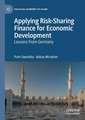
Applying Risk-Sharing Finance for Economic Development: Political Economy of Islam
Autor Putri Swastika, Abbas Mirakhoren Limba Engleză Hardback – 14 sep 2021

Preț: 748.98 lei
Preț vechi: 913.40 lei
-18%
Puncte Express: 1123
Carte tipărită la comandă
Livrare economică 04-18 decembrie
Livrare prin curier în România Termenul estimat este afișat lângă disponibilitate.
Transport gratuit pentru acest produs Plată online sau ramburs, în funcție de opțiunile comenzii.
Retur gratuit în 14 zile Comandă securizată și suport în română.
Specificații
ISBN-13: 9783030826413
ISBN-10: 3030826414
Pagini: 156
Ilustrații: IX, 143 p. 6 illus., 1 illus. in color.
Dimensiuni: 153 x 216 x 14 mm
Greutate: 0.28 kg
Ediția:1st ed. 2021
Editura: Palgrave MacMillan
Colecția Political Economy of Islam
Seria Political Economy of Islam
Locul publicării:Cham, Switzerland
ISBN-10: 3030826414
Pagini: 156
Ilustrații: IX, 143 p. 6 illus., 1 illus. in color.
Dimensiuni: 153 x 216 x 14 mm
Greutate: 0.28 kg
Ediția:1st ed. 2021
Editura: Palgrave MacMillan
Colecția Political Economy of Islam
Seria Political Economy of Islam
Locul publicării:Cham, Switzerland
Cuprins
Chapter 1. Introduction.- Chapter 2: Risk-sharing Economy: A Framework.- Chapter 3. Historical Review of Risk Sharing Instruments.- Chapter 4. Historical Roots of the German Economy.- Chapter 5. German Macroeconomic Policy(1933-1935).- Chapter 6. Summary, Conclusions and Policy Recommendations.
Textul de pe ultima copertă
This book examines the application of risk-sharing finance as a national economic policy in history and how it stimulated economic recovery during a short period in Germany between 1933 and 1935. Economic history indicates that risk-sharing instruments have promoted socio-economic development in many parts of the world while risk-shifting methods have imposed huge socio-economic costs on many nations, leading to debt slavery on individual members. This book highlights lessons to be learned from history and argues that risk-sharing is a powerful tool for generating rapid economic recovery and resumption of growth.
Putri Swastika is a Lecturer at the State Islamic Institute Metro (IAIN Metro), Indonesia.
Abbas Mirakhor has been teaching at various universities for 25 years and served at IMF as a staff member and an executive director for 24 years.
Abbas Mirakhor has been teaching at various universities for 25 years and served at IMF as a staff member and an executive director for 24 years.
Caracteristici
Highlights the potential of non-debt creating, risk-sharing finance as a national policy Provides historical support for promoting risk-sharing finance as a viable alternative to risk transfer Offers valuable lessons to achieve sustainable development, post-COVID