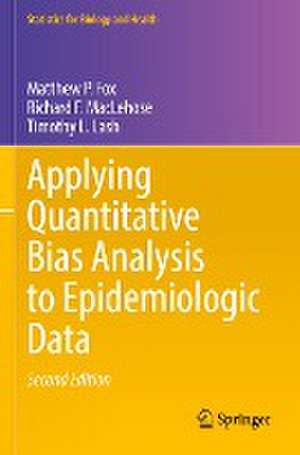
Applying Quantitative Bias Analysis to Epidemiologic Data: Statistics for Biology and Health
Autor Matthew P. Fox, Richard F. MacLehose, Timothy L. Lashen Limba Engleză Paperback – 26 mar 2023
As computational power available to analysts has improved and epidemiologic problems have become more advanced, missing data, Bayes, and empirical methods have become more commonly used. This new edition features updated examples throughout and adds coverage addressing:
- Measurement error pertaining to continuous and polytomous variables
- Methods surrounding person-time (rate) data
- Bias analysis using missing data, empirical (likelihood), and Bayes methods
| Toate formatele și edițiile | Preț | Express |
|---|---|---|
| Paperback (1) | 376.37 lei 3-5 săpt. | |
| Springer International Publishing – 26 mar 2023 | 376.37 lei 3-5 săpt. | |
| Hardback (1) | 429.77 lei 3-5 săpt. | |
| Springer International Publishing – 25 mar 2022 | 429.77 lei 3-5 săpt. |
Din seria Statistics for Biology and Health
- 18%
 Preț: 868.56 lei
 - 5%
 Preț: 816.17 lei
 - 18%
 Preț: 1340.49 lei
 - 15%
 Preț: 571.32 lei
 - 18%
 Preț: 1340.96 lei
 - 18%
 Preț: 1080.88 lei
 - 5%
 Preț: 840.97 lei
 -
 Preț: 374.34 lei
 - 15%
 Preț: 625.57 lei
 - 15%
 Preț: 563.34 lei
 - 5%
 Preț: 1050.03 lei
 - 18%
 Preț: 921.36 lei
 - 15%
 Preț: 628.24 lei
 - 18%
 Preț: 2032.28 lei
 - 5%
 Preț: 819.70 lei
 - 15%
 Preț: 608.56 lei
 - 18%
 Preț: 1340.49 lei
 - 15%
 Preț: 678.83 lei
 - 5%
 Preț: 693.55 lei
 - 15%
 Preț: 627.93 lei
 - 18%
 Preț: 700.55 lei
 - 5%
 Preț: 694.80 lei
 - 15%
 Preț: 632.02 lei
 - 18%
 Preț: 923.62 lei
 - 18%
 Preț: 849.32 lei
 - 5%
 Preț: 811.25 lei
 - 5%
 Preț: 363.51 lei
 -
 Preț: 382.10 lei
 - 20%
 Preț: 963.69 lei
 - 5%
 Preț: 693.55 lei
 - 20%
 Preț: 684.79 lei
 - 18%
 Preț: 895.45 lei
 - 18%
 Preț: 1065.87 lei
 - 5%
 Preț: 789.63 lei
 - 18%
 Preț: 922.72 lei
 - 18%
 Preț: 1339.89 lei
 - 18%
 Preț: 1177.32 lei
Preț: 376.37 lei
Preț vechi: 442.78 lei
-15%
Puncte Express: 565
Preț estimativ în valută:
66.57€ • 78.94$ • 57.100£
66.57€ • 78.94$ • 57.100£
Carte indisponibilă temporar
Specificații
ISBN-13: 9783030826758
ISBN-10: 3030826759
Pagini: 467
Ilustrații: XVI, 467 p. 76 illus., 39 illus. in color.
Dimensiuni: 155 x 235 x 32 mm
Greutate: 0.67 kg
Ediția:2nd ed. 2021
Editura: Springer International Publishing
Colecția Springer
Seria Statistics for Biology and Health
Locul publicării:Cham, Switzerland
ISBN-10: 3030826759
Pagini: 467
Ilustrații: XVI, 467 p. 76 illus., 39 illus. in color.
Dimensiuni: 155 x 235 x 32 mm
Greutate: 0.67 kg
Ediția:2nd ed. 2021
Editura: Springer International Publishing
Colecția Springer
Seria Statistics for Biology and Health
Locul publicării:Cham, Switzerland
Cuprins
1. Introduction and Objectives.- 2. A Guide to Implementing Quantitative Bias Analysis.- 3. Data Sources for Bias Analysis.- 4. Selection Bias.- 5. Uncontrolled Confounders.- 6. Misclassification.- 7. Measurement Error for Continuous Variables.- 8. Multiple Bias Modeling.- 8. Bias Analysis by Simulation for Summary Level Data.- 9. Bias Analysis by Simulation for Record Level Data.- 10. Combining Systematic and Random Error.- 11. Bias Analysis by Missing Data Methods.- 12. Bias Analysis by Empirical Methods.- 13. Bias Analysis by Bayesian Methods.- 14. Multiple Bias Modeling.- 15. Good Practices for Quantitative Bias Analysis.- 15. Presentation and Inference.- References.- Index.
Notă biografică
Timothy Lash, D.Sc., M.P.H., is professor in the Department of Epidemiology at the Rollins School of Public Health and honorary professor of cancer epidemiology in the Department of Clinical Epidemiology at Aarhus University in Aarhus, Denmark. Dr. Lash is also past-President of the Society for Epidemiologic Research (SER) for the 2014-2015 term. His research focuses on predictors of cancer recurrence, including molecular predictors of treatment effectiveness and late recurrence, and he also researches methods and applications of quantitative bias analysis.
Matthew Fox, D.Sc., M.P.H, is associate professor in the Center for Global Health & Development and in the Department of Epidemiology at Boston University. Before joining Boston University, he was a Peace Corps volunteer in the former Soviet Republic of Turkmenistan. Dr. Fox is currently funded through a K award from the National Institutes of Allergy and Infectious Diseases to work on ways to improve retention in HIV-care programs in South Africa from time of testing HIV-positive through long-term treatment. His research interests include treatment outcomes in HIV-treatment programs, infectious disease epidemiology, and epidemiological methods, including quantitative bias analysis.
Richard MacLehose, Ph.D., is associate professor in the Division of Epidemiology and Community Health at the University of Minnesota. Dr. MacLehose received his M.S. in epidemiology from the University of Washington and his Ph.D. in epidemiology from the University of North Carolina. His research interests include Bayesian statistics (including bias analysis), epidemiologic methods, applied biostatistics, and reproductive and environmental health.
Richard MacLehose, Ph.D., is associate professor in the Division of Epidemiology and Community Health at the University of Minnesota. Dr. MacLehose received his M.S. in epidemiology from the University of Washington and his Ph.D. in epidemiology from the University of North Carolina. His research interests include Bayesian statistics (including bias analysis), epidemiologic methods, applied biostatistics, and reproductive and environmental health.
Textul de pe ultima copertă
This textbook and guide focuses on methodologies for bias analysis in epidemiology and public health, not only providing updates to the first edition but also further developing methods and adding new advanced methods.
As computational power available to analysts has improved and epidemiologic problems have become more advanced, missing data, Bayes, and empirical methods have become more commonly used. This new edition features updated examples throughout and adds coverage addressing:
As computational power available to analysts has improved and epidemiologic problems have become more advanced, missing data, Bayes, and empirical methods have become more commonly used. This new edition features updated examples throughout and adds coverage addressing:
- Measurement error pertaining to continuous and polytomous variables
- Methods surrounding person-time (rate) data
- Bias analysis using missing data, empirical (likelihood), and Bayes methods
Caracteristici
Employs theory and skills to illustrate epidemiologic biases through a quantitative lens Features step-by-step examples for every method Includes guidance on best practices for bias analysis