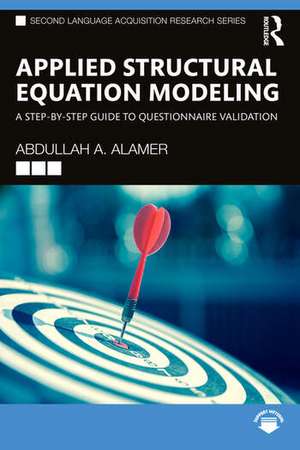
Applied Structural Equation Modeling: A Step-by-Step Guide to Validating Instruments: Second Language Acquisition Research Series
Autor Abdullah A. Alameren Limba Engleză Paperback – 30 mar 2027
The volume is distinctive in its systematic integration of common factor models and composite models, offering clear guidance on when and how to use techniques such as EFA, CFA, ESEM, set-ESEM, and CCA. It reflects the latest developments in SEM, including the recent implementation of composites within standard maximum likelihood estimation. Featuring simulated datasets and annotated outputs illustrating each method in action, Alamer presents these innovations in an accessible and applied manner. The book emphasizes transparent reasoning, minimal reliance on complex mathematics, and step-by-step tutorials using free software such as Jamovi and lavaangui. Each chapter combines theoretical justification with hands-on application and concludes with guidance on leveraging generative AI tools to enhance methodological rigor.
Designed for researchers, graduate students, and advanced practitioners in applied linguistics, psychology, education, and related social sciences, this valuable resource serves as both a reference and a course text in quantitative research methods, questionnaire design, and psychometric validation.
Din seria Second Language Acquisition Research Series
- 18%
 Preț: 1019.31 lei
 - 15%
 Preț: 473.04 lei
 - 15%
 Preț: 422.82 lei
 - 15%
 Preț: 563.69 lei
 - 8%
 Preț: 433.38 lei
 - 15%
 Preț: 563.70 lei
 -
 Preț: 445.17 lei
 -
 Preț: 368.65 lei
 -
 Preț: 441.29 lei
 - 15%
 Preț: 421.51 lei
 - 15%
 Preț: 545.99 lei
 - 15%
 Preț: 485.98 lei
 - 15%
 Preț: 451.38 lei
 - 15%
 Preț: 415.55 lei
 - 15%
 Preț: 476.07 lei
 -
 Preț: 448.05 lei
 -
 Preț: 471.89 lei
 - 15%
 Preț: 442.34 lei
 - 18%
 Preț: 802.57 lei
 - 15%
 Preț: 445.93 lei
 - 15%
 Preț: 537.82 lei
 -
 Preț: 482.73 lei
 - 18%
 Preț: 1146.59 lei
 - 18%
 Preț: 1305.15 lei
 - 18%
 Preț: 1110.62 lei
 - 15%
 Preț: 426.44 lei
 - 15%
 Preț: 471.41 lei
 -
 Preț: 446.56 lei
 - 18%
 Preț: 1108.22 lei
 - 18%
 Preț: 1119.14 lei
Preț: 342.82 lei
Preț vechi: 385.75 lei
-11% Precomandă
Puncte Express: 514
Carte nepublicată încă
Livrare prin curier în România Precomanda se expediază când titlul devine disponibil.
Transport gratuit de la 400.00 lei Plată online sau ramburs, în funcție de opțiunile comenzii.
Retur gratuit în 14 zile Comandă securizată și suport în română.
Doresc să fiu notificat când acest titlu va fi disponibil:
Se trimite...
Specificații
ISBN-13: 9781041164937
ISBN-10: 1041164939
Pagini: 196
Ilustrații: 106
Dimensiuni: 152 x 229 mm
Ediția:1
Editura: Taylor & Francis
Colecția Routledge
Seria Second Language Acquisition Research Series
Locul publicării:Oxford, United Kingdom
ISBN-10: 1041164939
Pagini: 196
Ilustrații: 106
Dimensiuni: 152 x 229 mm
Ediția:1
Editura: Taylor & Francis
Colecția Routledge
Seria Second Language Acquisition Research Series
Locul publicării:Oxford, United Kingdom
Public țintă
Academic, Postgraduate, and Undergraduate AdvancedCuprins
Preface 1. Overview of the nature of the constructs: Latent variables and composites Part I. Theoretical foundations and practical guidelines 2. Developing instrument items and pre-data collection validity 3. Data characteristics and SEM estimations 4. The common factor model and composite model; post-data collection validity 5. Empirical example of the common factor model: Validating the Second Language Trait Emotional Intelligence scale (L2-TEI) Part II. Empirical applications of common factor and composite models 6. Empirical example of the composite model: Validating the Language Classroom Engagement Inventory (LCEI)
Recenzii
"Alamer offers a clear, rigorous, and much-needed guide to construct validation using structural equation modeling. By distinguishing latent variables from composites and emphasizing theory-driven modeling, this book brings conceptual clarity to validation practices that are often taken for granted in applied research. With accessible explanations and practical examples, it is an essential resource for researchers and graduate students in applied linguistics and language psychology."
Herb Marsh, University of Oxford, UK
"This guide demystifies Structural Equation Modeling (SEM) for researchers in language acquisition and related fields. While covering essential SEM fundamentals, the book stands out for its practical, discipline-specific approach to questionnaire validation—bridging the gap between statistical theory and real-world application. Particularly innovative is the author's thoughtful integration of generative AI tools into the research workflow. Rather than ignoring or prohibiting these emerging technologies, the book provides explicit, productive guidance on leveraging AI to enhance—not replace—rigorous methodological practice."
Benjamin Domingue, Stanford University, USA
"This book offers an impressively coherent and authoritative integration of classical and contemporary approaches to structural equation modeling for construct validation. By guiding readers from established factor-based methods to newer developments such as ESEM and composite-based SEM, the author demonstrates both deep technical mastery and a profound pedagogical clarity. Throughout the volume, a strong commitment to improving the rigor, transparency, and theoretical grounding of empirical research in second language studies is evident. As such, this book will be an essential resource not only for applied linguists, but also for social science researchers seeking to strengthen the quality and credibility of their quantitative work."
Jörg Henseler, University of Twente, Netherlands
"This is a remarkably clear and well-organized account of crucial measurement and analysis issues for questionnaires and similar methods that seldom receive the attention they deserve. The challenges of aligning measurement and analysis are outlined, decision procedures provided, and some new and much better methods for dealing with them are introduced with carefully explained examples."
Philip Dale, University of New Mexico, USA.
"If I had one wish for L2 research, I think it would be better measurement. This book—full of examples, practical guidance, open-science supports, and the conceptual backing needed for researchers to validate their instruments with confidence—helps make that wish come true."
Luke Plonsky, Northern Arizona University, USA.
Herb Marsh, University of Oxford, UK
"This guide demystifies Structural Equation Modeling (SEM) for researchers in language acquisition and related fields. While covering essential SEM fundamentals, the book stands out for its practical, discipline-specific approach to questionnaire validation—bridging the gap between statistical theory and real-world application. Particularly innovative is the author's thoughtful integration of generative AI tools into the research workflow. Rather than ignoring or prohibiting these emerging technologies, the book provides explicit, productive guidance on leveraging AI to enhance—not replace—rigorous methodological practice."
Benjamin Domingue, Stanford University, USA
"This book offers an impressively coherent and authoritative integration of classical and contemporary approaches to structural equation modeling for construct validation. By guiding readers from established factor-based methods to newer developments such as ESEM and composite-based SEM, the author demonstrates both deep technical mastery and a profound pedagogical clarity. Throughout the volume, a strong commitment to improving the rigor, transparency, and theoretical grounding of empirical research in second language studies is evident. As such, this book will be an essential resource not only for applied linguists, but also for social science researchers seeking to strengthen the quality and credibility of their quantitative work."
Jörg Henseler, University of Twente, Netherlands
"This is a remarkably clear and well-organized account of crucial measurement and analysis issues for questionnaires and similar methods that seldom receive the attention they deserve. The challenges of aligning measurement and analysis are outlined, decision procedures provided, and some new and much better methods for dealing with them are introduced with carefully explained examples."
Philip Dale, University of New Mexico, USA.
"If I had one wish for L2 research, I think it would be better measurement. This book—full of examples, practical guidance, open-science supports, and the conceptual backing needed for researchers to validate their instruments with confidence—helps make that wish come true."
Luke Plonsky, Northern Arizona University, USA.
Notă biografică
Abdullah Alamer is an Associate Professor at King Faisal University, Saudi Arabia. He holds a Ph.D. from the University of New South Wales (UNSW), Australia. His primary research interest lies in the psychology of language learning, with structural equation modeling (SEM) being the dominant method in his work. He is an editorial board member in Innovation in Language Learning and Teaching among other journals.
Descriere
This book offers a state-of-the-art guide to validating constructs using structural equation modeling (SEM). Building on cutting-edge psychometric methods, it moves beyond traditional validation practices to provide a theory-driven framework for deciding how constructs should be conceptualized, modeled, and evaluated.