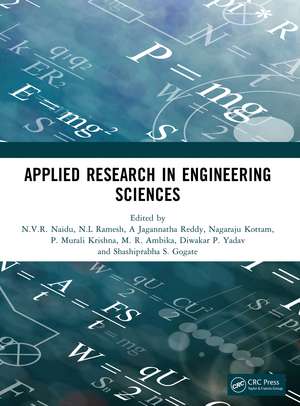
Applied Research in Engineering Sciences
Editat de N.V.R. Naidu, N.L Ramesh, A Jagannatha Reddy, Nagaraju Kottam, P. Murali Krishna, M. R. Ambika, Diwakar P. Yadav, Shashiprabha S. Gogateen Limba Engleză Paperback – 22 iun 2026
Preț: 552.23 lei
Preț vechi: 690.29 lei
-20%
Puncte Express: 828
Carte tipărită la comandă
Livrare economică 26 noiembrie-10 decembrie
Livrare prin curier în România Termenul estimat este afișat lângă disponibilitate.
Transport gratuit pentru acest produs Plată online sau ramburs, în funcție de opțiunile comenzii.
Retur gratuit în 14 zile Comandă securizată și suport în română.
Specificații
ISBN-13: 9781041297574
ISBN-10: 1041297572
Pagini: 658
Dimensiuni: 210 x 280 mm
Greutate: 1.22 kg
Ediția:1
Editura: CRC Press
Colecția CRC Press
ISBN-10: 1041297572
Pagini: 658
Dimensiuni: 210 x 280 mm
Greutate: 1.22 kg
Ediția:1
Editura: CRC Press
Colecția CRC Press
V-ar putea interesa
-
 Advances in Materials Science and TechnologySrikari Srinivasan-15%Preț: 506.89 lei596.35 lei
 -
 Preț: 357.79 lei
 -
 Advances in Engineering Research: Volume 4Victoria M Petrova-26%Preț: 1222.09 lei1662.54 lei
 -
 The AI ConEmily M. BenderPreț: 151.96 lei
 -
 Careers 2026Trotman EducationPreț: 461.04 lei
 -
 Techno-Societal 2022Prashant M. Pawar-24%Preț: 1917.20 lei2522.64 lei
 -
 Open Science in EngineeringMichael E. Auer-20%Preț: 1698.69 lei2123.36 lei
 -
 -18%Preț: 1752.00 lei2136.58 lei
 -
 New Trends in Engineering ResearchNenad Mitrovic-20%Preț: 999.44 lei1249.31 lei
 -
 Advances in Engineering Management, Innovation, and SustainabilityJames Olabode Bamidele Rotimi-18%Preț: 1369.52 lei1670.15 lei
 -
 Advances in Engineering Project, Production, and TechnologyJames Olabode Bamidele Rotimi-18%Preț: 1227.03 lei1496.37 lei
 -
 Algorithms and ComplexityIrene Finocchi-20%Preț: 502.85 lei628.57 lei
 -
 Electronic GovernmentIda Lindgren-20%Preț: 845.17 lei1056.45 lei
 -
 -20%Preț: 878.12 lei1097.66 lei
 -
 -20%Preț: 662.85 lei828.56 lei
 -
 -23%Preț: 1062.23 lei1379.51 lei
 -
 -18%Preț: 2015.01 lei2457.32 lei
 -
 -18%Preț: 1339.43 lei1633.44 lei
 -
 -18%Preț: 1780.82 lei2171.73 lei
 -
 -24%Preț: 2041.25 lei2685.84 lei
Public țintă
Academic, Undergraduate Advanced, and Undergraduate CoreNotă biografică
Dr. N. V. R. Naidu is currently serving as Principal at M S Ramaiah Institute of Technology, Bangalore, India. with over 42 years of experience in academia and Research. Dr. Naidu’s academic journey includes B.Tech. in Mechanical Engineering, M.Tech and Ph.D. in Industrial Engineering from Sri Venkateswara University. He has received Dr. J Mahajan Award (2008-09) from the Indian Institution of Industrial Engineering. Throughout his illustrious career, he has held pivotal roles such as Dean Faculty of Engineering and Executive Council Member at Visvesvaraya Technological University, reflecting his dedication to the advancement of academic excellence. He is serving on various academic boards and contributing his expertise to prestigious institutions in the field of Engineering. Dr. Naidu’s expertise in research is evident in his 140 published papers in prestigious National and International journals and conferences. He contributes as a reviewer for reputed journals and has chaired sessions at various conferences. Dr. Naidu has authored nine textbooks spanning Management, Total Quality Management, and Operations Research. Dr. Naidu has significantly impacted academic research, guided seven doctoral candidates in areas like robust design and supply chain networks and he is adjudicator for PhD thesis across India. His international engagements in countries like the USA, Japan, and Canada have enhanced industry-institution interactions. He has executed numerous funded programs and projects, advancing academia and industry collaboration.
Dr. N. L. Ramesh is a senior academician with over three decades of teaching and research experience in Mathematics. He obtained his B.Sc (1986), M.Sc (1988), and Ph.D (2005) from Bangalore University, completing his doctoral work on Gauss–Jacob–Radau Quadratic Schemes over Triangular Finite Elements. He joined the Department of Mathematics, M. S. Ramaiah Institute of Technology (MSRIT) in 1988 and currently serves as Professor and Head of the Department. His academic interests include Numerical Methods, Probability and Stochastic Processes, Complex Analysis, and Linear Algebra. He has taught a wide range of engineering mathematics courses across all levels and has guided academic activities through workshops, FDPs, and departmental initiatives. Dr. Ramesh has published research papers in reputed national and international journals, including IISc Journal and IEEMS. He is an active member of professional societies such as ISTE, the Ramanujan Mathematical Society, the Indian Science Congress, and the Association of Mathematics Teachers of India.
Prof. A. Jagannatha Reddy
has been serving as the Head of the Department of Physics, MSRIT since 2016. With over 35 years of teaching experience and 25 years of active research involvement, he continues to inspire both colleagues and students through his dedication and expertise. Prof. Reddy has contributed extensively to academic governance, having served as a member of various institutional and inter-institutional academic bodies. In research, Prof. Reddy has made notable contributions in the field of luminescence of nanomaterials. He has published more than 40 research articles in reputed National and International peer-reviewed journals. He has successfully guided five Ph.D. scholars and serving as Co-Principal Investigator for a major research project funded by the Department of Atomic Energy (DAE), BRNS, Mumbai. Additionally, he holds the distinction of patenting a novel material developed by his research team, demonstrating the practical relevance and innovation of his work.
Dr. Nagaraju Kottam is currently working as an Associate Professor & HOD of Department of Chemistry, Ramaiah Institute of Technology, Bengaluru. He has obtained his PhD in Physical Chemistry from Central College, Bangalore University, India. His research interests include the design and development of advanced nanomaterials and their composites for wastewater treatment, hydrogen generation, electrochemical, and biosensors applications. 25 years of experience in teaching and research. He has to his credit more than 100 research publications in refereed international journals, 07 Patents, 04 book chapters. Guided 09 Ph.D’s and another 03 are on-going one is DST-Inspire fellow. Mentored more than 15 UG/PG projects. Received best innovative project award of the year 2024 and 2020 from KSTA and KSCST, Bengaluru. He earned some government/institutional-funded projects and received prestigious “Award of Excellence in Teaching” from MSRIT for the year 2018-19. There is on-going institute level DST-FIST program. Life member for ‘Indian Society for Technical Education’ (LM-ISTE:133296), “Electrochemical Society of India” Indian Institute of Science, and for “Materials Research Society of India” Indian academy of sciences, Bangalore. (L.M. No: 1790)
Dr. P. Murali Krishna is the Assistant Professor in Chemistry at M S Ramaiah Institute of Technology (MSRIT), Bangalore. He has earned his M. Sc (Inorganic Chemistry) and Ph. D (Bio-Inorganic Chemistry) from Gulbarga University, Karnataka and Sri Krishnadevaraya University, Andhra Pradesh, respectively. Before joining MSRIT Bangalore in 2008, Dr Murali did post-doctoral work at the Inorganic and Physical Chemistry Division, Indian Institute of Science, Bangalore. His research work contributed to the field of Organometallic Chemistry, Organic synthesis, Nanomaterials applications to Chemical biology, Corrosion studies, Environmental Chemistry and Lithium-ion batteries. Dr Murali has published about 65 research articles in peer-reviewed International journals and about 110 in National and International conference proceedings. Under his guidance, 6 Research Scholars were awarded Ph. D. and currently guiding 3 Research Scholars. Two patents are under his credit. He is a reviewer for many peer-reviewed international and national journals published by Elsevier, Taylor and Francis, USA, and Springer. He completed two research projects on Bioinorganic Chemistry and Environmental Friendly Coatings. He has been a member of the American Chemical Society, the Society of Biological Inorganic Chemistry, and the Royal Society of Chemistry. Affiliated member of the International Union of Pure and Applied Chemistry (IUPAC), Honorary Member National Council of Teacher Scientists, India, life member of the Chemical Research Society of India, Indian Association of Chemistry Teachers, and Luminescence Society of India: Karnataka Chapter. He was awarded the Science Academies (IAS-NASI-INSA) Summer Research Fellowship (2013), Young Researcher award by Venus International Foundation, Chennai (2015), Young Faculty award by Education Expo TV, New Delhi (2017), Best Research Publication award from Nature Science Foundation, Coimbatore (2018) and best Researcher award from RULA (2019), Kalam Achievers Award (2020) for exemplary performance in the field of “science education & promotion by Kalam Foundation, UP. Apart from teaching and fundamental research activities, was nominated as a coordinator for the conduct of the Australian National Chemistry Quiz (ANCQ) sponsored by the Royal Australian Chemical Institute (RACI), Australia, in Bangalore and conducted for school children from 2009 onwards.
Dr. M. R. Ambika is working as an Assistant Professor of Physics, M S Ramaiah Institute of Technology, Bengaluru with 12 years of teaching and 13 years of research experience. She is an accomplished researcher working in the field of Radiation Physics, Polymer composites, Hybrid nanocomposites for super capacitor applications and Computational Physics. She has been rewarded with INSA Visiting Scientist Award (2025), Young Scientist Award (2023), NUCLEONIX-ISRP Award (2018), IANCAS Award (2015) etc. She takes the credit of patenting her work (2 Patents: 1 Indian & 1 German) published & granted and has completed one research project and currently, handling one major research project funded by Department of Atomic Energy, Board of Research in Nuclear Sciences (BRNS), Bhabha Atomic Research Centre, Mumbai. She is a life member of several professional bodies like, Indian Science Congress, Indian Association for Radiation protection and Indian Nuclear Society. She has served as a Guest Editor of special issue of Radiation Protection Dosimetry, Oxford University Press (December 2023) and reviewer for several international journals- Polymer Advanced Technology, Medical Physics, Radiation Protection Dosimetry and Radiation Physics & Chemistry. She has established active collaboration with Indian Institute of Science, Bengaluru; Bhabha Atomic Research Centre BARC, Mumbai; Indian Institute of Technology, Kharagpur; Bangalore University, Bengaluru, prestigious foreign universities such as Texas A & M University, UIUC and Sunway University, Malaysia. Currently, 3 students are working for their doctoral programme (Ph.D.) under her guidance and she has supervised 10 students for their masters project.
Dr. Diwakar P. Yadav is an Assistant Professor in the Department of Humanities and Social Sciences at M S Ramaiah Institute of Technology, Bengaluru. He holds a PhD in English Linguistics from Christ University, specializing in the Effect of Phonological and Phonetic Intervention on English Pronunciation and Oral Reading. He also possesses qualifications in M.A. (English), M.Ed., and MBA (HR). With over 18 years of experience in higher education including key roles at St. Joseph’s, Christ University and Visvesvaraya Technological University (VTU). Dr. Diwakar is an expert in Phonetics, Phonology, English Language Teaching, Corporate Communication, and Human Resource Management. He has served as a teacher trainer, academic advisor, and corporate communication trainer, contributing to institutional development, admissions, research culture, and campus recruitment across several institutions in Bengaluru and beyond. His contributions to teaching excellence were recognized with an award from the Government of Karnataka for the academic year 2011–12. Dr. Diwakar has published nationally and internationally in the fields of linguistics, education, HRM, leadership, and communication skills, and has offered consultancy and training to organizations such as the British Council and the Academy for Creative Teaching.
Dr. Shashi Prabha Gogate S. is a faculty member in the Department of Mathematics at Ramaiah Institute of Technology (RIT). Her areas of specialization include Fluid Mechanics and Numerical Methods. She has over 15 years of teaching and 12 years of research experience. Before joining RIT, Dr. Gogate served as a Guest Faculty at Bangalore Central University. She obtained her Ph.D. from Bangalore University for her doctoral research titled “Boundary-Layer in Three>Dimensional Flow: Numerical and Asymptotic Solutions.” Dr. Gogate has published 21 research papers in reputed international journals and has presented her work at several national and international conferences. She received the “Best Presenter Award” at an International Conference held at Kuvempu University, Shimoga. In addition to her research contributions, Dr. Gogate has delivered invited talks at reputed institutions such as Bangalore University and BMS College of Engineering (BMSCE). She is currently guiding three full-time Ph.D. scholars at Ramaiah Institute of Technology.
Dr. N. L. Ramesh is a senior academician with over three decades of teaching and research experience in Mathematics. He obtained his B.Sc (1986), M.Sc (1988), and Ph.D (2005) from Bangalore University, completing his doctoral work on Gauss–Jacob–Radau Quadratic Schemes over Triangular Finite Elements. He joined the Department of Mathematics, M. S. Ramaiah Institute of Technology (MSRIT) in 1988 and currently serves as Professor and Head of the Department. His academic interests include Numerical Methods, Probability and Stochastic Processes, Complex Analysis, and Linear Algebra. He has taught a wide range of engineering mathematics courses across all levels and has guided academic activities through workshops, FDPs, and departmental initiatives. Dr. Ramesh has published research papers in reputed national and international journals, including IISc Journal and IEEMS. He is an active member of professional societies such as ISTE, the Ramanujan Mathematical Society, the Indian Science Congress, and the Association of Mathematics Teachers of India.
Prof. A. Jagannatha Reddy
has been serving as the Head of the Department of Physics, MSRIT since 2016. With over 35 years of teaching experience and 25 years of active research involvement, he continues to inspire both colleagues and students through his dedication and expertise. Prof. Reddy has contributed extensively to academic governance, having served as a member of various institutional and inter-institutional academic bodies. In research, Prof. Reddy has made notable contributions in the field of luminescence of nanomaterials. He has published more than 40 research articles in reputed National and International peer-reviewed journals. He has successfully guided five Ph.D. scholars and serving as Co-Principal Investigator for a major research project funded by the Department of Atomic Energy (DAE), BRNS, Mumbai. Additionally, he holds the distinction of patenting a novel material developed by his research team, demonstrating the practical relevance and innovation of his work.
Dr. Nagaraju Kottam is currently working as an Associate Professor & HOD of Department of Chemistry, Ramaiah Institute of Technology, Bengaluru. He has obtained his PhD in Physical Chemistry from Central College, Bangalore University, India. His research interests include the design and development of advanced nanomaterials and their composites for wastewater treatment, hydrogen generation, electrochemical, and biosensors applications. 25 years of experience in teaching and research. He has to his credit more than 100 research publications in refereed international journals, 07 Patents, 04 book chapters. Guided 09 Ph.D’s and another 03 are on-going one is DST-Inspire fellow. Mentored more than 15 UG/PG projects. Received best innovative project award of the year 2024 and 2020 from KSTA and KSCST, Bengaluru. He earned some government/institutional-funded projects and received prestigious “Award of Excellence in Teaching” from MSRIT for the year 2018-19. There is on-going institute level DST-FIST program. Life member for ‘Indian Society for Technical Education’ (LM-ISTE:133296), “Electrochemical Society of India” Indian Institute of Science, and for “Materials Research Society of India” Indian academy of sciences, Bangalore. (L.M. No: 1790)
Dr. P. Murali Krishna is the Assistant Professor in Chemistry at M S Ramaiah Institute of Technology (MSRIT), Bangalore. He has earned his M. Sc (Inorganic Chemistry) and Ph. D (Bio-Inorganic Chemistry) from Gulbarga University, Karnataka and Sri Krishnadevaraya University, Andhra Pradesh, respectively. Before joining MSRIT Bangalore in 2008, Dr Murali did post-doctoral work at the Inorganic and Physical Chemistry Division, Indian Institute of Science, Bangalore. His research work contributed to the field of Organometallic Chemistry, Organic synthesis, Nanomaterials applications to Chemical biology, Corrosion studies, Environmental Chemistry and Lithium-ion batteries. Dr Murali has published about 65 research articles in peer-reviewed International journals and about 110 in National and International conference proceedings. Under his guidance, 6 Research Scholars were awarded Ph. D. and currently guiding 3 Research Scholars. Two patents are under his credit. He is a reviewer for many peer-reviewed international and national journals published by Elsevier, Taylor and Francis, USA, and Springer. He completed two research projects on Bioinorganic Chemistry and Environmental Friendly Coatings. He has been a member of the American Chemical Society, the Society of Biological Inorganic Chemistry, and the Royal Society of Chemistry. Affiliated member of the International Union of Pure and Applied Chemistry (IUPAC), Honorary Member National Council of Teacher Scientists, India, life member of the Chemical Research Society of India, Indian Association of Chemistry Teachers, and Luminescence Society of India: Karnataka Chapter. He was awarded the Science Academies (IAS-NASI-INSA) Summer Research Fellowship (2013), Young Researcher award by Venus International Foundation, Chennai (2015), Young Faculty award by Education Expo TV, New Delhi (2017), Best Research Publication award from Nature Science Foundation, Coimbatore (2018) and best Researcher award from RULA (2019), Kalam Achievers Award (2020) for exemplary performance in the field of “science education & promotion by Kalam Foundation, UP. Apart from teaching and fundamental research activities, was nominated as a coordinator for the conduct of the Australian National Chemistry Quiz (ANCQ) sponsored by the Royal Australian Chemical Institute (RACI), Australia, in Bangalore and conducted for school children from 2009 onwards.
Dr. M. R. Ambika is working as an Assistant Professor of Physics, M S Ramaiah Institute of Technology, Bengaluru with 12 years of teaching and 13 years of research experience. She is an accomplished researcher working in the field of Radiation Physics, Polymer composites, Hybrid nanocomposites for super capacitor applications and Computational Physics. She has been rewarded with INSA Visiting Scientist Award (2025), Young Scientist Award (2023), NUCLEONIX-ISRP Award (2018), IANCAS Award (2015) etc. She takes the credit of patenting her work (2 Patents: 1 Indian & 1 German) published & granted and has completed one research project and currently, handling one major research project funded by Department of Atomic Energy, Board of Research in Nuclear Sciences (BRNS), Bhabha Atomic Research Centre, Mumbai. She is a life member of several professional bodies like, Indian Science Congress, Indian Association for Radiation protection and Indian Nuclear Society. She has served as a Guest Editor of special issue of Radiation Protection Dosimetry, Oxford University Press (December 2023) and reviewer for several international journals- Polymer Advanced Technology, Medical Physics, Radiation Protection Dosimetry and Radiation Physics & Chemistry. She has established active collaboration with Indian Institute of Science, Bengaluru; Bhabha Atomic Research Centre BARC, Mumbai; Indian Institute of Technology, Kharagpur; Bangalore University, Bengaluru, prestigious foreign universities such as Texas A & M University, UIUC and Sunway University, Malaysia. Currently, 3 students are working for their doctoral programme (Ph.D.) under her guidance and she has supervised 10 students for their masters project.
Dr. Diwakar P. Yadav is an Assistant Professor in the Department of Humanities and Social Sciences at M S Ramaiah Institute of Technology, Bengaluru. He holds a PhD in English Linguistics from Christ University, specializing in the Effect of Phonological and Phonetic Intervention on English Pronunciation and Oral Reading. He also possesses qualifications in M.A. (English), M.Ed., and MBA (HR). With over 18 years of experience in higher education including key roles at St. Joseph’s, Christ University and Visvesvaraya Technological University (VTU). Dr. Diwakar is an expert in Phonetics, Phonology, English Language Teaching, Corporate Communication, and Human Resource Management. He has served as a teacher trainer, academic advisor, and corporate communication trainer, contributing to institutional development, admissions, research culture, and campus recruitment across several institutions in Bengaluru and beyond. His contributions to teaching excellence were recognized with an award from the Government of Karnataka for the academic year 2011–12. Dr. Diwakar has published nationally and internationally in the fields of linguistics, education, HRM, leadership, and communication skills, and has offered consultancy and training to organizations such as the British Council and the Academy for Creative Teaching.
Dr. Shashi Prabha Gogate S. is a faculty member in the Department of Mathematics at Ramaiah Institute of Technology (RIT). Her areas of specialization include Fluid Mechanics and Numerical Methods. She has over 15 years of teaching and 12 years of research experience. Before joining RIT, Dr. Gogate served as a Guest Faculty at Bangalore Central University. She obtained her Ph.D. from Bangalore University for her doctoral research titled “Boundary-Layer in Three>Dimensional Flow: Numerical and Asymptotic Solutions.” Dr. Gogate has published 21 research papers in reputed international journals and has presented her work at several national and international conferences. She received the “Best Presenter Award” at an International Conference held at Kuvempu University, Shimoga. In addition to her research contributions, Dr. Gogate has delivered invited talks at reputed institutions such as Bangalore University and BMS College of Engineering (BMSCE). She is currently guiding three full-time Ph.D. scholars at Ramaiah Institute of Technology.
Cuprins
Foreword, Acknowledgement, About the Editors, Associate Editors, PART I: PHYSICS, 1. Fluorescence Quenching and the Role of Non-Hybrid Metal Oxide Nanoparticles as Quenchers for Analyte Detection: A Brief Review, 2. Ti3C2 MXene and Gd2O3 Composites Chemistry and Electrochemistry for Energy Storage Systems, 3. Lithium Zinc Phosphate Glasses Doped with MoO3: Insights from Spectroscopic, Elastic, and Radiation Shielding Investigations, 4. Synthesis, Characterization, Dielectric and Magnetic Properties of PVDF-HFP-Ni0.5Cu0.5GdxFe2-xO4 Polymer Composites, 5. Impact of Oxygen Plasma Treatment on the Structural, Electrical and Magnetic Properties of La0.7Ba0.3MnO3, 6. Alfvén Wave Mode Coupling as a Source of Compressible Acoustic Waves in the Solar Corona, 7. TiO2 Nanorods Ornamented by Mg Substituted Nanohydroxyapatite Layer Synergistically Improve Mechanical Properties and In Vitro Bioactivity, 8. Interplay of Magnetic Interaction Strength and Hydrodynamics on Pattern Emergence in a Monolayer of Magnetically Interacting Particles at a Fluid-Fluid Interface, 9. A Top-Down Approach to Exfoliate 2D Bismuthene, 10. Effect of Capillary Attraction on Weak Magnetic Dipole Interaction Driven Self-Organization of Objects Confined to an Air Water Interface, 11. Fabrication and Study of Raman Spectroscopy on Van der Waals Heterostructure using Few-Layered Graphite, 12. Effects of Annealing Temperature and Precursor Molar Concentration on Structural and Optical Properties of Pure Lanthanum Oxide (La2O3) thin Films Derived via Sol-Gel Spin Coating Technique, 13. Structural and Optical Properties of Indium and Gallium-doped Zinc Oxide thin Transparent Conducting Films for Optoelectronic Applications, 14. Effect of Sm+ Ions on Optical Properties of Boro-Tellurite Glasses, 15. Cu2SnS3/ZnS Core Shell Quantum Dots for White Light Emitting Diode Applications, 16. Experimental Evaluations of the Structural, Optical, and Spectroscopic Characteristics of B2O3-Li2O-Al2O3-Yb2O3 Glasses, 17. Structural, Magnetic, Dielectric and EMI Shielding Behavior of Co-Cu Nanoferrites, 18. Radon and Thoron Exhalation Rates in the Soil of Hemavathi River Basin, Karnataka, India, 19. Transport Properties of Nano Magnesium Aluminate Synthesized with Millet Extract as a Fuel, 20. Combined Experimental-DFT Investigation of Third-Order Nonlinear Optical Properties of Benzanthrone Dye, 21. Fluorescence-Based Sensing of Mono- and Disaccharides using 2-Methoxyphenyl Boronic Acid: A Study on Binding Affinity and Selectivity for Diabetes Management, PART I: CHEMISTRY, 22. Effect of Macelignan on NF-ƙB Signaling Pathway and Study of Anti-Inflammatory Property onLPS Stimulated RAW264.7 Macrophage, 23. Green Synthesis of Silver Nanoparticles: Molecular Docking Investigations, Antimicrobial Activity and Treatment of Lumpy Skin Disease, 24. A Simple and New Approach for the Fabrication of Hierarchical 0-D Copper Phosphonate HollowSphere and their Excellent Energy Storage Performance of Supercapacitor Application, 25. Exploring Alternative Fuels in the Cement Industry–A Sustainable Approach to Reducing Greenhouse Gas Emissions, 26. Biosynthesis of Carbon Dots from Medicinal Plants and Evaluation of Their Potential as Potent Antibacterial Agents, 27. Need of Energy-Efficient Achievements in the Cement Industry, 28. Controlled Morphology and Functional Applications of Y2O3 Nanoparticles, 29. Natural Anticancer Therapeutics: Investigating Melaleuca Alternifolia Extract for DrugPotential Against Blood Cancer, 30. Synthesis and Characterization of Iridium Nanoparticle as Being Active Catalyst for the Efficient and Discriminating Oxidation of Isoleucine, 31. Design and Photocatalytic Investigation of p-n Heterojunction Nanocomposite MnCo2O4/SnO2, 32. Magnetic p-n Heterojunction BiOI/Ni0.7Zn0.3Fe2O4: An Effective Strategy for Photocatalytic Degradation of Rhodamine B, 33. Design and Photocatalytic Evaluation of BiOI/MnCoFeO4 Nanocomposite for Rhodamine B Degradation, 34. Electrochemical Oxidation of Rhodamine-B Dye Using a Cadmium-Graphite Modified Electrode: Optimization, Mechanistic Insights, and Biodegradability Enhancement, 35. Biosynthesis and its Characterization of Silver Nano-Biocomposite of Caralluma Adscendens, 36. Catalytic Tetranuclear Copper (II) Complexes as Functional Mimics of Catechol Oxidase, 37. Leucas Aspera– Fueled Biogenic Synthesized CdS Nanoparticles: Characterization, Evaluation of Catalytic and Corrosion Inhibition Properties, 38. Biodiesel from Waste Cooking Oil: A Review of Catalyst Development and Performance, 39. Pancreatic Lipase Inhibitory Potential of Combretum Rotundifolium Flower Extract: An In Vitro Approach for Obesity Management, 40. Liquid Fuel Synthesis from Agave Americana Inedible Seed Oil through Alcoholysis and Critical Analysis of its Fuel Properties, 41. Stability Indicating RP-HPLC Method Development and Validation for the Determination of Antihelminthic Drug in Pure and Dosage Form, 42. Basal Plate of Allium Cepa L. as Low-Cost Bio-Adsorbent for Mercury Ions Removal from Simulated Wastewater, 43. Synthesis and Evaluation of Sustainable Magnetic Nanoparticles for Mercury Removal, PART THREE: MATHEMATICS, 44. Relaxation Methods for Viscous Flows, 45. Fekete Szegö Estimate for Bi-Bazilevič and Bi-Pseudo-Starlike Type Functions Associated with the Generalized Bivariate Fibonacci Polynomial, 46. Effects of Dissipation on Transient MHD Concentric Heat Transfer in a Vertical Wavy Channel via a Porous Medium, 47. MHD Convective Flow of a Nano Fluid Over an Inclined Vertical Porous Surface with Radiation Effect, 48. Magnetized Mixed Convection Boundary Layer Nanofluid Flow along an Inclined Plate Embedded in a Porous Media, 49. MHD Convection Heat and Mass Transfer Flowing of Nanofluid within a Vertical Channel with Asymmetric Slips and Newtonian Cooling, 50. Convective Heat Transfer in a Non-Uniformly Vertical Channel Through a Porous Medium with Hall Effects, 51. Logarithmic Coefficients for a New Subclass of Univalent Function Associated with Four-Leaf Shaped Domain, 52. An Examination of Thermal Stresses in a Radial Porous Fin with Varying Thermal Conductivity, 53. Conformally Transformed of Douglas Space of Second Kind with Certain I and II Approximate Matsumoto Metric, 54. Influence of Stretching/Shrinking Mechanism on Moving Longitudinal Porous Fin in Presence of Hybrid Nanofluid During Heat Transfer Analysis, 55. Application of Singular Value Decomposition in Digital Image Processing, 56. A Numerical Analysis of MHD Two-Phase Flow of Casson Fluid Inasymmetric Convergent Channel, 57. Hydromagnetic Convective Two Phase Flow of Casson Fluid in Adivergent Channel, 58. The Combined Impact of Viscous Shear and Magnetic Field on Porous Journal Bearing, 59. DTM Approach of MHD Fluid Flow Across Multiple Regions Through a Permeable Cylinder with OHMIC Heating, 60. Heat Transfer Characteristics of Unsteady Hydrodynamic Casson Fluid Flow with Suction/Injection, 61. Analysis of Heat and Mass Transfer in Three-Dimensional Fluid Flow over a Nonlinear Stretching Sheet Under the Influence of Forchheimer and Ohmic Effects, 62. Dual Solution for a Non-Uniform Heat Source/Sink and Quadratic Drag Effect on MHD Nanofluid Flow, 63. Influence of Electric Field Modulation on Magneto Electrothermoconvection in Porous Dielectric Medium, 64. Convection Under 1g or mg in Newtonian Variable Viscosity Liquids with Temperature Dependent Volumetric Heat Source/Sink, 65. Nonlinear Viscous Drag Effect and Viscous Dissipation on Non-Linear Convective Double Diffusive for Hybrid Nano Material with Irregular Heat Source between Concentric Cylinders, 66. Slip Effects on Renier-Rivlin Fluid Flow Over a Stretching Sheet with a Heat Source, 67. Viscous Dissipation Effects on Marangoni Boundary Layer Flow of Hybrid Nanofluid Past a Permeable Stretching Surface in a Porous Medium, 68. Impact of Variable Magnetic Field on Heat and Mass Transfer in Squeezing Flow between Two Concentric Circular Cylinders by Shooting Technique, 69. Thermal Performance with Viscous Dissipation by the Approach of RKF and NR Method—Mathematical Investigation of Nanofluid Composed of Dia and Ag Nanoparticles, 70. Computational Modelling for the Combined Effects of Viscous Dissipation and Heat Radiation for Darcy-Forchheimer Flow of Carbon Nanotubes Along a Curved Geometry with Exponentially Stretched Surface, 71. Impact of Magnetic Field on Marangoni Convection in Hybrid Nanofluid Flow Over a Stretching Surface, 72. Magnetohydrodynamics Flow and Heat Transfer in Semi-Porous Cylindrical Filter Surrounded by Impermeable Media–A Review, 73. Thermal Radiation and Viscous Forchheimer Drag Effects on Casson Fluid Flow Over Exponentially Stretching Curved Sheet in Porous Media, 74. Combined Effect of MHD and Roughness on Porous Finite Journal Bearing with Slip/No-Slip Surface, 75. Analytical Model of Electromechanical Shape Memory Alloy-based Tunable Piezoelectric Energy Harvester with Point Mass Considered at the Cantilever Tip, 76. Sub Arithmetic Progressions, PART 4: HUMANITIES AND SOCIAL SCIENCES, 77. Green Vehicle and Safety Risks-Impact on Customer Perception and Mitigation Strategies, 78. Impact of Phonetics Training on English Pronunciation: A Review Analysis, 79. Leveraging Digital Resources to Enhance the Teaching and Learning Process in Engineering Education: A Review, 80. Integrating UIDAI’s Virtual ID into Public Administration and Governance: An Alternative to Identity Documents for Assuring the Security Concerns, 81. Impact of AI Tools on Sustainable Marketing Operations that Leads to Develop Sustainable Society in India, 82. The Affordances of Technology and Human Values for Ethical Implications and Organizational Success, 83. Sexual Harassment in The Digital Era in IT Sectors, 84. A Study on Adaptive Learning through Digital Software in Second Language Teaching and Learning, 85. Analysing the Korean Drama Anti-Heroine through themes of Revenge, Class Struggle and Justice, 86. Revolutionizing English Language Learning: The Role of Artificial Intelligence in Modern Education: A Systematic Review, 87. Social Media and Language Transformation: Exploring Emerging Vocabulary and Syntax in Digital Communication in South India, PART FIVE: ENGINEERING, 88. A Review on Renewable Energy Harvesting System using Footsteps, 89. The Safe-Guard: Signal-Triggered Voice-Vibrator Alert, 90. Performance Analysis of Machine and Deep Learning Methods for Real-Time Disease Identification in Bombyx Mori Silkworks, 91. Study of EMI Shielding Effectiveness of Nylon 66 Nanofiber Interleaved Carbon/Epoxy Laminates by Finite Element Method, 92. Non-Intrusive Apiary Monitoring System for Analysis of Beehive Conditions, 93. Real-time Network Anomaly Detection via GNNs in Telecommunication Systems, 94. An Environmental Study on the Efficiency of Banana Peel and Pith Powders in Wastewater Treatment, 95. Evaluating Neem and Tulsi Leaf Powders for Sustainable Wastewater Treatment: An Environmental Perspective, 96. Comparative Evaluation of Mango and Moringa Seed Powders as Natural Coagulants in Wastewater Treatment, 97. Smart Guard: A Dynamic and Expandable System for Multiclass Attack Detection and Categorization in Extensive IoT Environment, 98. Dendrite Growth Theories in Crystalline Solids — A Review, 99. Environmental Study on Utilizing Orange and Lemon Peel Powders for Effective Wastewater Treatment
Descriere
It is a privilege to present this edited volume comprising selected scholarly contributions from the 2nd International Conference on Applied Research in Engineering Sciences (ICARES-2025).