Cantitate/Preț
Produs

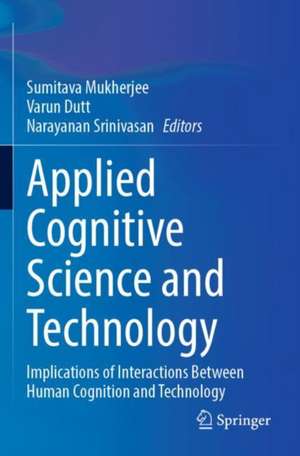
Applied Cognitive Science and Technology

Editat de Sumitava Mukherjee, Varun Dutt, Narayanan Srinivasan
en Limba Engleză Paperback – 25 aug 2024

Observăm de multă vreme o lacună în literatura academică referitoare la consolidarea cercetărilor ce unesc știința cognitivă aplicată de evoluția tehnologică rapidă. Volumul Applied Cognitive Science and Technology, publicat sub egida Springer, vine să suplinească această lipsă, oferind un cadru riguros pentru înțelegerea modului în care interacțiunea dintre mintea umană și agenții artificiali modelează viitorul societății. Ne-a atras atenția modul în care editorii Sumitava Mukherjee, Varun Dutt și Narayanan Srinivasan au reușit să integreze domenii aparent divergente, de la securitatea cibernetică comportamentală până la designul de inginerie și interfețele social media.

Această lucrare acoperă o arie tematică similară cu Psychological Studies of Science and Technology de Kieran C. O'Doherty, însă se distinge printr-o abordare mult mai aplicată și orientată către tehnologiile emergente, precum AI și învățarea automată. În timp ce alte texte se concentrează pe istoria sau filosofia tehnologiei, volumul de față analizează mecanismele psihologice concrete care determină adoptarea sistemelor de suport decizional și impactul antropomorfizării agenților artificiali asupra utilizatorului.

Structura volumului reflectă o progresie logică de la fundamentele comportamentale ale inteligenței artificiale către aplicații complexe în realitatea virtuală și neuroștiințe computaționale. Cuprinsul relevă capitole esențiale despre jocurile de securitate Markov și evaluarea algoritmilor de „deep reinforcement learning” în raport cu performanța umană. Această ediție în limba engleză nu este doar o sinteză teoretică, ci un instrument de lucru care demonstrează cum studiul proceselor cognitive ajută direct la finisarea produselor tehnologice moderne, fiind o resursă indispensabilă pentru curricula de psihologie cognitivă și inginerie.

Citește tot Restrânge

Preț: 83852 lei

Preț vechi: 110331 lei
-24%

Puncte Express: 1258

Carte tipărită la comandă

Livrare economică 21-28 decembrie

Livrare prin curier în România Termenul estimat este afișat lângă disponibilitate.
Transport gratuit pentru acest produs Plată online sau ramburs, în funcție de opțiunile comenzii.
Retur gratuit în 14 zile Comandă securizată și suport în română.

Specificații

ISBN-13: 9789819939688
ISBN-10: 9819939682
Pagini: 280
Dimensiuni: 155 x 235 x 15 mm
Greutate: 0.48 kg
Editura: Springer

De ce să citești această carte

Recomandăm această carte cercetătorilor și practicienilor care doresc să înțeleagă fundamentul psihologic din spatele tehnologiilor de vârf. Cititorul câștigă o perspectivă interdisciplinară asupra modului în care designul tehnologic influențează sarcina cognitivă și decizia umană. Este un titlu esențial pentru cei care activează în AI, securitate cibernetică sau factori umani, oferind modele matematice și studii de caz concrete pentru optimizarea interacțiunii om-mașină.


Despre autor

Editorii acestui volum sunt figuri proeminente în mediul academic internațional, specializați în intersecția dintre psihologie și tehnologie. Sumitava Mukherjee și colegii săi, Varun Dutt și Narayanan Srinivasan, aduc o expertiză vastă în modelarea computațională, procesele decizionale și științele cognitive. Contribuția lor colectivă reflectă o orientare modernă către cercetarea experimentală și aplicată, aceștia fiind recunoscuți pentru eforturile de a integra principiile psihologiei cognitive în dezvoltarea sistemelor inteligente și a strategiilor de securitate digitală.


Descriere scurtă

This book fills the long-pending gap in consolidating research on applied cognitive science and technology. It explores the broader implications of interactions between human cognition and technology by touching upon artificial intelligence (AI) and artificial agents, decision support and assistance support systems, cybersecurity threats, computational modeling of cognition through artificial neural networks and machine learning, human factors, engineering design, and social media interfaces. With an interdisciplinary scope that addresses psychological and technological issues, this unique book shows how cognitive science is furthered by technology(or platforms) while simultaneously illustrating how the study of cognitive processes is helping shape technological products. Accordingly, it offers a valuable resource for researchers and practitioners in a broad array of fields, such as psychology, science, engineering and management.

Cuprins

Towards Behavioral AI: Cognitive factors underlying the public psychology of artificial intelligence.- Defining the Relationship Between Level of Autonomy in a Computer and Cognitive Workload of its User.- Cognitive effects of anthropomorphization of artificial agents in human-agent interactions.- Psychological Factors Driving Adoption of Decision Support Tools.- Model-based operator assistance: How to match engineering models with humans’ cognitive representations of their actions?.- Behavioral cyber-security: Influence of availability of information about opponent’s actions on decision-making in markov-security games.- Exploring Cybercriminal Activities, Behaviours and Profiles.- Computer Vision Technology: Do Deep Neural Networks Model Nonlinear Compositionality in the Brain’s Representation of Human-Object Interactions?.- Evaluation of different deep reinforcement learning algorithms in complex search-and-retrieve virtual simulation against human performance.- Cognate Identification to Augment Lexical resources for NLP.- Psychophysiological Monitoring to Improve Human-Computer Collaborative Tasks.- Human-Technology interfaces: Did ‘I’ do it? Agency, Control and why it matters.- Effects of Analogies and Analogical Distance on Ideation in Conceptual Phase of Engineering Design.- Humiliation and Technology: Dilemmas and Challenges for State, Civil Society and Industry.-Technology: Does It Help or Harm Intelligence—or Both?.

Notă biografică

Sumitava Mukherjee is an assistant professor at the Department of Humanities and Social Sciences, Indian Institute of Technology Delhi. Dr. Mukherjee has his academic backgrounds in computer engineering and cognitive science. At IIT Delhi, he was a founding member of the Cognitive Science Programme and served as the Co-ordinator from 2021–2023. He also initiated Decision Lab as a research-cum-knowledge partner for decision research in India, the Scarcity lab research group to work on thinking and decision making under scarcity and poverty and started a public dialogue by setting up a website Humans and Technology. He works on foundational and applied aspects of judgment and decision making that generate socially relevant behavioral insights. He also initiated a focused research agenda to generate insights and have dialogues on a human view of technology based on behavioral science. He was awarded the Emerging Psychologist award in 2014 by NAOP India, the Outstanding Researcher award by Indian Institute of Technology Gandhinagar in 2014 and the Young Psychologist award in 2020 by NAOP India for his contributions academically and professionally. 

Varun Dutt is an associate professor in the School of Computing and Electrical Engineering at Indian Institute of Technology Mandi, India. Dr. Dutt has applied his knowledge and skills in the fields of psychology, public policy and computer science to explore how humans make decisions on social, managerial and environmental issues. Dr. Dutt serves as a senior member of IEEE; as the Chair of Indian Knowledge System and Mental Health Applications (IKSMHA) Centre, IIT Mandi; and, as the Principal Investigator at the Applied Cognitive Science (ACS) Lab, IIT Mandi. He is currently serving as an associate editor of Frontiers in Psychology (Cognitive Science) journal, a review editor of Frontiers in Decision Neuroscience journal and a member of the editorial board of the International Journal on Cyber Situational Awareness. 
 
Narayanan Srinivasan is a professor and Head at the Department of Cognitive Science, Indian Institute of Technology, Kanpur, India. Prior to this, he was a professor at the Centre of Behavioural and Cognitive Sciences, University of Allahabad, India. He studies mental processes, especially attention, emotions, consciousness and decision making using multiple methodologies. Dr Srinivasan has edited eleven books and seven special issues. He has published more than 180 papers in journals, books and conference proceedings. Dr. Srinivasan is a fellow of Association for Psychological Science, National Academy of Psychology (India), and Psychonomic Society. He is an associate editor of Cognitive Processing, Neuroscience of Consciousness, Frontiers in Consciousness Research, and Mindfulness. 

Caracteristici

Offers an interdisciplinary review of cutting-edge concepts in technology and cognitive science Presents diverse methods and research from an applied cognitive science perspective Appeals to readers from a broad range of disciplines, including engineering and technology